
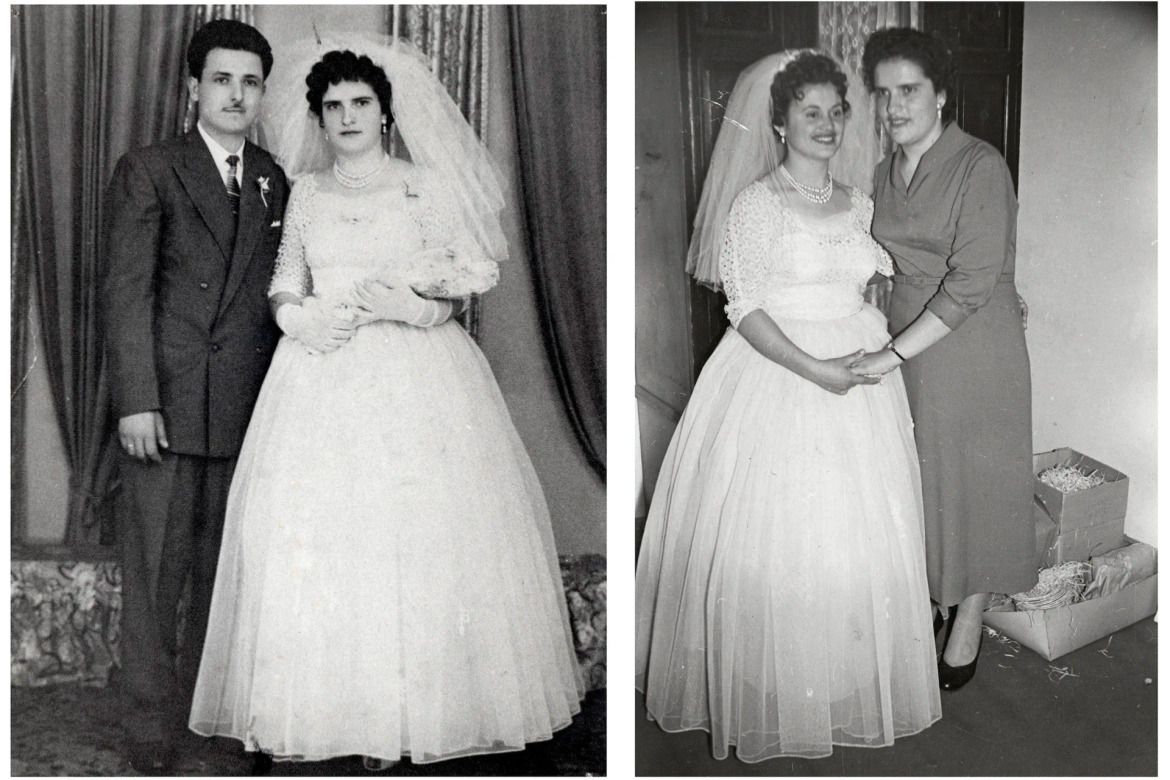
When Greek-Australian photographer Effy Alexakis looked closely at a group of family wedding photographs, she discovered that the women pictured shared more than the experience of beginning new lives far from Greece.
They were wearing the same wedding dress.
The dress was first worn by Alexakis’s mother, Maria Kritikos, who arrived in Australia aboard the migrant ship Tasmania in 1956. Maria’s brother had purchased it for her wedding. It was later lent to five other Greek women, connecting six brides through an object that might otherwise have disappeared into an attic or family album.
Alexakis has since begun tracing the dress through the surviving photographs and, where possible, photographing the women who wore it. Their story is featured in a new SBS News video report marking nearly 70 years since the Tasmania brought Maria and other Greek migrants to Australia.
The shared dress offers an intimate window into the much larger movement of Greeks to Australia after World War II. Greece emerged from occupation and civil war with devastated infrastructure, widespread poverty and limited prospects, particularly in rural communities. Australia, meanwhile, was pursuing a large-scale immigration program that brought workers and families from across Europe.
Women did not all travel under the same circumstances. Some joined relatives already established in Australia. Some arrived through employment and assisted-migration programs. Others came to marry men they knew through family arrangements, correspondence or photographs. Ships carrying large numbers of single women and prospective brides became popularly known as “bride ships,” although the label can flatten a far more complicated collection of individual experiences.
For many women, emigration meant leaving parents and siblings with no certainty about when they would see them again. Telephone calls were expensive, air travel was beyond the reach of most families and letters could take weeks. Australia offered possibility, but it also meant distance on a scale that is difficult to imagine today.
Once there, Greek immigrant women worked inside and outside the home, raised families and helped establish the churches, associations and businesses that sustained the growing diaspora. Much of that labor was rarely recorded in official histories.
The wedding dress helps make that history visible.
Its passage from one bride to another reflected the practical economy of immigrant life. New arrivals depended upon relatives, friends and other members of the community for accommodation, employment, introductions and the countless necessities involved in establishing a household. A dress bought for one woman could become part of five more family histories.
Alexakis has spent more than four decades documenting Greek life in Australia. Together with historian Leonard Janiszewski, she has assembled an extensive photographic and oral record of the community, preserving stories that might otherwise have remained inside private homes. Their continuing work, exhibitions and publications can be explored through Photowrite. Her work has challenged the idea that Greek-Australian history can be reduced to migration statistics or a handful of familiar stereotypes.
The project involving her mother’s dress grew from that same approach: begin with the individual, preserve what survives and allow an apparently ordinary object to reveal a much larger history.
Seven decades after Maria Kritikos arrived in Australia, the dress she wore is no longer simply a piece of family memorabilia. It is evidence of six women beginning again—and of the informal bonds that helped a generation of Greek immigrants turn an unfamiliar country into home.
Featured image: Wedding photographs from Effy Alexakis’s project documenting the dress shared by her mother, Maria Kritikos, and other Greek brides. Courtesy of Effy Alexakis. Video: SBS News. Watch the original report on YouTube.