
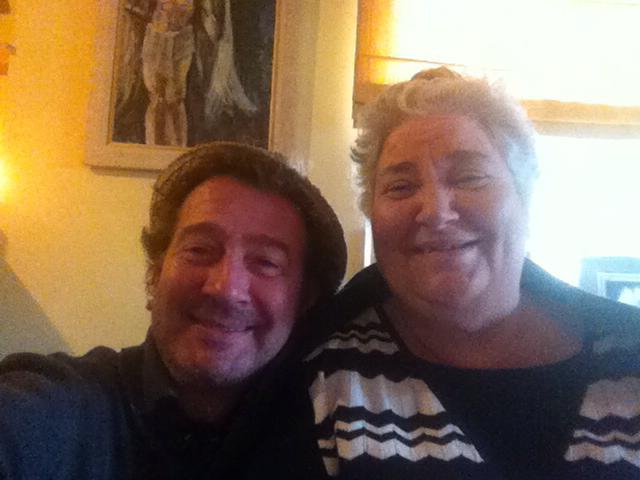

I spent the day with my mom today in a suburb of Athens where she’s visiting family, after two and a half months in Crete. I brought her to Greece in December to spend Christmas with her family.
It had been years since she spent the holidays in her native town, where she was born and with the people she created her early memories with as a kid, before leaving as a teen-aged newlywed to the USA with my dad in 1962.
I also brought her here for another reason. We were faced with some tough news last year from her doctors that my mom is suffering from a condition known as Primary Progressive Aphasia— a degenerative brain disease in the family of dementia. I wanted her to see her brother and sisters in Hania and spend some time with them because I, nor the doctors who are treating her, know how quickly her condition might worsen.
Primary progressive aphasia (PPA) is caused by degeneration in the parts of the brain that control speech and language. This type of aphasia begins gradually, with speech or language symptoms that will vary depending on the brain areas affected by the disease. For example, in one type of PPA, people may initially have trouble producing speech, or articulating, whereas in another variant, word-finding and comprehension problems are more pronounced.
My mom is currently experiencing the first type— she is slowly losing her ability to speak clearly and coherently. She still speaks, but with great difficulty. It’s a pronounced difference from the mother I grew up with— fast with her tongue and always with an opinion about what I was wearing, where I was going and what I was doing— usually not in agreement with me.
Today, she just sits idly in her chair and smiles. She smiles at everything I do and everything I say. It’s comforting that she still smiles, despite all she’s experiencing.
As Greeks, we are trained not to talk about these things. We keep family secrets inside the family. It’s our way of life— what will the people say? Ti tha pei o kosmos?
We did this with my father’s mental illness— severe depression. We didn’t want people to think he was “crazy” or was seeing psychologists. We kept him isolated and we didn’t share our stories— even with those closest around us. Years after his death, when I talked to people about our own sufferings with his illness, I learned one by one, that so many of my own friends experienced similar mental illnesses in their own families.
One person who taught me the most was Anthoula Katsimatides, who shared her own family’s stories about losing her own brother to suicide. He too suffered from mental illness and it was a story Anthoula shared with me a while back that gave me the courage to be open with my own stories.
Ever since I first went public with a post I wrote about my mom’s condition a few months ago, I’ve received calls and emails from dozens of people— friends offering their support, people whose family members had the same disease and just random strangers offering words of support.
I have to say that sharing this and talking about this has been a blessing, as was spending the holidays in Greece with my mom, creating new memories and recalling past ones.