
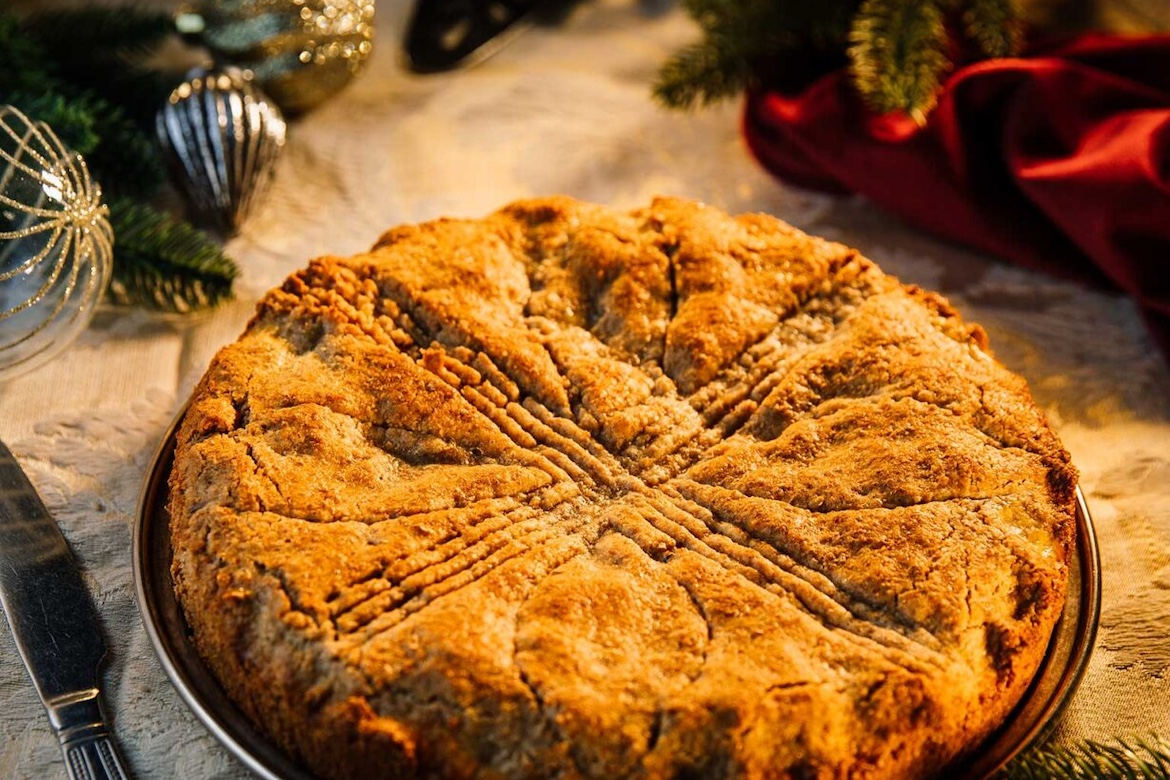
A highly aromatic New Year’s cake from Smyrna/Asia Minor (Βασιλόπιτα της Σμύρνης) which is more like a large, buttery, crumbly cookie dough baked in a pan, perfumed with citrus, vanilla, and spice. The evolution of this recipe is consistent with the way Smyrna evolved as a major European metropolitan area in the 1800s and until its destruction when the invading Turkish army burned the city.
Affluent pre-1922 Smyrna enjoyed the privilege of direct commercial and cultural contact with the big cities of Europe, bringing unique clothing, music and trends in every aspect of life, including gastronomy. Confectionery ingredients used in European royal courts and wealthy households such as sugar, various spices and chocolate made their way to Smyrna and enriched the food culture of the local Greeks.
As a result, Smyrna’s women learned to prepare sweets that were largely unknown in mainland Greece, enriching them with ingredients unavailable and unknown in Athens and beyond. In this way, the Smyrna-style Vasilopita evolved differently than other cakes across the Aegean in other Greek towns and villages. It became a cake made without sourdough or yeast. It resembles a cookie dough, is crumbly and buttery, and is filled with ground nuts, citrus zest or juice, and spices.
Like traditional music and dance of the Smyrna Greeks, food has been a tangible cultural element that has kept this heritage alive, long after the last building burned and the last refugee fled the shores of Asia Minor.
Yield: One round pan 32 cm (about 12½ in)
Ingredients
320 gr sheep’s butter or sheep/goat butter (the jarred kind often used for kourabiedes), cold (≈ 2.8 sticks / about 1 cup + 6½ Tbsp)
140 ml olive oil (≈ ½ cup + 1½ Tbsp)
250 gr granulated sugar (≈ 1¼ cups)
juice of ½ lemon( about 1–2 Tbsp, depending on the lemon)
Juice of 1 orange (typically ¼–½ cup, depending on the orange)
Juice of 1 mandarin (typically 2–4 Tbsp, depending on the mandarin)
70 ml cognac (≈ ¼ cup + 2 tsp)
1 vanilla bean, split lengthwise; scrape out the seeds
950–1,000 g wheat flour, suitable for dough/bread (add as needed) (≈ 7½ to 8⅓ cups; you might not use it all)
¼ tsp salt
½ tsp baking powder
Egg wash: 1 egg, lightly beaten with 1 Tbsp milk
Instructions
- Put the butter and olive oil in the bowl of a stand mixer. Beat first on low, then higher speed, for about 10 minutes, until you get a fluffy, thick cream.
- Add the sugar and beat until incorporated. Add the lemon, orange, and mandarin juices, the cognac, and the vanilla seeds, and beat 1–2 minutes more.
- In a bowl, mix the flour, salt, and baking powder. Add this gradually to the mixer on low speed, until you form a soft, pliable dough. (You may not need all the flour.)
- Preheat the oven to 200°C (392°F).
- Butter a shallow round pan 30–32 cm (12–12½ in). Press the dough into the pan, inserting the coin in one spot.
- Press with your palms to flatten so the thickness is no more than 2 cm (about ¾ in). Brush the surface with the egg wash.
- Use a fork to score a cross on the surface. (If you have the traditional double-headed eagle stamp used by many Asia Minor Greeks, press it into the spaces between the arms of the cross.)
- Bake on the middle rack for 20–25 minutes, until nicely browned. It **will not rise much; it should end up no taller than 3 cm (about 1¼ in).
- Let it cool completely in the pan, then remove very carefully. Be careful as it’s quite fragile/crumbly.
Recipe translated into English from Gastronomos