

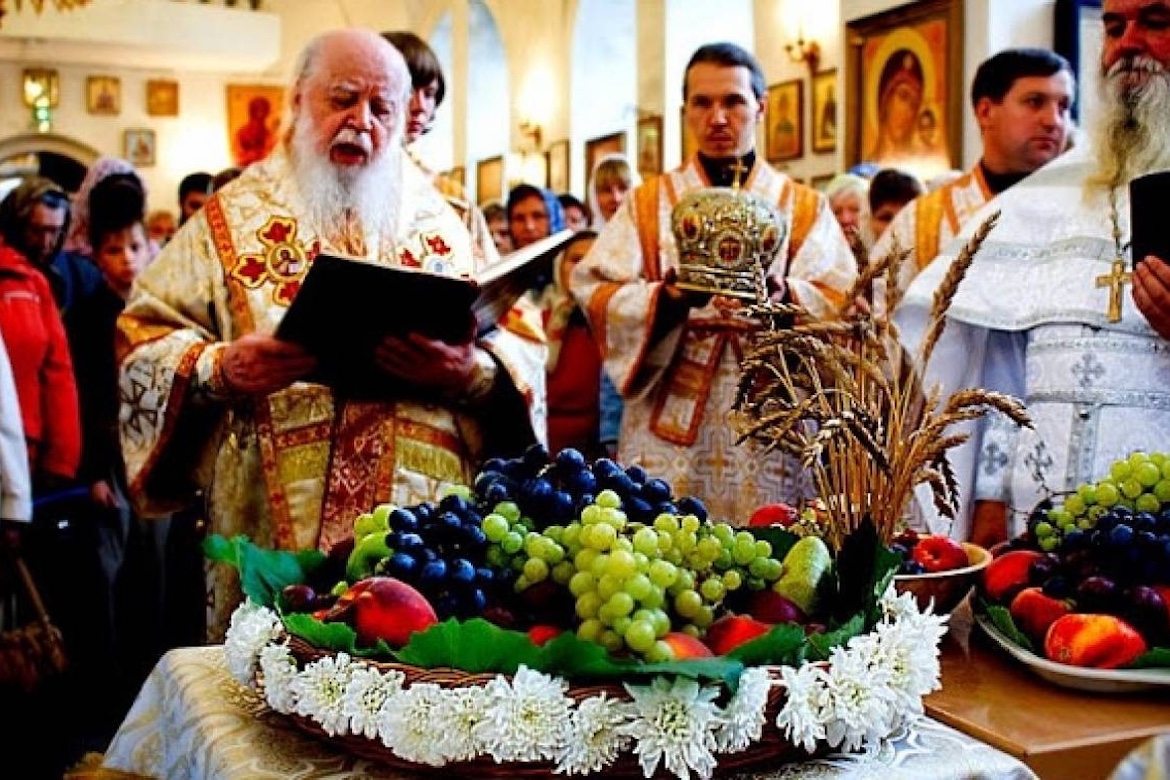
On the Feast of the Transfiguration, Greeks carry the first grapes of summer into churches to be blessed and shared—a tradition rooted in Christian faith, the agricultural calendar and a ritual instinct reaching deep into antiquity.
In the first days of August, when the grapes begin to ripen under the Greek summer sun, baskets and trays filled with carefully cut bunches appear inside village churches, island chapels and city parishes.
The grapes are not there for decoration.
Every August 6, on the Feast of the Transfiguration of Christ, worshippers in communities across Greece bring the first grapes of the season to church. At the conclusion of the Divine Liturgy, the priest reads a special prayer over the fruit, blesses it and distributes it among the congregation.
Today, the grapes may have been purchased that morning at a neighborhood market. But in Greece’s traditional farming communities, they came directly from the family vineyard and carried a much greater meaning.
Before the full harvest began, before the grapes were pressed and before the new wine was made, the season’s first sweetness was offered in gratitude.
It is a simple ritual, but it brings together some of the oldest strands of Greek life: the vineyard, the changing seasons, the village church and the ancient understanding that the first fruits of the earth should be offered before they are enjoyed.
A feast of light in the middle of summer
The Orthodox Church celebrates the Feast of the Transfiguration every year on August 6.
According to the Gospel accounts, Christ took the apostles Peter, James and John onto a high mountain, traditionally identified as Mount Tabor. There, his appearance was transformed before them. His face shone like the sun and his garments became brilliantly white, revealing his divine glory.
The grapes entered the celebration through the agricultural calendar.
Across much of Greece and the eastern Mediterranean, early August traditionally marked the arrival of the first ripe grapes. The feast therefore fell at the moment when growers could finally cut the earliest bunches from their vines.
These first offerings were known as aparches, the first portion of the harvest presented in thanksgiving before the remainder was gathered, eaten or sold.
For families whose lives depended upon the land, the gesture carried real weight. Months of pruning, tending and waiting could still be undone by drought, disease, hail or an untimely storm.
Bringing the first grapes to church was a way of giving thanks for what had reached maturity and asking for a blessing upon the harvest still to come.
An echo reaching back to antiquity
The blessing of grapes as it is practiced today belongs firmly to the Christian tradition. But the instinct behind it reaches much further back into Greek history.
Ancient Greeks also offered the first fruits of the earth before enjoying the harvest themselves. These offerings, likewise called aparchai, could include grain, fruit, olive oil, wine and other agricultural products.
The practice was widespread across the ancient Greek world, from small offerings made by farming families to more organized presentations at major sanctuaries. A detailed Oxford study of first-fruit offerings in ancient Greece describes aparchai as an important part of religious life from the Archaic through the Hellenistic periods.
At Eleusis, for example, first portions of the grain harvest were offered to Demeter and Kore, the goddesses closely associated with agriculture, fertility and the cycle of the seasons.
Grapes and wine occupied their own powerful place in the ancient imagination. The vineyard was not simply a source of food and drink, but part of a sacred agricultural world in which cultivation, abundance and divine favor were closely intertwined.
With the arrival and spread of Christianity, that older Greek impulse was not simply erased. It was transformed.
The gods receiving the offering changed. The prayers changed. The religious meaning changed. But the underlying gesture remained recognizable: the land has produced its fruit, and before taking it for ourselves, we pause to give thanks.
That continuity is part of what makes the August 6 tradition so compelling. It is not a frozen ceremony passed unchanged through thousands of years. It is something more organic—a deeply rooted cultural instinct that found a new expression within Christian worship.
The first fruits continued to be offered. Gratitude remained at the center.
The grape and the Christian story
Among all the fruits of the Greek countryside, the grape carries a particularly strong Christian symbolism.
The image of the vine appears repeatedly throughout Scripture. Christ tells his disciples, “I am the vine; you are the branches.” Wine is also one of the two central elements, together with bread, used in the Divine Eucharist.
The grape therefore represents more than the beginning of the harvest. It points toward its own transformation into wine and toward wine’s place at the heart of Christian sacramental life.
That symbolism fits naturally with the Feast of the Transfiguration—a celebration of revelation, light and the transformation of the visible world.
On Mount Tabor, Christ’s divine nature is revealed through his human form. In the vineyard, an ordinary fruit will eventually be pressed and transformed into something new.
The connection between the feast and the harvest is therefore both practical and poetic.
The grapes ripen at the right time of year, but they also carry the perfect symbolism for a feast centered on transformation.
A custom documented through the Byzantine centuries
The blessing of agricultural produce was already part of Christian life during the early centuries of the Church.
Over time, special prayers developed for the blessing of new fruits, grain, vineyards and grapes. Christian authorities distinguished these first-fruit offerings from the bread and wine consecrated during the Eucharist, while continuing to bless and distribute them among the faithful.
The Byzantine history of the custom is especially rich.
A scholarly study published by the Church of Greece on the blessing of grapes traces prayers, church rules and harvest ceremonies through centuries of Orthodox practice.
Byzantine emperors and patriarchs participated in elaborate ceremonies marking the grape harvest. Historical descriptions tell of grapes being blessed, exchanged and eaten during imperial gatherings near Constantinople.
By the medieval period, church manuscripts explicitly connected the blessing with the Feast of the Transfiguration. A special prayer thanked God for the favorable air, rain and calm weather that had allowed the new fruit of the vine to reach maturity.
The prayer asks that the grapes bring joy to those who eat them—a reminder that the custom was not only solemn, but celebratory.
The harvest had arrived. The fruit was ready. The community could now share it.
Why August 6?
The simple answer is that this was when the first grapes traditionally began to ripen in many parts of the Greek world.
But the date was not always exactly the same everywhere.
In warmer regions, grapes could be ready by early August. In cooler climates or mountain villages, the harvest arrived later. Some Byzantine and local traditions record grapes being blessed on August 15, the Feast of the Dormition, or on other dates closer to the local harvest.
The church calendar and the farming calendar met according to the rhythm of the land.
Over time, however, August 6 became the date most closely identified with the custom throughout Greek Orthodox practice. Medieval church rules describe grapes being placed before an icon of Christ and blessed by the priest at the conclusion of the Liturgy.
The Transfiguration brought together all the elements already contained within the fruit: light, maturity, abundance and transformation.
Different villages, different details
As the custom spread across Greece, individual communities developed their own traditions around it.
In Agia in the Kydonia region of western Crete, families traditionally brought grapes to church on the evening before the feast. The bunches remained inside overnight before being blessed and distributed the following morning.
In Krousonas, near Heraklion, worshippers carried grapes together with bunches of basil. At the end of the service, each person received antidoron, grapes and basil.
Some families ate a few of the blessed grapes and placed the rest inside the wine barrel, carrying the blessing of the feast into the year’s new wine.
Elsewhere, baskets contained not only grapes but other fruits of the season. The precise details changed according to climate, crops and village traditions, but the essential ritual remained the same.
The first fruits were brought into the church, offered in gratitude, blessed and shared with the community.
When the church calendar followed the land
For much of Greek history, religious life and agricultural life were not separate worlds.
Feast days marked the changing seasons as much as they marked events in the lives of Christ, the Virgin Mary and the saints.
There were days associated with sowing and pruning, with the first oil, the wheat harvest, the opening of wine barrels and the movement of shepherds and their animals between seasonal grazing grounds.
The calendar told people when to fast and feast, but it also helped them measure the year.
The blessing of the grapes belonged to that world.
The fruit represented months of labor, the future supply of wine and raisins, income for the household and the survival of the family through another winter.
The offering acknowledged something generations of farmers understood instinctively: human beings may cultivate the vineyard, but they do not command the rain, sun or seasons.
A tradition that survived the move to the cities
Modern Greece has changed dramatically since the days when most families lived directly from the land.
Millions of Greeks moved from villages to Athens, Thessaloniki and other cities. Vineyards were abandoned, family fields were sold and younger generations grew up without ever participating in a harvest.
Yet every August, grapes still appear inside the churches.
In a city parish, they may arrive in plastic crates from a supermarket rather than in woven baskets from a nearby vineyard. The person carrying them may know little about pruning vines or pressing wine.
But the gesture survives.
It has also traveled with Greek communities around the world. Orthodox churches in the United States, Canada, Australia and elsewhere bless grapes on August 6, even when the local agricultural season bears little resemblance to summer in Greece.
The custom has outlived the farming world that created it because its message remains immediate and understandable.
Receive what the earth has given. Be grateful. Share it with others.
The first sweetness of the season
It would be easy to dismiss the blessing of grapes as a picturesque village custom—a colorful detail suitable for a photograph of a whitewashed chapel and an elderly priest.
But the tradition carries something much larger.
It preserves the memory of a Greece where families measured the year through the soil, the harvest and the church calendar. It joins Christian theology with an ancient culture of first-fruit offerings. And it transforms an ordinary piece of summer fruit into a symbol of labor, abundance and gratitude.
On August 6, the grapes are carried beneath the icons and church lamps. A prayer is read over them. The bunches are divided into smaller pieces and passed from hand to hand.
The first sweetness of the harvest is not kept for one family.
It is offered, blessed and shared.
And in that simple gesture, modern Greece remains connected to something very old: the belief that abundance should begin not with taking, but with giving thanks.