
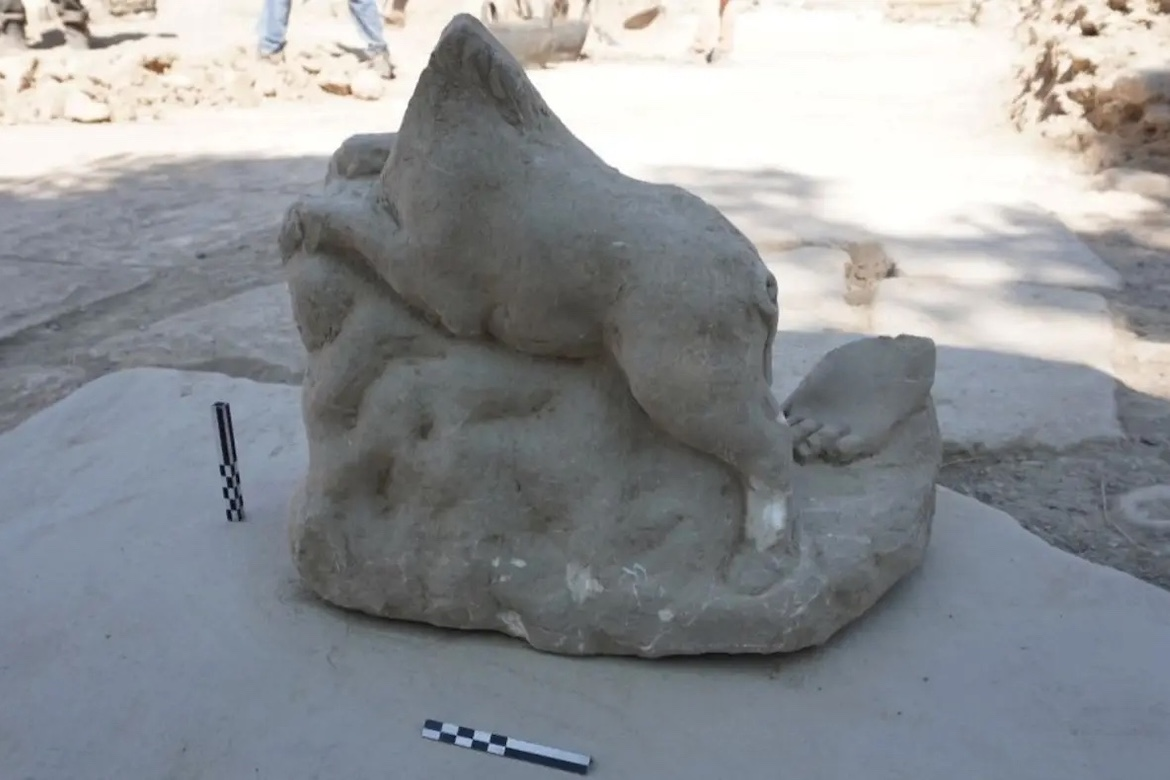
Archaeologists digging through the ancient city of Gortyna in southern Crete have uncovered something that few expected: a life-sized statue of a pig, perfectly preserved in the heart of what was once one of the island’s great urban centers.
The discovery came during a summer excavation conducted by the University of Rome “La Sapienza” in collaboration with the Ephorate of Antiquities of Heraklion. The dig focused on Gortyna’s so-called North Road, one of the city’s main thoroughfares during the Roman period.
There, among the ruins of public buildings and weathered paving stones, the team unearthed the stone figure of a pig—an unusual find in Greek archaeology, where statues of animals are rare compared to the endless depictions of gods, heroes, and humans.
The statue, carved in striking realism, was found standing on what appears to be its original base. Its placement along a major street suggests that it wasn’t hidden in a sanctuary or buried as a votive offering—it was meant to be seen.
This has led experts to wonder whether the animal might have had symbolic or civic importance, perhaps connected to local religious practices, agricultural fertility, or even as a protective emblem for travelers entering the city.
Gortyna, after all, was no small outpost. Once a powerful city-state and later the capital of Roman Crete, it stood at the crossroads of Mediterranean trade and culture.
The city is already known for the famous “Gortyn Code,” one of the oldest surviving legal inscriptions in Europe. Every new find here—especially one as peculiar as this—adds another layer to our understanding of how ancient Cretans lived, worshipped, and imagined their place in the world.
The dig team is still studying the statue’s details to determine its exact age and significance. For now, the pig of Gortyna stands as a reminder that history’s surprises often appear in the most unassuming forms. A humble animal, carved in stone two thousand years ago, is once again standing at the center of a city’s story.