
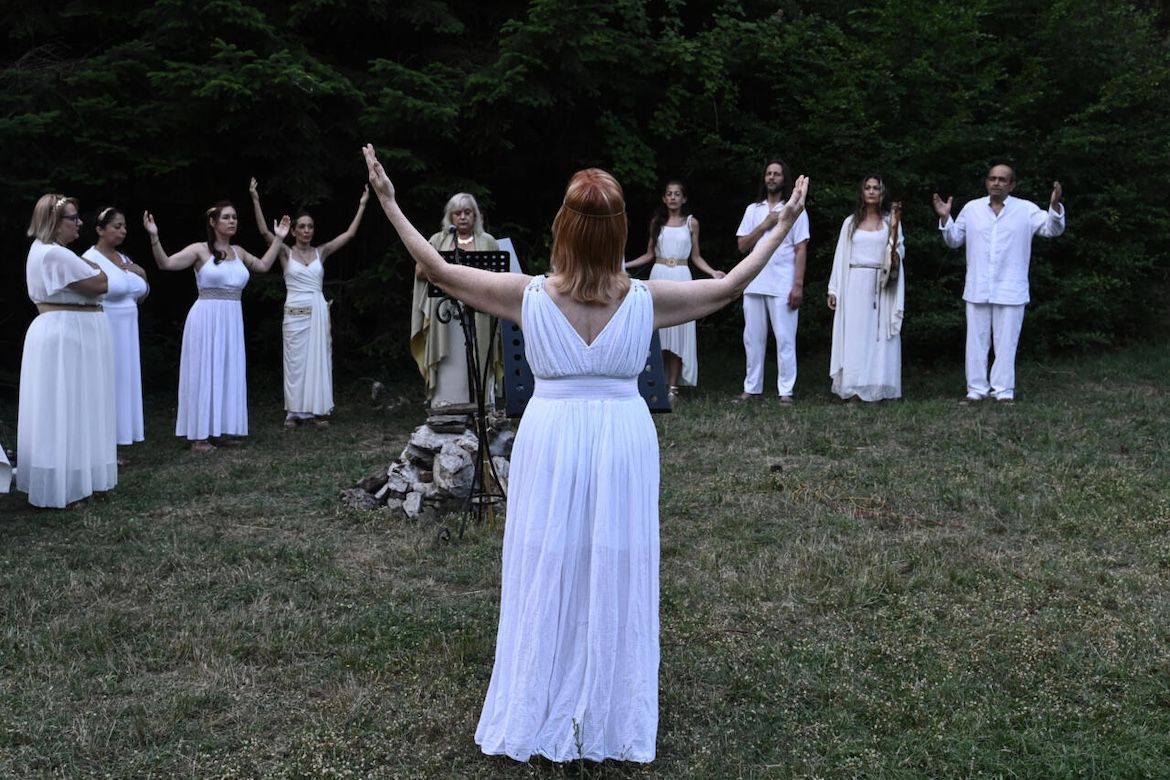
At the foot of Mount Olympus, hundreds of devotees of ancient Greek deities gathered this summer for Prometheia, a four-day festival held annually near Litochoro and the archaeological site of Dion.
The festival, featured in a recent AFP video report, includes torchlight processions, hymns, symbolic ceremonies and gatherings in the natural landscape surrounding the mountain long associated in Greek mythology with the twelve Olympian gods. AFP reported that participants, many of them polytheists, gather each year to revive ceremonies connected to ancient Greek religious and cultural traditions.
Prometheia has been held for more than three decades. The 2026 festival took place July 2–5 on Mount Olympus.
The event is organized by the association “Prometheus, the Fire Bringer,” named for the Titan Prometheus, who according to Greek mythology stole fire from the gods and gave it to humankind. AFP quoted the association’s president, Georgia Altintasiotou, as saying the goal is to highlight aspects of Greece’s cultural and historical heritage.
The ceremonies include processions near Dion, torchlight runs, theatrical performances, dances and symbolic rituals in the forests and along the nearby River Enipeas. Participants also gather by the river to honor nature and invoke mythological figures such as the Nymphs and Nereids. Reuters has previously reported that rituals at Prometheia have included raising hands to the sky, pouring wine on the ground and dipping feet in the Enipeas River as acts of purification or homage to the gods.
Some participants adopt names inspired by antiquity. AFP reported that many members of the association change their first names following a ceremony and address one another by names drawn from ancient Greek figures or concepts. One participant, Triantafyllos Athanassoulas, told AFP that at the festival he uses the name Hermodoros, meaning “gift of Hermes.”
The modern worship of ancient Greek deities is often described as Hellenic polytheism, Hellenism or Hellenic ethnic religion, depending on the organization or practitioner. It is not a single centralized movement. Groups in Greece and abroad use different names, structures and approaches, but many focus on the worship of the Olympian gods, household ritual, public ceremonies, ancient hymns, libations and the revival of pre-Christian Greek religious traditions.
One Athens-based group, LABRYS Religious Community, describes its purpose as preserving, promoting and practicing the Hellenic polytheistic religious tradition through public rituals, lectures, publications, theatrical and musical events. The group also emphasizes household worship, altars and libations as part of religious practice.
Another organization, the Supreme Council of Ethnic Hellenes, known by its Greek acronym YSEE, has worked for decades for the recognition of Hellenic ethnic religion in Greece. In 2017, the European Congress of Ethnic Religions reported that Greek authorities had recognized Hellenic Religion as a “known religion,” a legal status connected to the public exercise of worship and permission to establish places of worship. The same report noted that YSEE was still seeking broader recognition as a religious legal entity.
The U.S. State Department’s 2017 International Religious Freedom Report on Greece also noted that the Greek government approved, for the first time, a permit for YSEE to operate a house of prayer, identifying the group as a polytheistic community revering the ancient Hellenic gods. The same report states that Greece’s constitution recognizes Greek Orthodoxy as the “prevailing religion,” while also protecting freedom of religious conscience and worship, subject to restrictions involving public order and proselytizing.
Legal recognition for groups connected to ancient Greek religious practice has developed gradually. In 2006, Kathimerini reported that an Athens court granted public recognition to ELLIN.A.I.S., a society whose charter defined ancient Greek religion as the worship of the twelve gods of Mount Olympus, as well as other gods, heroes and ancestors honored by the ancient Greeks. The society’s charter also described ceremonies involving hymns, ancient symbols, vessels, statues, images and bloodless offerings such as fruit, plants, incense, wine, water and oil.
Reliable figures for the total number of practitioners are difficult to determine. Kathimerini reported in 2006 that there were no official figures for the faithful, while citing a U.S. State Department estimate of approximately 2,000 followers of ancient polytheistic Hellenic religions in Greece at the time. More recent reporting has focused less on national numbers and more on public gatherings such as Prometheia, which draws hundreds of participants and visitors each year.
For participants, the festival combines religion, cultural revival and connection to place. AFP quoted Symeon Charizanos, a 53-year-old office worker, as saying he does not seek to convert others, but to preserve values and virtues he associates with his ancestors. Semeli Travlou, a writer and founding member of the organizing association, described Prometheia as an effort to return to ancestral roots.
The annual gathering takes place in one of Greece’s most symbolically charged landscapes. Mount Olympus, the highest mountain in Greece, has been associated since antiquity with the dwelling place of the Olympian gods. At Prometheia, that mythological geography becomes the setting for a contemporary religious and cultural practice that continues to draw devotees, visitors and media attention from Greece and abroad.