


While a persistent heat dome is currently subjecting Western and Central Europe to scorching temperatures exceeding 40°C (104°C), Greece has so far been lucky enough to avoid the extreme heat.
This is largely thanks to the meltemia. These protective northerly winds, driven by the same European high-pressure system, are funneling cooler air across the Aegean, keeping Greece cool. However, this is about to change as the summer season progresses.
Meteo.gr analyzed 400 potential scenarios provided by the Copernicus Climate Change Service, and calculated a 92% probability that the average surface temperature this July in Greece will exceed average seasonal levels.
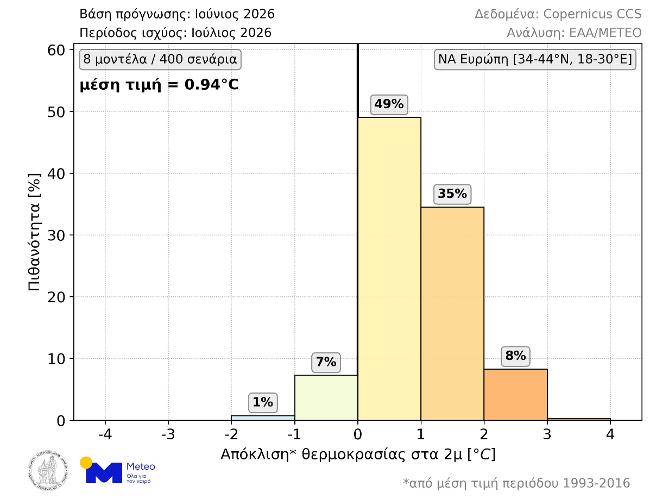
Temperature Differential (°C) / Photo Credit: Meteo.gr
The data shows a 49% likelihood of a temperature anomaly between 0 and 1°C (1.8°F), a 35% likelihood of an anomaly between 1 and 2°C (1.8 – 3.6°F), and a not too slim 8% likelihood of temperatures surging more than 2°C (3.6°F) above the 1993-2016 average. According to Meteo.gr, The mean expected temperature increase across all aggregated scenarios stands at +0.94°C or 1.69°F
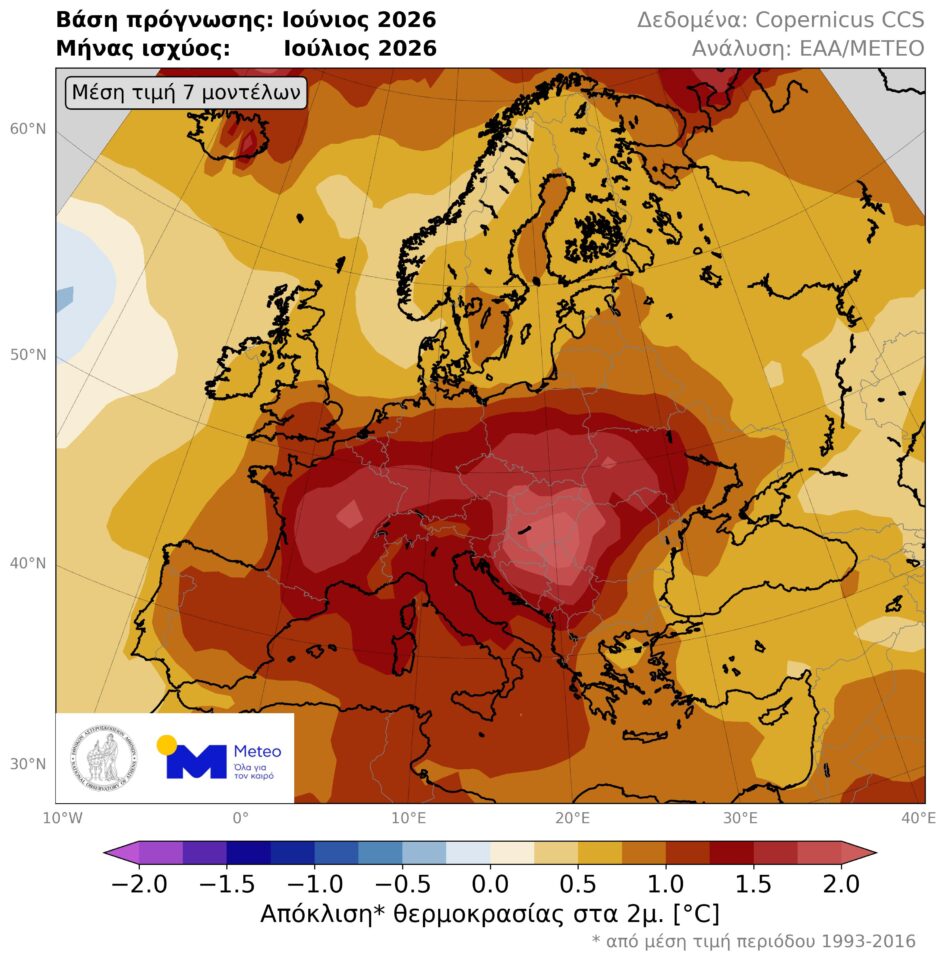
Meteo.gr notes that, while long-term forecasts such as these estimate general seasonal trends rather than precise daily weather patterns, the possibility for a hotter-than-average July in Greece is now almost certain.