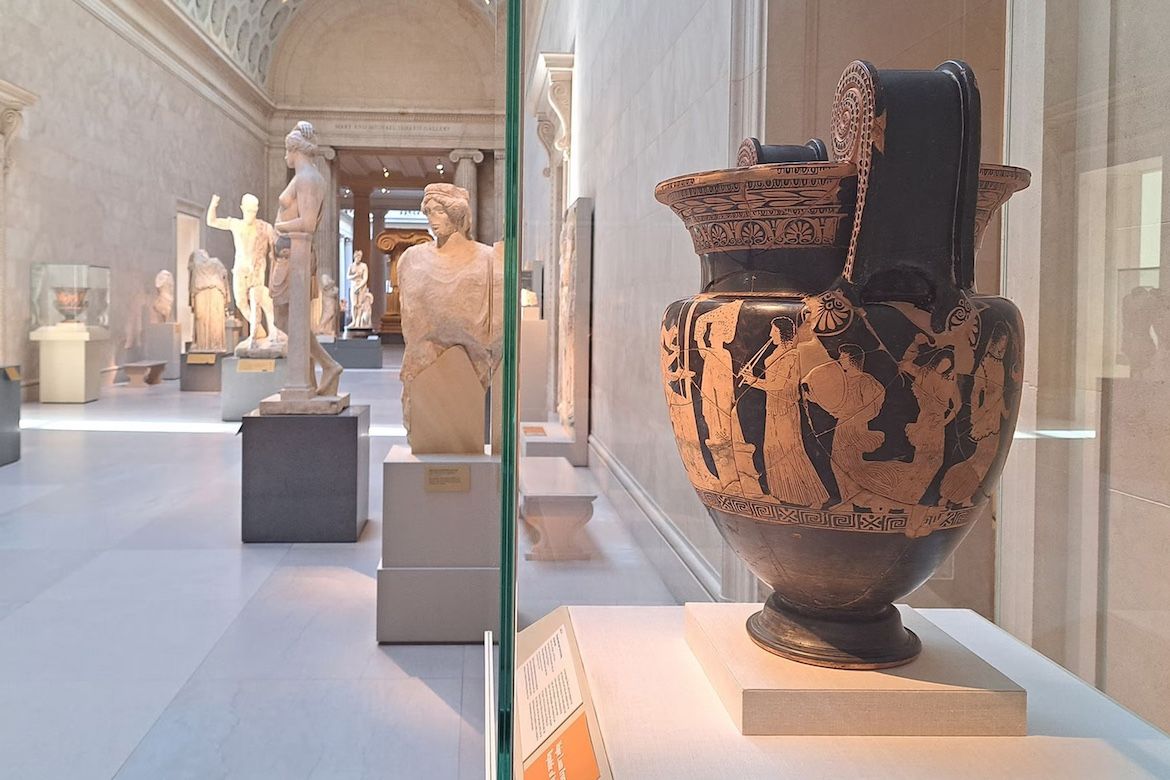

The Metropolitan Museum of Art in New York will present a major exhibition examining the maritime trade networks and cultural exchanges that shaped ancient Greek art and the wider Mediterranean world.
Across Wine-Dark Seas: Art and Identity beyond Ancient Greece will open at The Met Fifth Avenue on December 20, 2026, and remain on view through April 11, 2027. The exhibition will be included with museum admission.
The exhibition will bring together more than 180 works created between the eighth and early fifth centuries BC, a period during which Greek communities expanded their maritime activity across the Mediterranean and Black Sea regions.
According to The Met, the exhibition will examine how travel, trade and contact with other societies influenced Greek artistic styles, techniques, traditions and mythology. It will also consider the influence Greek communities had on the cultures they encountered.
The period covered by the exhibition coincided with several major developments in the ancient Greek world, including the growth of the city-state, the construction of monumental temples across the Mediterranean, the establishment of festivals such as the Olympic Games, the adoption of an alphabet from the Phoenicians and the development of the Homeric epics The Iliad and The Odyssey.
Objects featured in the exhibition will include works made from stone, metal, terracotta, glass and amber. The presentation will be organized geographically, beginning with the Eastern Mediterranean and West Asia and continuing through Egypt and North Africa, Italy, Sicily and Sardinia, the Western Mediterranean and Europe, and the Balkans and Black Sea.
The structure is intended to present the ancient Mediterranean as a connected network of societies rather than as a region centered exclusively on Greece. The exhibition will include works produced by both Greek and non-Greek artists.
Among the objects highlighted by The Met is an Attic red-figure drinking cup dating to approximately 480 BC. The terracotta kylix depicts Herakles traveling west across the sea inside the enormous cauldron of Helios, the sun god. The work, held by the Vatican Museums, represents the uncertain sea voyages undertaken by ancient travelers as they moved toward the limits of their known world.
Italian institutions are contributing 31 loans from eight museums, including the Regional Archaeological Antonino Salinas Museum in Palermo, the Capitoline Museums in Rome and the Mont’e Prama Foundation in Sardinia. The Vatican Museums are providing four additional loans, while 16 Italian specialists have contributed to the exhibition catalogue.
Can’t see the exhibition? Reserve your copy of the coffee table catalogue here.