
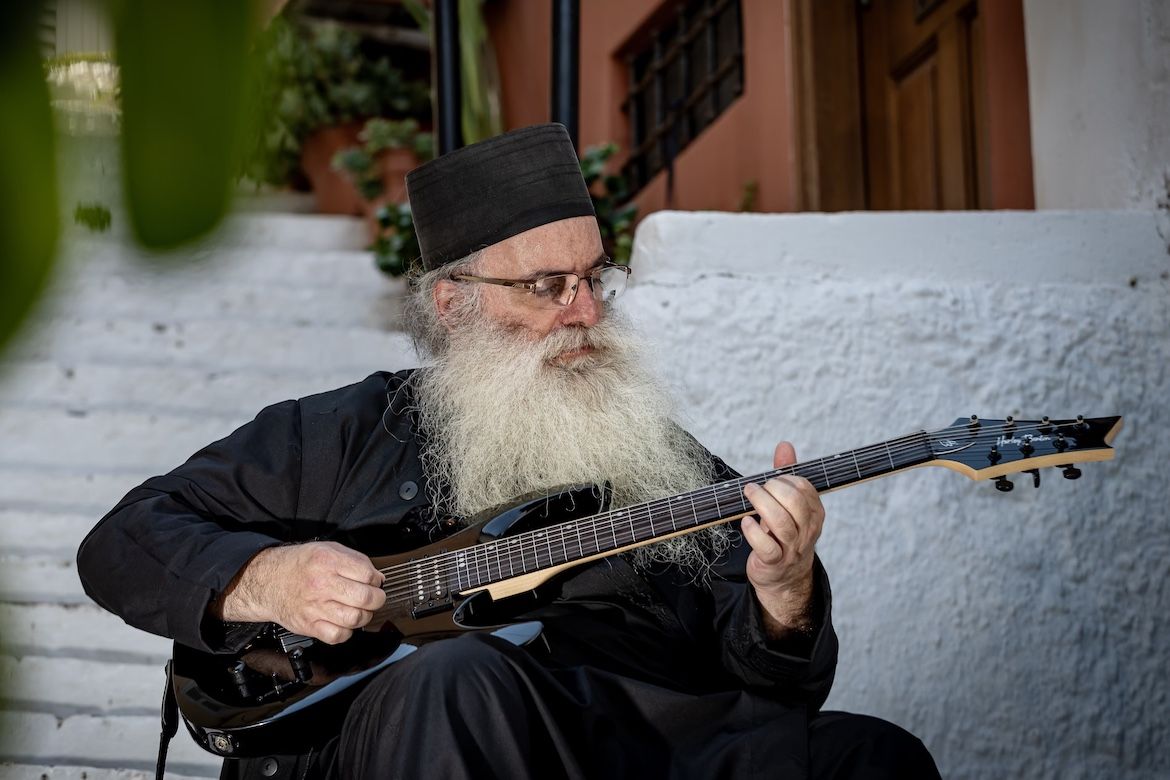
A Greek Orthodox priest from Nafplio has become one of the year’s most unexpected international music discoveries with an album that combines Byzantine musical traditions, doom metal, electronic beats, religious chants and even ecclesiastical rap.
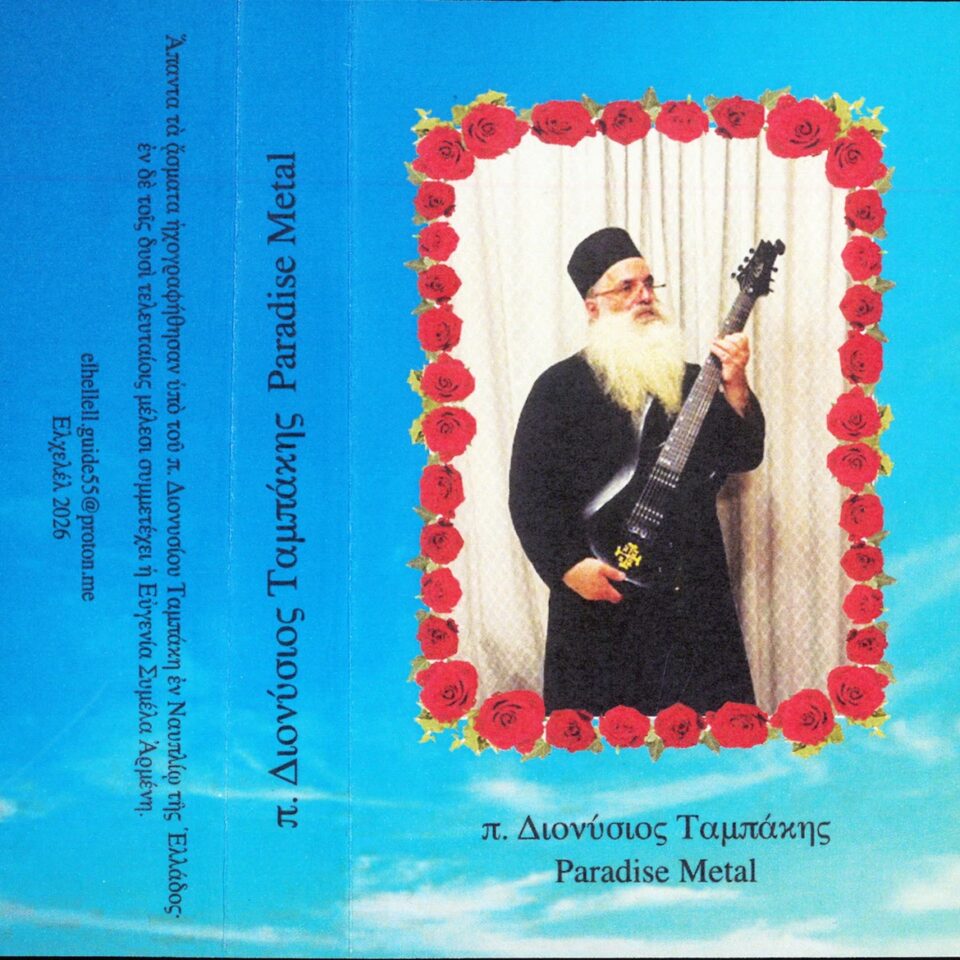
Father Dionysios Tabakis, a 53-year-old married priest and father of three, recorded his debut album, Paradise Metal, largely by himself inside his home. Released on April 29 by the Athens-based Heat Crimes label and Thessaloniki’s Elhellel, the 12-track album has attracted attention from music critics and experimental-music listeners around the world.
The project received a major boost in May when influential music publication Pitchfork awarded it a score of 7.6, describing it as an “inspiring and idiosyncratic debut” that moves between drone metal, techno Christmas carols, field recordings and Orthodox hymns.
That recognition transformed the previously little-known priest into an international cult figure. The album became one of Bandcamp’s bestselling releases, generated demand for a limited-edition vinyl pressing and led to coverage by international music publications including Stereogum and, most recently, The Guardian.
Father Tabakis serves at the Church of the Nativity of the Theotokos, commonly known as Panagitsa, in Nafplio. He has lived in the historic Peloponnesian city for nearly three decades, while quietly developing a musical practice rooted in the traditions of the Eastern Mediterranean.
Born in Piraeus in 1972, he is the descendant of Greeks displaced from Smyrna during the destruction of the city in 1922. He has said that the Byzantine culture carried by Asia Minor refugees remained central to his family identity and later shaped his understanding of music.
He began learning Byzantine music through priests in his parish while still in middle school and later taught himself to play an extensive collection of traditional instruments. Among them are the qanun, oud, cümbüş, ney, zurna, Pontic and Constantinopolitan lyras, kabak kemane and yaylı tanbur.
His music is based not simply on the sounds of Byzantine chant, but on its musical structure, including scales and microtonal intervals that differ from those used in most Western music.
One of the album’s defining sounds comes from the perdesiz, a fretless electric guitar capable of producing notes between the fixed semitones found on a conventional guitar. Father Tabakis has compared its fluid sound to the natural movement and tonal flexibility of the human voice.
His preferred instrument is a modified seven-string Harley Benton electric guitar that reportedly cost €135. Its fretless neck allows him to reproduce some of the smaller intervals, known as moria, used in Byzantine music and traditional Eastern Mediterranean performance.
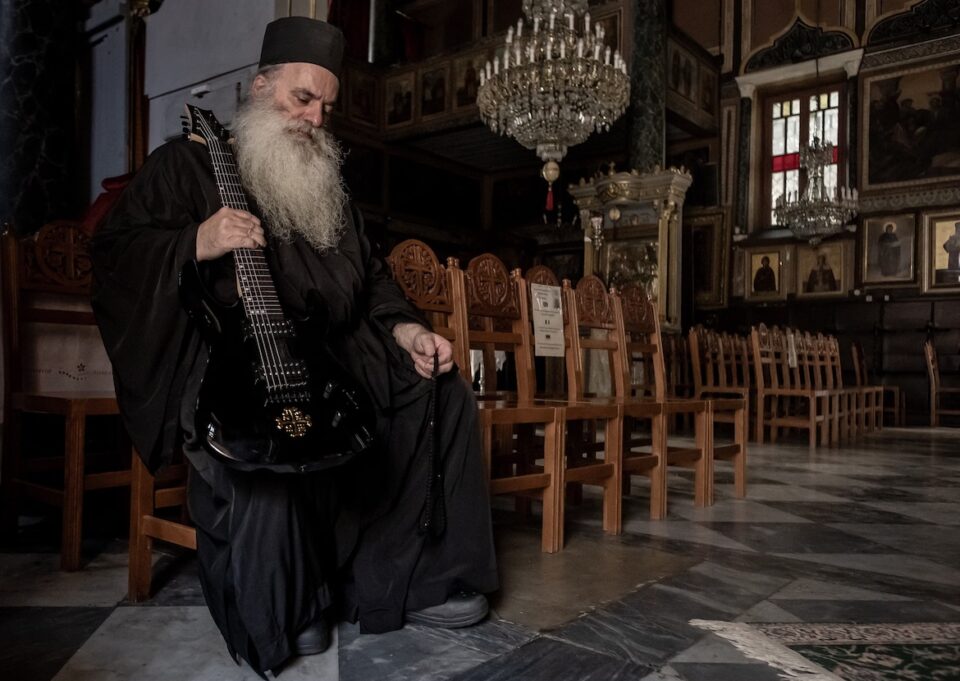
The result is music that moves between long, distorted guitar drones and passages resembling sustained Orthodox chanting. Some tracks are solemn and meditative, while others introduce electronic rhythms, synthesizers, satire and contemporary Greek slang.
“Techno en Monastirio,” or “Techno in a Monastery,” begins with the question “Are you ready?” before placing rhythmic chanting over an electronic beat.
Another track, “Anarchos Theos,” adapts Byzantine Christmas carols into a nearly six-minute techno composition. “Dubai Paei,” meaning “Bye, Dubai,” uses the biblical image of Babylon to satirize luxury, wealth and their fragility.
One of the album’s most unconventional titles is “Flexareis Karga — Ekklisiastiki Rap,” which can be loosely translated as “You’re Flexing Big Time — Church Rap.”
Father Tabakis said he searched online for current slang while writing the song, an attempt to communicate with younger listeners in language they would recognize.
Two of the album’s tracks feature the voice of Evgenia Symela Armeni, a young singer Father Tabakis met through the church. Armeni recorded her vocals on a mobile phone in her university apartment.
She performs “Chaire Parthene Soumela,” a Pontian hymn dedicated to the Virgin Mary of Soumela, and the album’s closing track, “Rodon Psychis,” or “Rose of the Soul.”
Her Orthodox chant-style vocals are paired with atmospheric guitar and, at the conclusion, the sound of Greek bagpipes.
Father Tabakis began recording his own compositions approximately four years ago. His son introduced him to music-production software, while an upstairs neighbor helped teach him the guitar.
He began uploading his experiments to YouTube, where he has posted hundreds of recordings featuring traditional instruments, Byzantine melodies and electric-guitar improvisations. His work eventually attracted Nikolas Rafael, founder of the Thessaloniki label Elhellel, who located the priest through an email address posted on a Christian internet forum and proposed releasing an album.
Despite his growing profile, Father Tabakis has remained largely removed from the promotional machinery of the music business. He reportedly declined numerous television appearances following the album’s release because he feared being presented as a novelty rather than taken seriously as a musician.
His music has also prompted discussion about the uneasy historical relationship between the Orthodox Church and secular musical instruments, particularly the electric guitar. Orthodox worship is traditionally vocal and does not generally incorporate instruments into the Divine Liturgy.
Father Tabakis, however, rejects the idea that an instrument can be inherently incompatible with religious life. He views musical creativity as another way of expressing faith and exploring beauty.
“The guitar was made by God,” he told The Guardian. “The devil cannot create something. God has created all.”
He has described his music as an attempt to challenge old misunderstandings and use sound to unite rather than divide people. The album itself is largely devotional and personal rather than overtly preachy, addressing themes including isolation, depression, vanity, prayer and the search for hope.
Father Tabakis is not the first Greek Orthodox cleric to enter the world of rock music. During the 1990s, the group Paparokades — whose name roughly translates as “priest rockers” — attracted widespread attention in Greece with Christian rock and heavy-metal recordings. Their performances and confrontational lyrics also generated controversy within church circles.
Paradise Metal, however, has emerged from a different setting. Rather than forming a conventional band or pursuing mainstream popularity, Father Tabakis created the album through solitary experimentation, combining the sounds of his priestly and cultural
life with inexpensive recording equipment and digital technology.
Until the album’s success, he had never performed his music before a live audience. He is now scheduled to make a rare concert appearance at London’s Iklectik venue on November 13.
Father Tabakis has made clear that his growing musical career will not replace his vocation. He continues to serve his parish in Nafplio and has said that he would never leave the priesthood to become a full-time musician.
For the moment, the unlikely success of Paradise Metal has placed an Orthodox priest, a fretless electric guitar and the microtonal traditions of Byzantine music before an international audience that few could have predicted.
Images from Panagiotis Moschandreou/The Guardian