
On the remote island of Othonoi, The Krank’s monumental land art installation places two prehistoric hunters face-to-face with a modern drilling platform—and directly within a landscape facing an uncertain future.
On a remote beach at Greece’s westernmost inhabited island, two figures from prehistory confront a machine from a possible future.
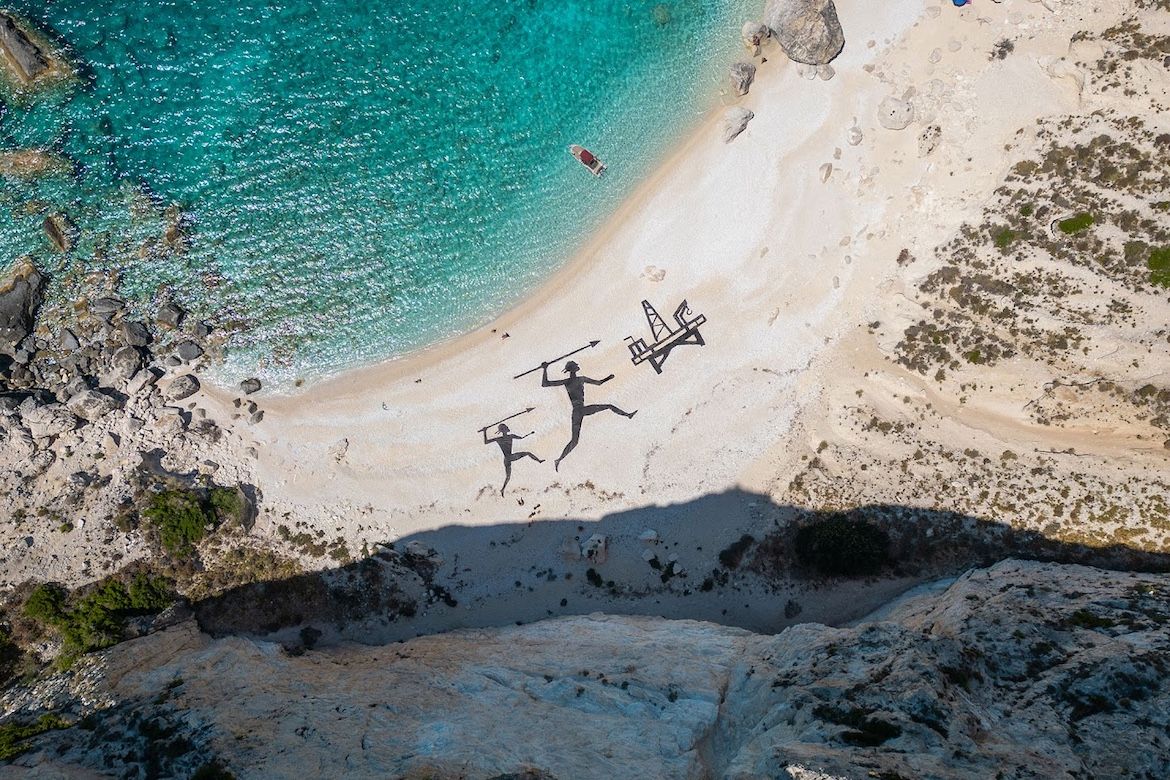
The scene is part of “The Hunt,” a temporary, 500-square-meter land art installation created by Greek visual artist The Krank on the island of Othonoi, northwest of Corfu. Rendered in black across the pale beach, the work depicts two prehistoric hunters standing opposite the silhouette of an offshore drilling platform.
The Krank, who was born in Greece in 1988 and lives and works in Athens, moves between painting, video, new media, installations and large-scale land art. His work frequently explores the boundaries between the accidental and the intentional, the temporary and the permanent, and humanity’s increasingly complicated relationship with technology and the natural environment.
He has exhibited throughout Europe and internationally, including at Documenta Halle in Kassel, Berlin Art Week, the Athens Conservatory, the German Historical Museum, the European Capital of Culture Eleusis 2023 and Transmediale in Berlin, as well as at the Czong Institute for Contemporary Art in South Korea and the Berry Campbell Gallery in New York.
His best-known environmental work before “The Hunt” was “Footprint,” a 1,000-square-meter installation created on Paxos for the 2022 Paxos Biennale. Shaped like an enormous human boot print, the deliberately temporary work addressed humanity’s environmental impact and the tension between economic development and the preservation of nature.
With “The Hunt,” The Krank has returned to the Ionian Sea with an even more direct intervention.
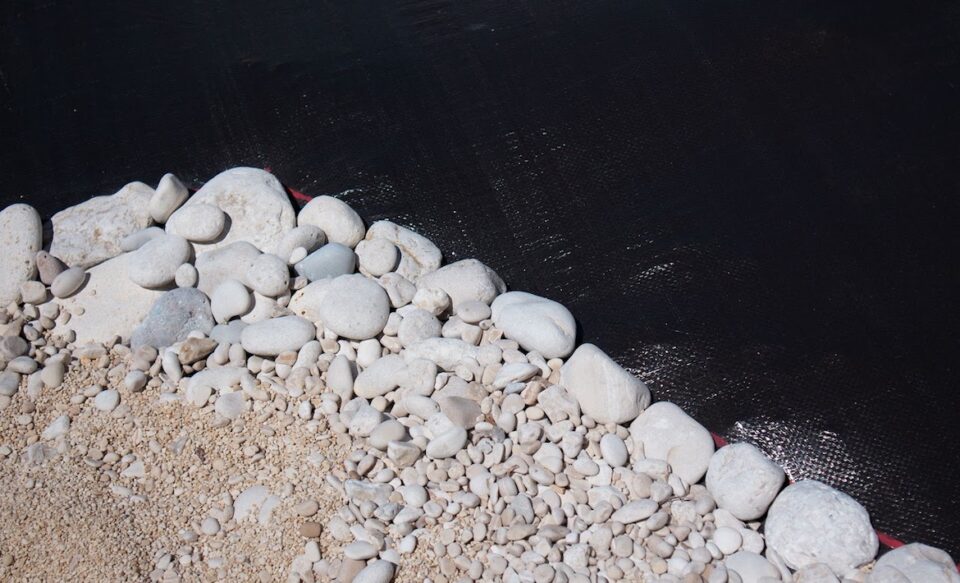
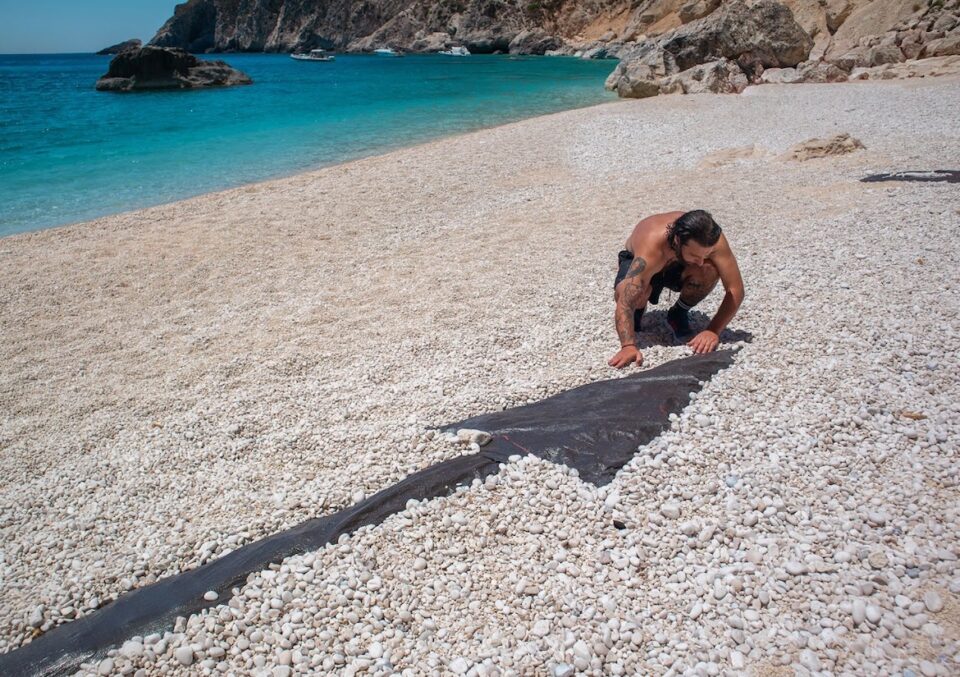
Created from black geotextile, the installation borrows the visual language of prehistoric cave paintings to compress thousands of years of human activity into a single image. The primitive hunter seeking food for survival is placed opposite the contemporary energy industry searching for resources beneath the seabed.
The two figures are separated by millennia but connected by what the artist describes as the same basic human impulse: the desire to search, conquer and extract from the environment.
Humanity, however, is no longer presented only as the hunter. In The Krank’s interpretation, it has also become vulnerable to the technological and industrial systems it created.
“The machine no longer functions merely as a tool, but as a force that reshapes the environment and threatens the conditions of human existence,” the project description states. The human figures appear almost like archaeological remains—the final witnesses to a landscape that could one day be transformed by industry.
The Location Is Part of the Work
“The Hunt” was created during the inaugural Ionian Lab artist residency, organized by the Athens contemporary art space Space52 in collaboration with Kalogerou 1844.
The residency brought four artists to Othonoi in July 2026 to develop works responding directly to the island’s geography, history, mythology, natural environment and small local community.
Organizers described the island not as a neutral location for displaying art, but as an active participant in the creative process.
For The Krank, the exact location became fundamental to the meaning of the work.
The installation was created on a beach facing Block 2, an offshore hydrocarbon exploration concession in the northwestern Ionian Sea. According to the project organizers, the artwork was positioned approximately 10 kilometers from the concession area.
It was therefore not a depiction of a distant environmental debate. It was placed inside the landscape whose future is being discussed.
The first idea for the work began forming in October 2025, The Krank told the Greek publication LiFO, during a dinner on the nearby island of Paxos.
A resident participating in a conversation about offshore exploration described feeling vibrations inside her home during earlier survey activity. The account stayed with the artist, who began imagining an unseen technological presence moving through the landscape at night.
When he was later invited to participate in the Othonoi residency, The Krank began researching the island and discovered the proximity of the beach to Block 2.
The beach’s enormous rocks suggested the walls of a prehistoric cave and led him toward the visual language of cave painting. His initial sketches were conceived for the rocks before the composition was transferred onto the ground.
The resulting image brought two prehistoric hunters face-to-face with an offshore platform at the point where, symbolically, the ancient human search for survival meets the modern search for energy.
The artist said the work could not have been created in another location because the beach was not merely its background. The landscape was the reason for the work’s existence.
Hunter and Prey
For The Krank, the title “The Hunt” does not offer a simple answer about who is doing the hunting.
Humans have always searched the natural world for the resources needed to survive. What has changed, he said, is the scale of that search and the consequences made possible by modern technology.
Humanity remains the hunter but can also become the prey of the systems it has created.
That ambiguity is central to the installation. The offshore platform appears as a product of human intelligence and technological advancement, but also as an imposing force capable of transforming the environment on which human life depends.
The work also draws upon Othonoi’s mythological associations. Near the beach is a cave traditionally connected to Calypso, the nymph who detained Odysseus on her island for seven years in Homer’s Odyssey.
The Krank said that while living and working on Othonoi, mythology did not feel confined to the distant past. Instead, myth, landscape and present-day life seemed to coexist, offering a language through which contemporary concerns could be understood.
A Temporary Work About Permanent Change
The installation’s temporary nature created another layer of tension.
As The Krank completed the work, some people on the beach reportedly approached him with concerns about the unfamiliar black material spread across the landscape. They wanted to know what it was, whether it would cause damage and whether it would be removed.
The artist explained that the installation was temporary and had been designed to disappear.
The exchange exposed what he saw as an important contradiction: a removable artwork attracted immediate concern while the possibility of a much larger and more lasting industrial intervention beyond the horizon remained more abstract.
As The Krank spoke with the beachgoers about the installation and the nearby exploration concession, they walked toward the rocks to view the artwork in relation to the sea.
The conversation gradually moved away from the material on the beach and toward the future of the landscape itself.
“Perhaps that was where my gesture was truly completed,” the artist told LiFO—not simply in the construction of the installation, but at the moment when people no longer looked at the horizon in the same way.
Greece Moves Toward Exploratory Drilling
The offshore project referenced by the installation has advanced significantly over the past year.
Block 2 is an exploration concession in the northwestern Ionian Sea, adjacent to the Italian Exclusive Economic Zone. The concession is held by a joint venture involving ExxonMobil, Energean and HELLENiQ ENERGY.
ExxonMobil holds a 60 percent interest, Energean holds 30 percent and HELLENiQ ENERGY holds 10 percent. Energean remains the operator during the exploration stage. ExxonMobil would assume operatorship during a potential development phase only if hydrocarbons are discovered and the project proceeds.
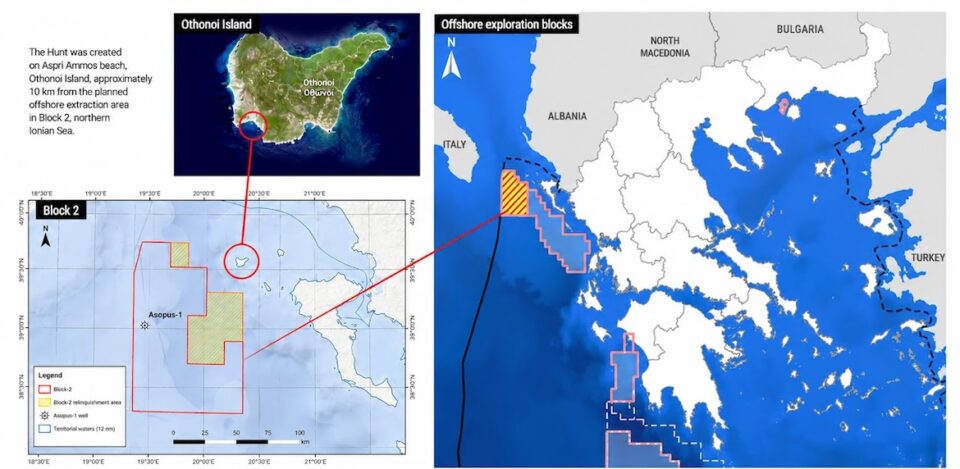
In March 2026, the consortium formally notified Greek authorities that it would enter the concession’s second exploration phase.
That phase includes an obligation to drill one exploration well. According to the Hellenic Hydrocarbons and Energy Resources Management Company, the drilling is being planned in water approximately 900 meters deep and at a distance of more than 55 kilometers from shore.
The consortium subsequently contracted Stena Drilling for the operation, with exploratory drilling planned for February 2027. It would be Greece’s first offshore exploration drilling operation in approximately 40 years.
The companies involved have presented the project as an opportunity to determine whether commercially viable natural gas deposits exist beneath the Ionian Sea and to strengthen Greece’s position in the European energy market.
Environmental organizations, meanwhile, have opposed Greece’s broader expansion of offshore hydrocarbon exploration, warning about the potential effects of seismic surveys and drilling on whales, dolphins and other marine life, as well as the long-term consequences of additional fossil-fuel development.
Exploratory drilling does not mean that commercial extraction has been approved. Any future production would depend on the results of the well, further technical and financial assessments, additional permits and subsequent development decisions.
“The Hunt” does not attempt to explain that complex debate through maps, geological studies or energy policy.
Instead, it reduces the issue to a single image: two human figures, an industrial machine and the landscape caught between them.