
The acclaimed Homer translator says Christopher Nolan’s blockbuster is visually overwhelming but emotionally and intellectually shallow—even as audiences around the world continue flocking to see it.
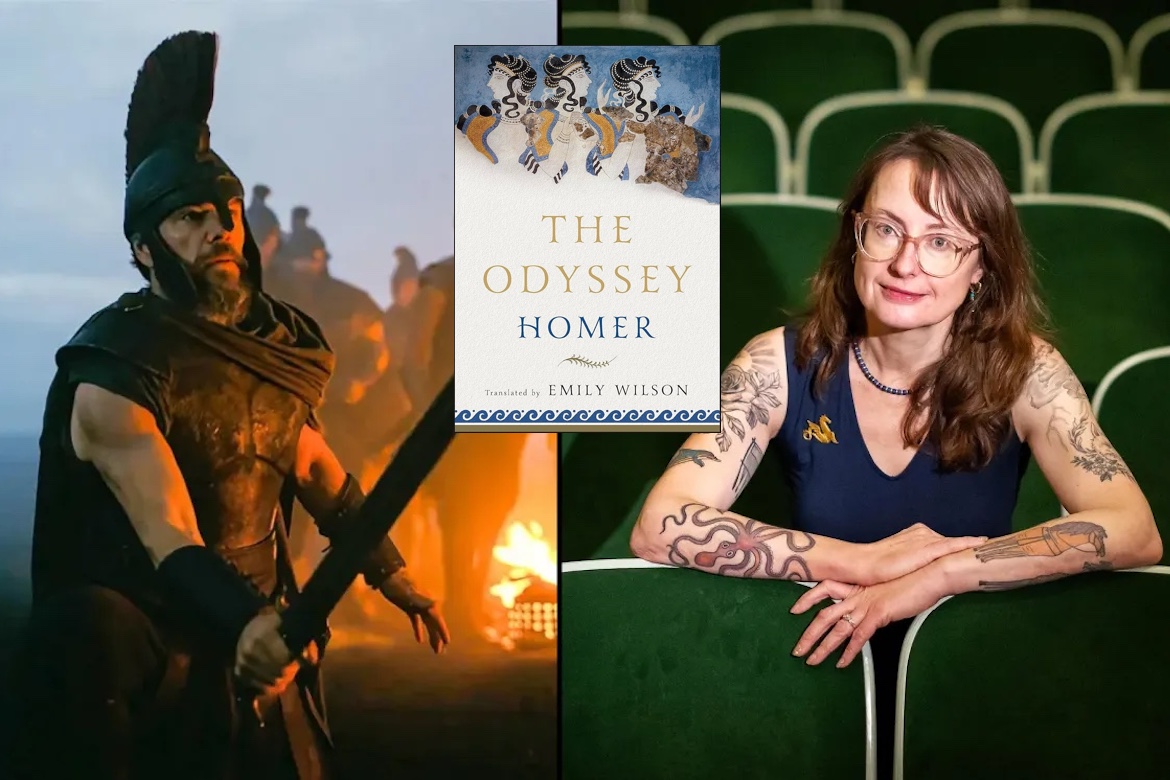
Christopher Nolan has transformed one of the foundational works of Greek literature into the cinematic event of the summer. Emily Wilson, whose celebrated translation helped shape his conception of Odysseus, believes he missed much of what makes Homer’s story worth telling.
Wilson, a professor and chair of classical studies at the University of Pennsylvania, became the first woman to publish a complete English translation of Homer’s Odyssey in 2017. Nolan specifically cited the opening of Wilson’s translation—“Tell me about a complicated man”—when discussing his approach to Odysseus, played in the film by Matt Damon.
Wilson’s response after seeing the movie could hardly have been more severe.
In an essay titled “An Uncomplicated Man” for the London Review of Books, Wilson writes that she “would be ashamed to have written any part of this script.”
Her criticism is not primarily that Nolan changed Homer. Wilson has repeatedly made clear that adaptations are allowed to reinvent their source material. Before the film’s release, she told Vulture in a wide-ranging interview, “It’s not my story. People can do whatever they like with it.”
She also dismissed much of the pre-release outrage over modern dialogue, diverse casting and other supposed violations of historical accuracy. The Odyssey, she pointed out, is not a historical document, and Homer’s stories have been reworked, expanded and radically transformed for thousands of years.
Her objection is that Nolan’s adaptation does not transform Homer into anything sufficiently rich of its own.
In her London Review of Books essay, Wilson describes the movie as another example of Nolan’s familiar combination of “grandiosity and superficiality.” She acknowledges its scale, momentum and technical spectacle, but argues that the film’s characters and ideas are too underdeveloped to support its ambitions.
“The writing is abysmal,” she concludes.
At the center of Wilson’s disappointment is Nolan’s Odysseus. The complicated, resourceful and constantly transforming figure described in Homer—and captured in the opening line of Wilson’s translation—has become, in her view, a comparatively simple action hero burdened by guilt.
In a series of posts summarizing her argument, Wilson said the film focuses on Odysseus feeling guilty about his actions during the Trojan War without seriously presenting the experiences of his victims. The result, she argues, is a story that rewards the perpetrator for feeling troubled while leaving the people harmed by war largely faceless and unheard.
That criticism goes to the heart of her reading of Homer. The ancient poems may glorify warriors, but they also repeatedly shift perspective, forcing audiences to see war through the suffering of families, enemies, enslaved people and civilians. Nolan, Wilson believes, reduces that moral and emotional complexity to the familiar image of a brooding hero carrying private trauma.
She is equally critical of the film’s treatment of women.
Wilson explained in an interview with Harper’s Bazaar that Homer’s poem contains multiple voices and competing interpretations of Odysseus’ homecoming. Penelope, Circe, Calypso, Athena, Helen, Nausicaa and the enslaved women of Ithaca do not simply decorate the hero’s journey. Their perspectives complicate it.
“An adaptation has to have something to say,” Wilson told the magazine. In her view, Nolan instead “dilutes the women” while centering Odysseus’ internal conflict, repeating a familiar pattern from the director’s other films in which a troubled man struggles to return to a distant or idealized woman.
The problem becomes especially clear in the homecoming.
Speaking with The Times after seeing the film, Wilson said the reunion between Odysseus, Penelope and Telemachus failed to move her.
“It didn’t land emotionally for me at all,” she said. As she watched Odysseus struggle to return to Ithaca, she found herself wondering: “Do I really care if this guy gets back to his wife?”
For Wilson, Homer spends the entire poem constructing the complicated emotional, political and psychological meaning of that return. Nolan, despite spending hundreds of millions of dollars recreating the voyage, never gives her enough reason to care about its destination.
Moviegoers around the world appear to feel very differently.
Less than two weeks after its release, The Odyssey had earned more than $652 million worldwide, including more than $362 million outside North America. The movie earned $87 million during its second weekend in the United States and Canada, the strongest second weekend of Nolan’s career and a drop of only 30 percent from its enormous opening.
The Associated Press reported that theaters around the world were adding screenings to accommodate demand. Most screenings in the rare 70mm IMAX format were already sold out through September.
Wilson does not deny the film’s power as a popular phenomenon. She describes it as an entertaining action movie, acknowledges that her teenage children enjoyed it and concedes that Homer’s story remains strong enough to survive even an adaptation she finds deeply unsatisfying.
More importantly, she welcomes the attention Nolan has brought to ancient literature. The film is filling cinemas, driving readers toward Homer and sending Wilson’s own translation back into the hands of a new generation.
That is what makes her criticism more interesting than a simple battle between an academic purist and a Hollywood filmmaker. Wilson is not demanding obedience to the ancient poem. She is arguing that Nolan had every right to reinvent The Odyssey—but failed to replace Homer’s complexity with an equally compelling vision.
Audiences, meanwhile, are responding to something else: the enormous images, the immersive sound, the monsters, the battles and the increasingly rare experience of a movie that feels like a genuine global event.
Both things may ultimately be true. Nolan’s Odyssey can be, in Wilson’s judgment, a shallow interpretation of Homer and still become one of the most powerful gateways to Greek literature in generations.