
Every summer has a book. Not the book you’re supposed to read. The book you can’t put down.
The one you start on a flight to Greece and find yourself reading at a café in Chania, on a ferry deck in the Cyclades, or long after everyone else has gone to bed.
This summer, my recommendation is Stephan Talty’s new book, The American School of Spies: The Archaeologists Who Fought the Nazis and Saved the Treasures of Ancient Greece.
At first glance, it sounds like a niche history book. It isn’t.
It’s part spy thriller, part World War II history, part archaeological adventure, and part Greek American story. Most importantly, it’s true.
The story begins during one of the darkest chapters in modern Greek history.
In April 1941, Nazi forces invaded Greece. The occupation would bring famine, executions, destruction, and the near annihilation of Greece’s Jewish communities. But Hitler’s interest in Greece extended beyond military conquest.
Like many Nazi ideologues, Hitler was obsessed with Ancient Greece. The regime promoted the bizarre theory that the achievements of classical Greece were evidence of an Aryan past. Nazi archaeologists and scholars arrived in occupied Greece hoping to uncover artifacts that would support their racial mythology and, where possible, transport some of Greece’s greatest treasures back to Germany.
What they found instead was something unexpected. Empty museums. Hidden collections. Missing treasures.
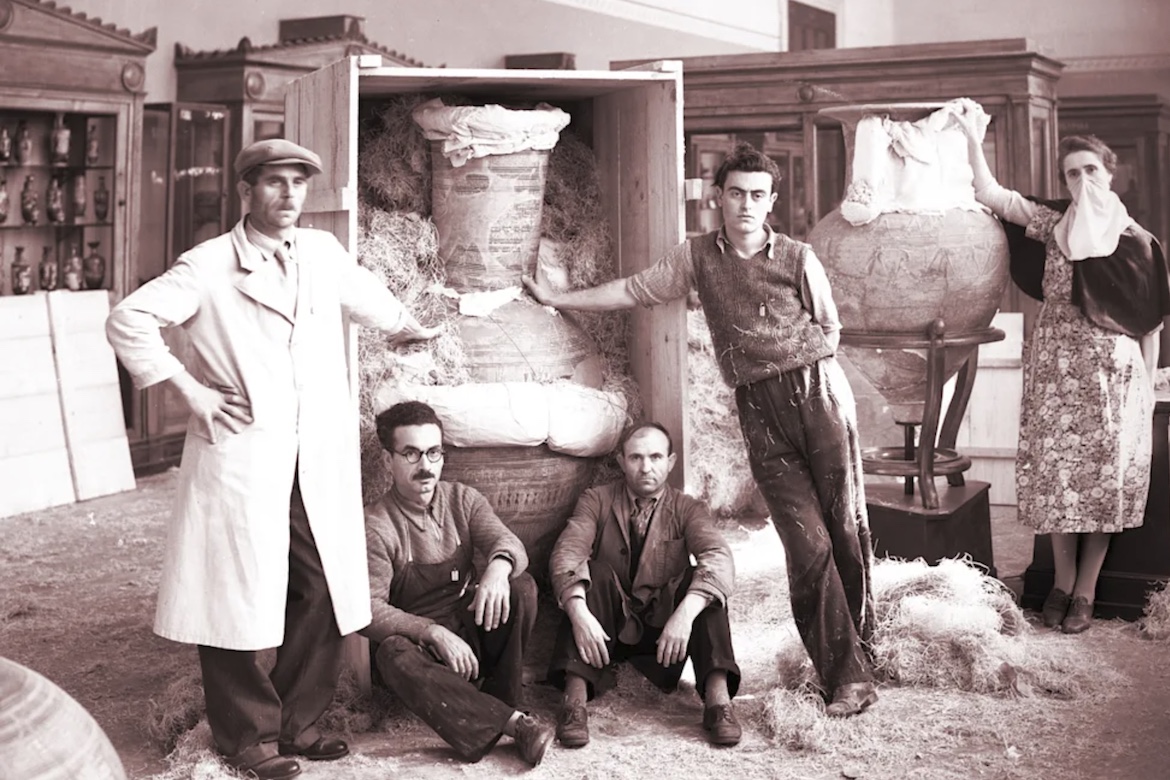
Long before the Nazis arrived, Greek archaeologists, museum workers, curators, laborers, and ordinary citizens had launched one of the most remarkable cultural rescue operations of the war. Priceless antiquities were packed into crates, hidden in caves, buried beneath the earth, and concealed in secret locations across the country. The famous treasures of the National Archaeological Museum— including masterpieces known around the world— simply vanished from Nazi reach.
But that is only half the story.
Talty introduces readers to a group of unlikely American heroes connected to Greece through scholarship, archaeology, and a deep affection for the country.
At the center of the story is Rodney Young, a Princeton-trained archaeologist who had spent years studying and excavating in Greece through the famed American School of Classical Studies at Athens. When war engulfed Europe, Young was recruited by the newly created American intelligence service, the Office of Strategic Services—the organization that would eventually become the CIA.
Young was tasked with assembling what became known as the “Greek Desk,” a remarkable network of scholars, classicists, archaeologists, architects, linguists, and intelligence operatives who used their knowledge of Greece to fight the Nazis. Their mission was not only to gather intelligence and support resistance efforts but also to help protect the cultural inheritance of an entire civilization.
Among them were American academics who suddenly found themselves learning espionage, creating cover identities, transmitting intelligence, and coordinating operations behind enemy lines. Some worked under humanitarian cover. Others relied on archaeological work to conceal intelligence activities. They were scholars by training and spies by necessity.
The story becomes even more compelling when Greek Americans enter the picture.
The OSS actively recruited young men from Greek immigrant communities throughout the United States. Many spoke Greek. Many had parents or relatives still living in occupied villages and towns. Thousands volunteered. Some became spies. Others joined specialized military units and returned to the homeland their parents had left behind to help liberate it.
There is something deeply moving about that connection.
American scholars risking their lives to save the birthplace of democracy.
Greek Americans crossing the Atlantic to fight for a country many knew only through stories told at family tables.
Greeks risking everything to preserve artifacts that had survived for thousands of years.
Together, they formed an unlikely alliance dedicated not only to defeating fascism but to protecting memory itself.
In many ways, that is what makes this story feel so relevant today.
When we talk about World War II, we often focus on battles, generals, and political leaders. We rarely talk about the people who understood that culture is worth defending too.
The statues buried beneath Athens. The museum collections hidden from occupiers. The scholars who became spies. The immigrants who returned to fight for their ancestral homeland.
These are reminders that civilizations are preserved not only by armies, but by people willing to protect stories, ideas, art, and history.
This is not simply a wartime tale. It is a story about the enduring relationship between Greece and America. It is a story about philhellenes and patriots. About archaeology and espionage. About heritage and sacrifice.
And it is one of those rare true stories that sounds too extraordinary to have actually happened.
Which is exactly why it deserves a place on your summer reading list.