

A new analysis by the FLAME Pyro-meteorology team of the National Observatory of Athens has revealed that more than 11 million stremmata (approximately 2.71 million acres) of land in Greece have been scorched by over 150,000 wildfires over the past 25 years.
The team studied official data from the Hellenic Fire Service between 2000 and 2024, identifying long-term trends in the process.
Fewer Fires but Greater Damage
The good news is that the number of fires during Greece’s fire season (May–October) has decreased from an average of 4,300 annually (2000–2012) to 3,700 (2013–2024).
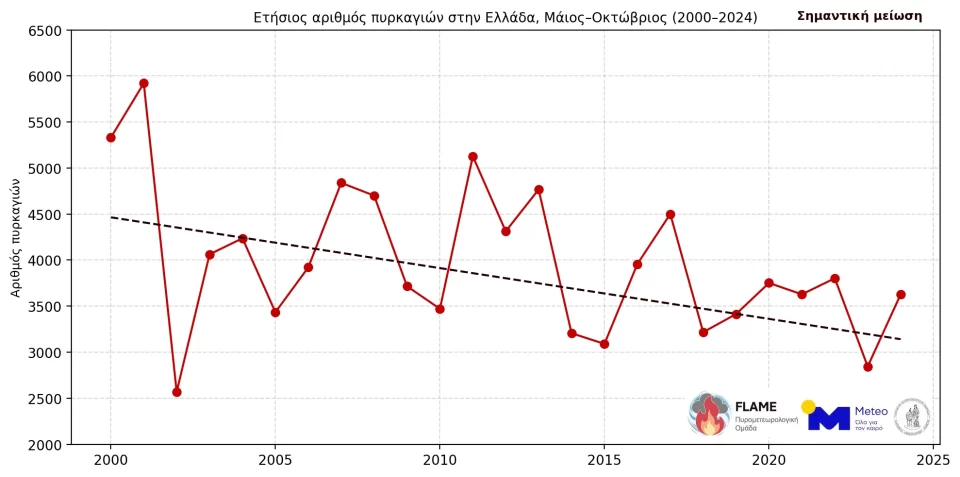
Number of fires in Greece, May-October (2000-2024) / Photo Credit: FLAME
The bad news is that total area burned by these fires is increasing, reflecting growing severity per incident. Data shows an average increase of roughly 1,482 more acres (6,000 stremmata) burned during the fire-season (May–October), with each passing year.
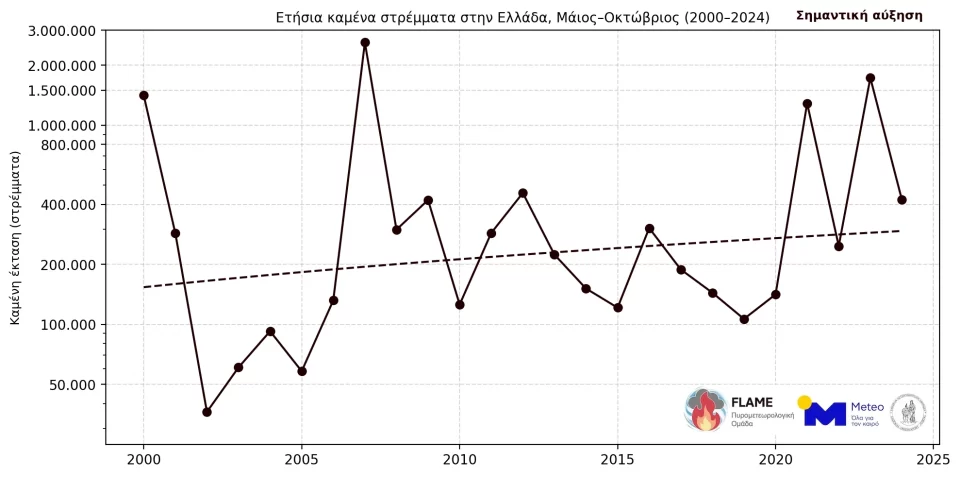
Area burned (stremmata) in Greece, May-October (2000-2024) / Photo Credit: FLAME
More and Bigger Fires
Larger fires that burn more than 494.21 acres (2,000 stremmata) during the fire season (May-October) have become more frequent on average. While these larger fires account for just 0.5% of the annual number of fires in Greece, they contribute disproportionately to the total area they burn.
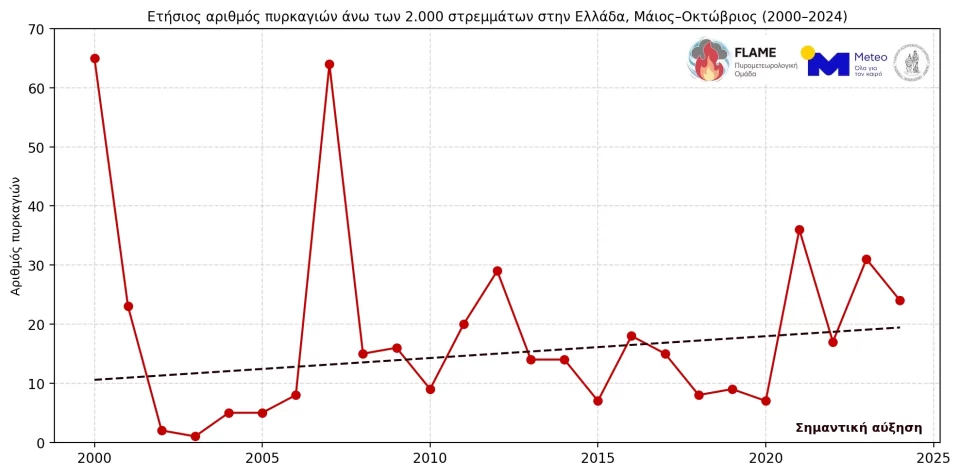
Number of fires (burning more than 2000 stremmata) in Greece, May-October (2000-2024) / Photo Credit: FLAME
The largest fires are also increasing in size with each passing year. Simply put, Greece doesn’t have just more large fires, but more large fires that keep getting larger.
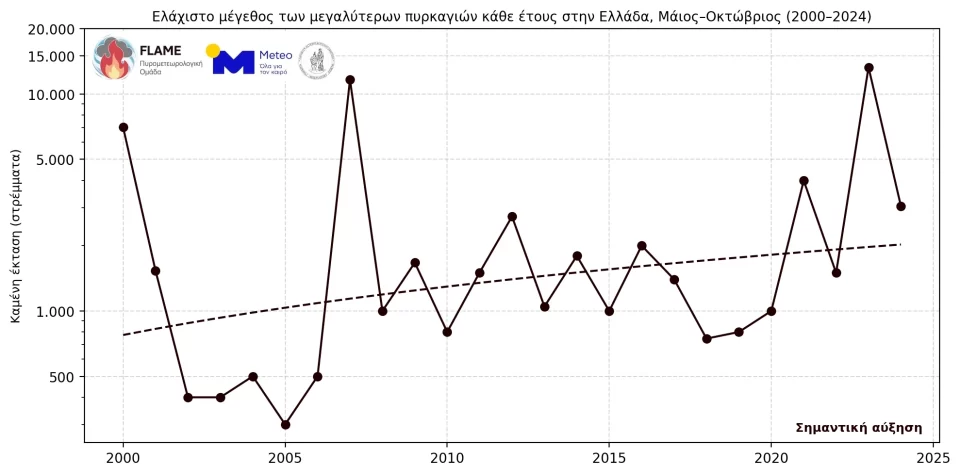
Minimum size of largest fires (stremmata) in Greece per year, May-October (2000-2024) / Photo Credit: FLAME
According to the FLAME Pyro-meteorology team, this finding may reflect worsening fire conditions caused by climate change, which in turn favor the development of large wildfires. However, it may also indicate a weakness by first responders to adapt to fires that escape initial containment and grow in scale.
Off-Season Fire Activity on the Rise
Wildfire activity during the off-season, i.e. from November to April, is increasing at an alarming rate. Starting in 2012, the average number of off-season fires has risen by 47%.
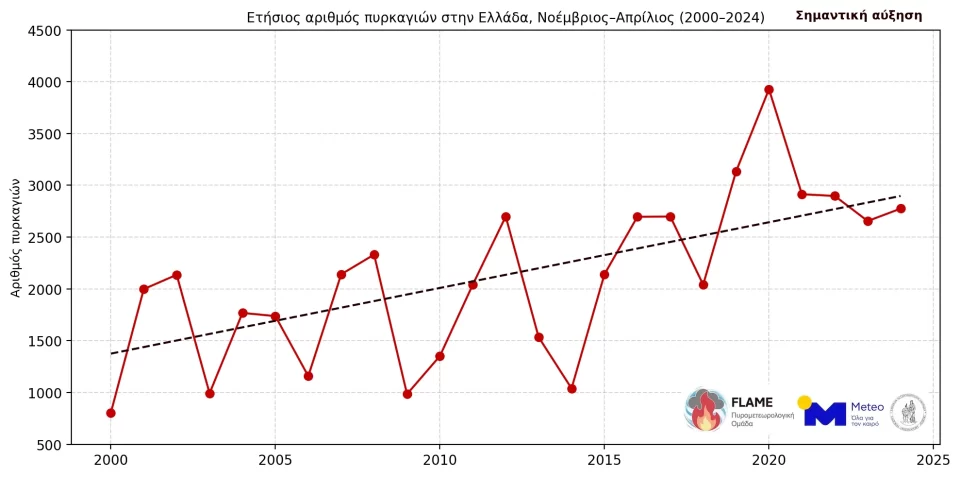
Number of fires in Greece per year, November-April (2000-2024) / Photo Credit: FLAME
The average area burned from off-season fires has increased from about 4,447.89 acres (18,000 stremmata) to over 5,683.42 acres (23,000 stremmata) annually.
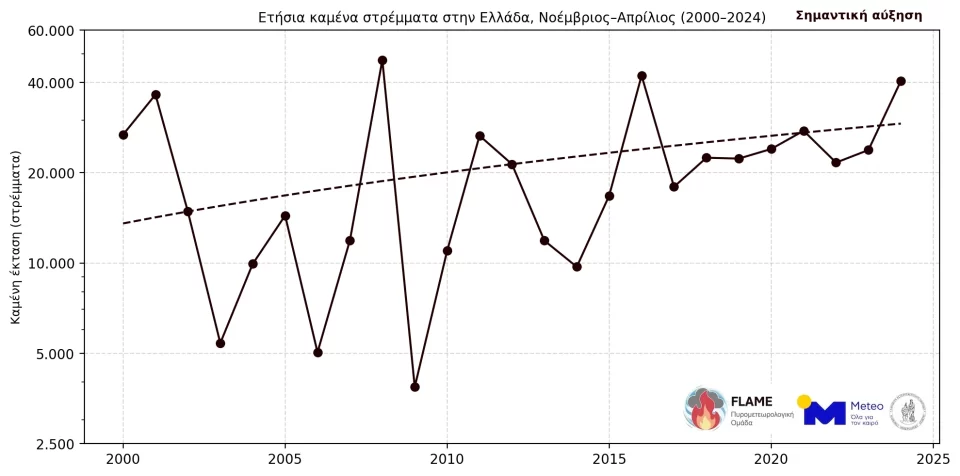
Area burned (stremmata) in Greece per year, November-April (2000-2024) / Photo Credit: FLAME
Geographic Shift of Fires in Greece
During the fire season, most of Greece saw fewer fires in 2013-2024 compared to 2000-2012. But some areas, especially in the historically low fire-risk area of northern Greece, now experience more fires during the fire season (May-October).
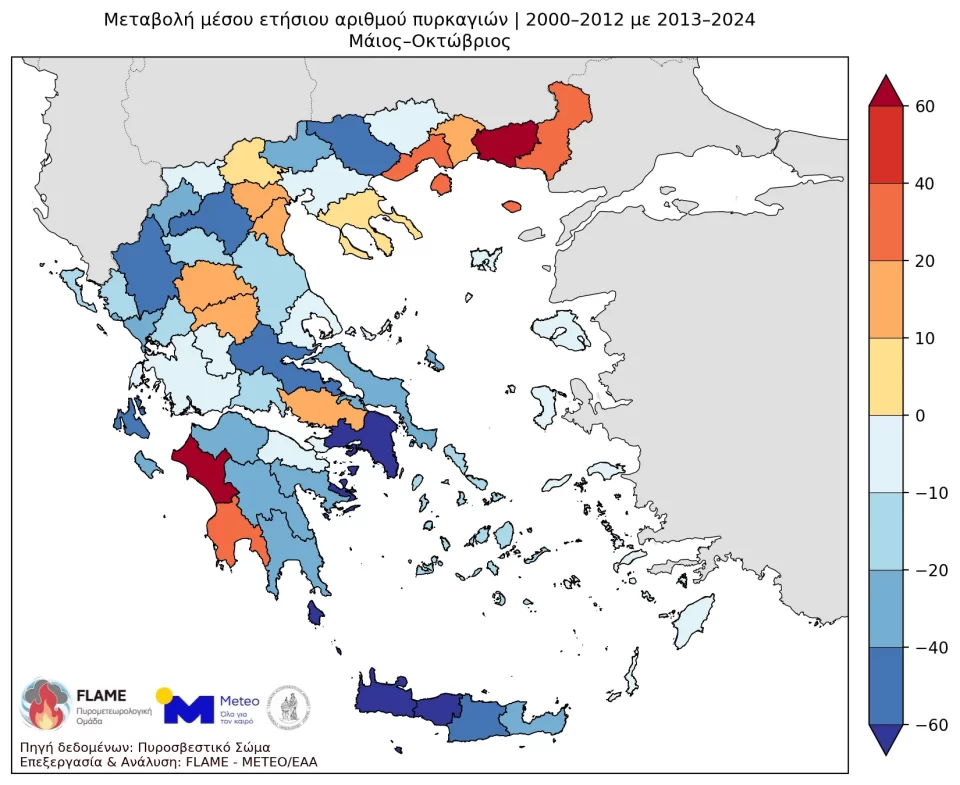
Change in average number of fires per year, May-October (2000-2012 vs 2013-2024) / Photo Credit: FLAME
More worrying is that off-season fires (November-April) are increasing throughout Greece, even in areas that were not considered particularly prone to fires.
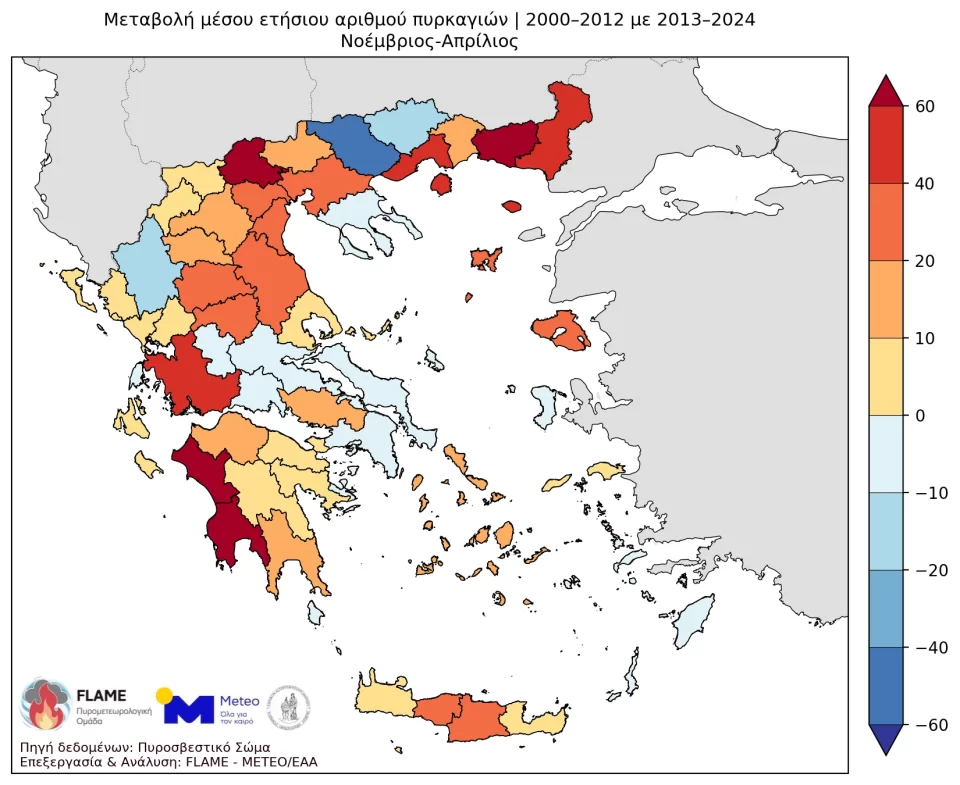
Change in average number of fires per year, November-April (2000-2012 vs 2013-2024) / Photo Credit: FLAME
The Attica region, Euboea island, Evros, Viotia and the Dodecanese islands have seen their fair share of large fire-season wildfires in the past few years – more in 2013-2024 compared to 2000-2012.
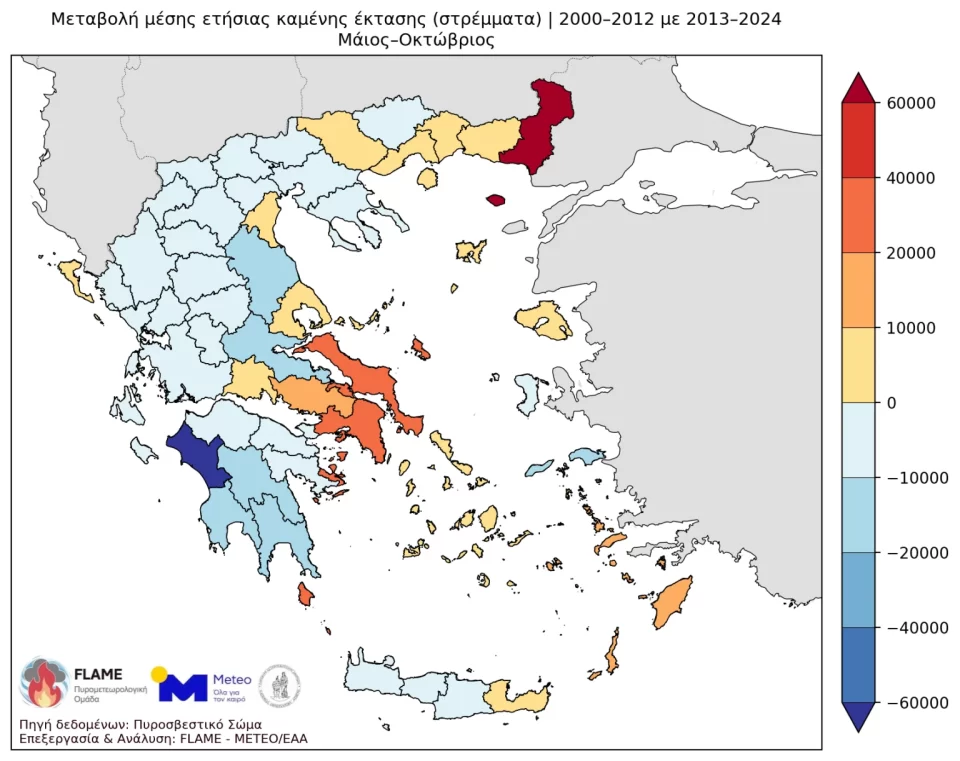
Change in average yearly area burned (stremmata), May-October (2000-2012 vs. 2013-2024) / Photo Credit: FLAME
But in the 2013-2024 off-season, there seems to be an uptick of fires throughout the entire country compared to 2000-2012.
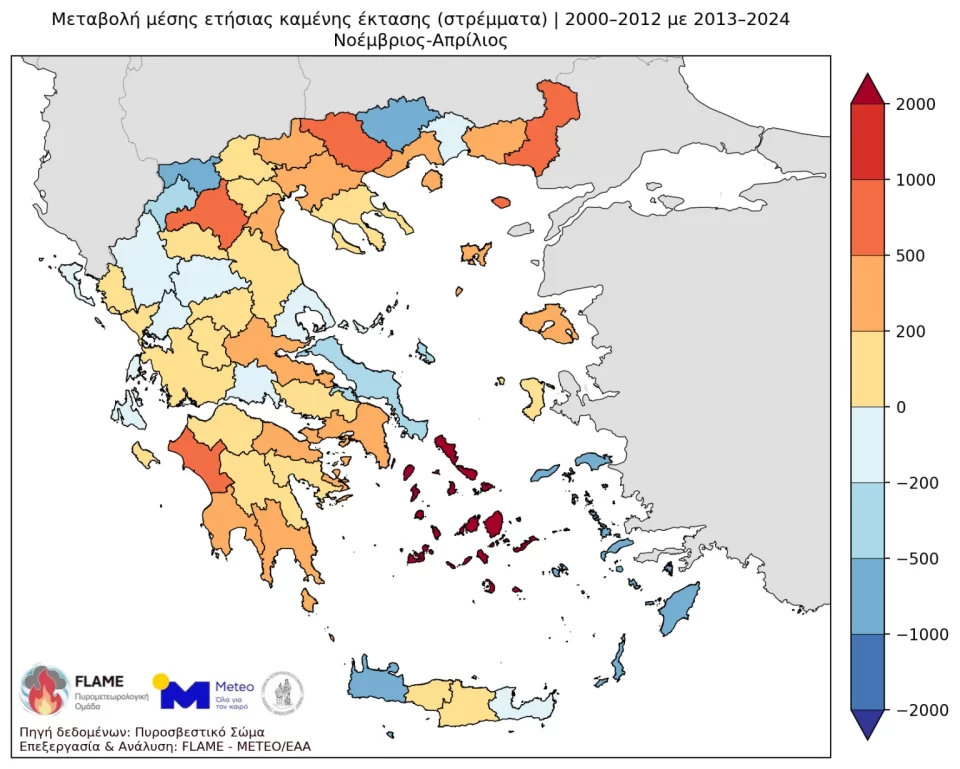
Change in average yearly area burned (stremmata), November-April (2000-2012 vs. 2013-2024) / Photo Credit: FLAME