
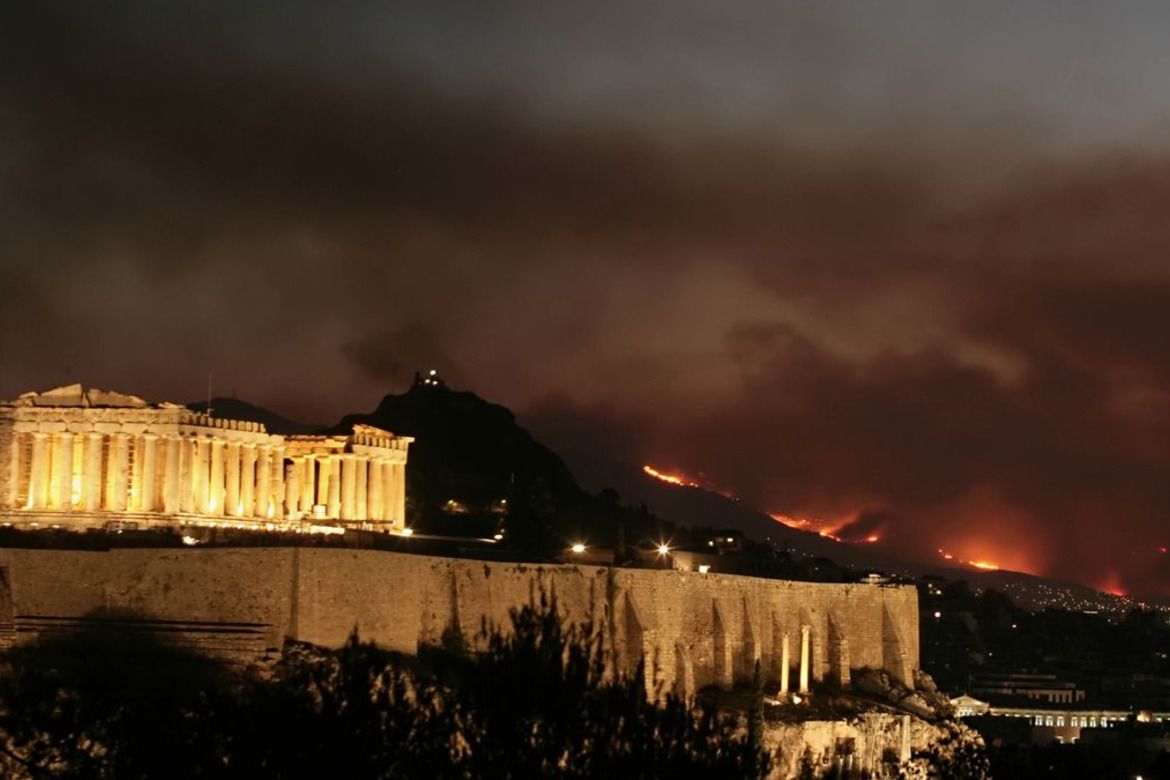
As increasingly destructive wildfires threaten archaeological sites, Greece is taking extraordinary—and sometimes uncomfortable—measures to defend its ancient heritage.
In the autumn of 1940, as war reached Greece, archaeologists and museum workers began dismantling the country’s most important collections.
Statues were lowered into trenches beneath museum floors. Smaller objects were packed into crates and hidden in basements, natural caves and bank vaults. The operation continued for six months as Greek forces fought the invading Italian army and the threat of a German assault grew closer.
By the time German officers climbed the steps of Athens’ National Archaeological Museum on April 28, 1941, they found its galleries empty.
The treasures they expected to inspect—and potentially seize—had disappeared beneath their feet.
More than eight decades later, Greece is again taking extraordinary measures to protect its ancient inheritance from an advancing threat. This time, the danger is not an invading army but wildfire: faster, more intense and increasingly capable of reaching archaeological landscapes once considered relatively secure.
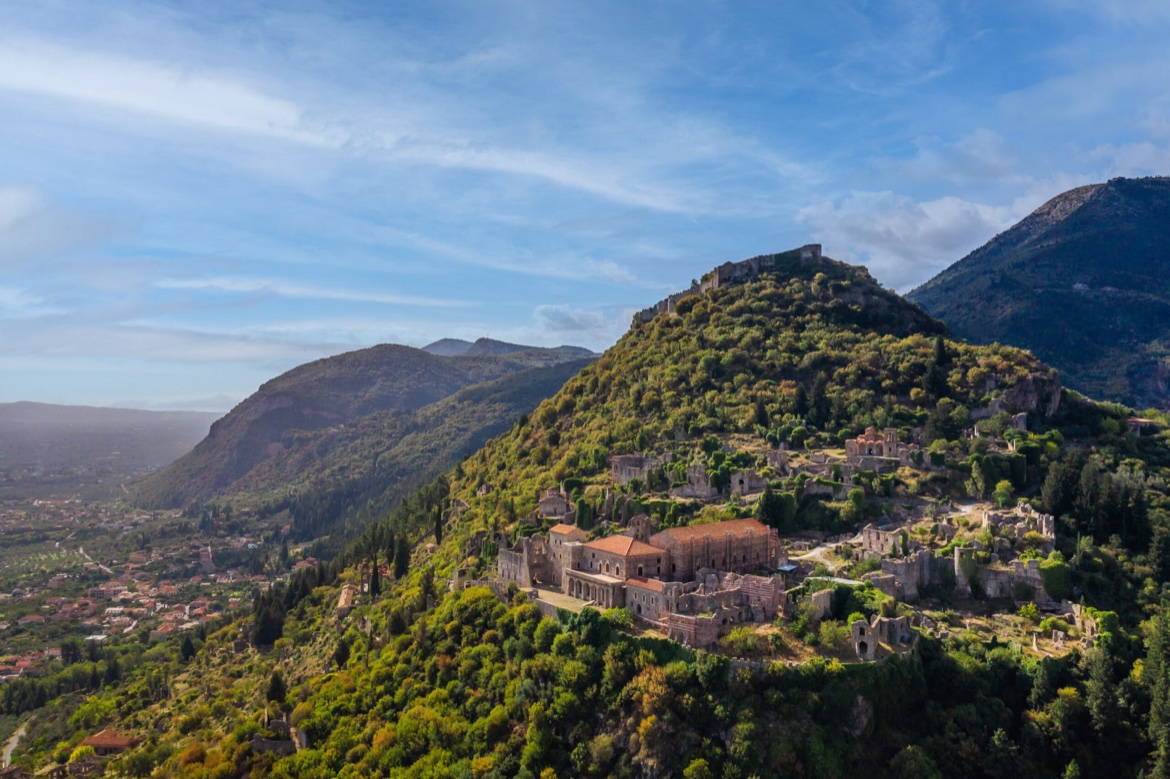
At Mystras, the sprawling Byzantine city built into the slopes of Mount Taygetus near Sparta, authorities have constructed an emergency access road through the archaeological landscape so firefighting vehicles can reach vulnerable sections of the site.
It represents an uncomfortable tradeoff. Building roads and installing heavy infrastructure within archaeological sites can disturb ground that may contain undiscovered remains. But without access for firefighters, everything still standing above that ground could be lost.
The dilemma was recently explored in a New York Times report examining how Greece is adapting its preservation practices to a threat that can no longer be treated as exceptional.
A medieval city surrounded by fuel
Mystras is not a conventional archaeological site.
Founded in the 13th century, the fortified city became one of the final great centers of Byzantine political and cultural life before the fall of Constantinople. Its palaces, monasteries, churches and walls descend across a steep, heavily vegetated mountainside.
That landscape is part of what makes Mystras extraordinary. It also makes the UNESCO World Heritage site especially difficult to defend from fire.
A wildfire approaching through the surrounding vegetation could move rapidly uphill, while the site’s narrow paths, uneven terrain and centuries-old structures limit the movement of emergency crews.
Greece has consequently installed a modern fire-suppression system at Mystras, part of a project reported to cost approximately €3 million. In July 2025, officials held a large emergency exercise there, simulating a wildfire outside the site and testing the evacuation of visitors, coordination among agencies and ability of firefighters to respond.
The exercise reflected a larger change in thinking. Protecting monuments can no longer begin after a disaster.
“The protection of monuments can no longer be limited to restoration after damage,” Climate Crisis and Civil Protection Minister Giannis Kefalogiannis said when Greece presented its broader heritage strategy. Protection, he said, must instead be built around prevention, preparedness and systematic planning.
Greece builds a digital shield around its past
Mystras is part of a developing network of fire-detection systems planned for 22 major archaeological sites, monuments and culturally important landscapes across Greece.
Eight systems were operating by August at locations including Mystras, Mycenae, Epidaurus, Ancient Olympia, Dion, Platamonas, the Temple of Aphaia on Aegina and the archaeological site of Peristeria in Messenia.
The technology combines thermal and optical cameras, including remotely operated cameras capable of providing 360-degree coverage. When a potential fire is identified, the systems can transmit images and other information directly to control centers and the Fire Service.
The network has already been tested in a real emergency.
On July 31, a system monitoring the area around Mycenae detected a fire at Fichtia in the Argolis region. It automatically issued an alert and transmitted images and data to the control center, according to reports on the expanding network.
Additional systems have been planned for sites including the Acropolis, Knossos, Delphi, Phaistos, Dodona, Ancient Messene, the Palace of Nestor, Hosios Loukas, Nicopolis, Tatoi, Mount Athos, Samothrace and Thasos.
The cameras are only one part of the defense.
New national regulations require archaeological sites to be classified according to their wildfire risk. Site managers must develop individual protection plans covering vegetation clearance, firefighter access, evacuation routes, emergency drills and personnel training.
The approach recognizes an obvious but sometimes overlooked reality: Greece’s archaeological sites are not isolated monuments displayed inside controlled environments. Many are extensive landscapes surrounded by forests, scrubland and dry vegetation.
Ancient Olympia has repeatedly faced fires in the surrounding region. Flames entered Mycenae in 2020, blackening parts of the ground around the Bronze Age citadel. Other sites confront different climate-related threats: flooding at Dion, erosion and heavy rainfall at Malia, rockfalls at Delphi and rising seas around coastal and island monuments.
A national strategy extending to 2050
Greece’s response is no longer confined to seasonal fire precautions.
In March, the government presented what it called the country’s first comprehensive national strategy for protecting cultural heritage from climate change. Developed with the National and Kapodistrian University of Athens and the National Hellenic Research Foundation, the program examines wildfires, flooding, extreme heat, landslides and coastal erosion.
The strategy is connected to a €22 million project funded through the European Union’s Recovery and Resilience Facility. Initial risk assessments have been applied to 19 archaeological sites, with climate-adaptation plans envisioned for 40 sites by 2030.
The longer planning horizon extends to 2050.
According to the government’s presentation of the program, the system is organized around four connected principles: diagnosis, monitoring, prevention and response.
That sounds bureaucratic. On the ground, it can mean cameras on ancient hillsides, water networks beside Byzantine churches, vegetation removed from archaeological landscapes and new roads cut so a fire engine has a chance of reaching the flames.
Each intervention carries risks. Infrastructure can intrude visually upon a historic landscape. Construction can disturb unexcavated archaeology. Aggressive vegetation removal can alter the environmental character of a site.
But doing nothing now carries a greater risk.
Protecting the past by disturbing it
When war came to Greece in 1940, the safest place for the country’s statues was underground.
Museum workers removed thousands of objects from display, concealed the most valuable collections and buried monumental sculptures beneath the National Archaeological Museum. Their remarkable operation ensured that the German occupiers encountered bare walls, empty display cases and floors that revealed nothing about what was hidden below.
That story is told in greater detail in “Nazi Invaders Find Empty Archaeological Museum in Athens.”
Today, the threat is different. There is no army to outwit and no surrender that will bring the danger to an end. Greece is preparing for a long struggle against conditions expected to make fires, floods, heat and erosion continuing features of archaeological preservation.
For generations, protecting antiquities often meant leaving them untouched.
In a changing climate, leaving them alone may become the more destructive choice.