

Irena Karafilly is the author of several acclaimed books, as well as of numerous short stories, articles, poems, published, anthologized, and broadcast. Her stories have won Canada’s National Magazine Award as well as the CBC Literary Award for Fiction. “Arrested Song” was a finalist for the Quebec Writers’ Federation’s Hugh MacLennan Paragraph Fiction Prize. Karafilly currently divides her time between Montreal and Athens. For more information, including readers’ reviews, please visit: irenakarafilly.com
Arrested Song is a real page-turner, but writing a historical novel that starts with the Albanian War and ends with the fall of the Junta must have been a challenging project. What made you want to do it?
I was, initially, just interested in the story of a village woman rumoured to have collaborated with the Germans during the Occupation. But this woman had lived through all the historic events of the 20th century, so I quickly realized that her story was inextricable from the story of her nation. Talking to non-Greeks, I discovered that most people knew very little about modern Greek history, so one of the things I wanted to do was tell the story of Greeks’ suffering throughout the 20th century.
Your heroine is a fascinating woman, especially considering that she spent most of her life in a remote village. Is the character based on a real person?
Yes and no. The story was inspired by a brilliant woman who was said to have also inspired the Greek classic, The Schoolmistress with the Golden Eyes. But if you read that book, you’ll see that the only two things my character has in common with Myrivilis’s heroine are her profession and the color of her eyes.
A good part of your novel is set during the German Occupation. How did Calliope Adham come to be working for the German invaders?
She was the only daughter of a headmaster, a “hazobabas” who, among other things, had taught her French and German. She was linguistically gifted, so when the Germans took over the village, she was recruited to work as their liaison officer.
One of the things that’s interesting about Callope is that she does things that most of us would agree are wrong, yet somehow you make us like and admire her. How do you explain this?
Well, a saintly character does not make for a very interesting plot. Calliope is a complex woman and, like the rest of us, she is very flawed. We admire her because of her strength of character and, of course, I’m very pleased that readers have found her likeable. I think that to like a character we have to understand him or her, and I believe that readers understand my Calliope. I also think that we like her because she is so open about her own shortcomings. She never whitewashes her own mistakes, and she suffers a lot for them. I think readers naturally sympathize with a character who suffers so much hardship.
Arrested Song is, among other things, a love story, and you keep us guessing to the very end. Is that deliberate?
What good is a novel without a love story? And what’s a good love story without obstacles? So, yes, I didn’t want to resolve it too easily. I wanted to make sure my readers kept turning pages to the very end!
What was your biggest challenge in writing this book?
I think the most difficult thing was to seamlessly weave Calliope’s personal story with the larger story; to acquaint the reader with Greece’s history and make it all compelling. It was also extremely difficult to condense several decades into a marketable length.
I’ve read somewhere that it took you about seven years to research and write this book. Was any of it fun?
Yes, when I didn’t hate it, I loved it. My first published book was a collection of Greek stories, which I wrote in Canada. I love writing about Aegean island life, especially when I’m away from Greece. I love describing village life: capturing the beauty of the island, the customs and beliefs, the colorful characters – all that gave me enormous pleasure.
You obviously know the village of Molyvos very well. How much time did you actually spend there?
About 7 years. Probably the most enriching time of my life.
Who do you think is the ideal reader for this book?
The book is of obvious interest to Greeks because it deals with issues that all Greeks care about, but you don’t have to be Greek or even a Hellenophile, to enjoy it because there are so many other elements – social, moral, political – and, at the heart of the book there is that exceptionally moving love story. Foreigners who love Greece have told me that reading my book was the next best thing to going back to the islands.
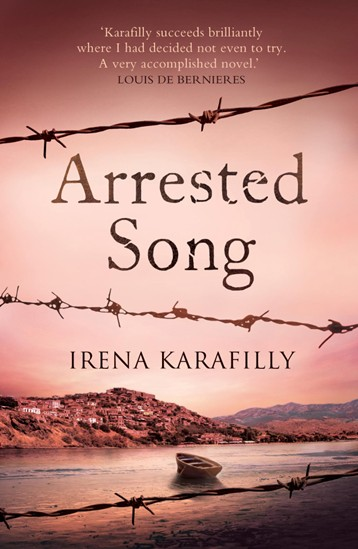
Arrested Song Cover: Photo Credit irenakarafilly.com
A somewhat longer version of this novel was originally published by Picador Australia under the title The Captive Sun.