
Plenty of books promise to transport readers to a Greek island. The better ones understand that island life is about considerably more than whitewashed houses, blue water and long lunches beside the sea.
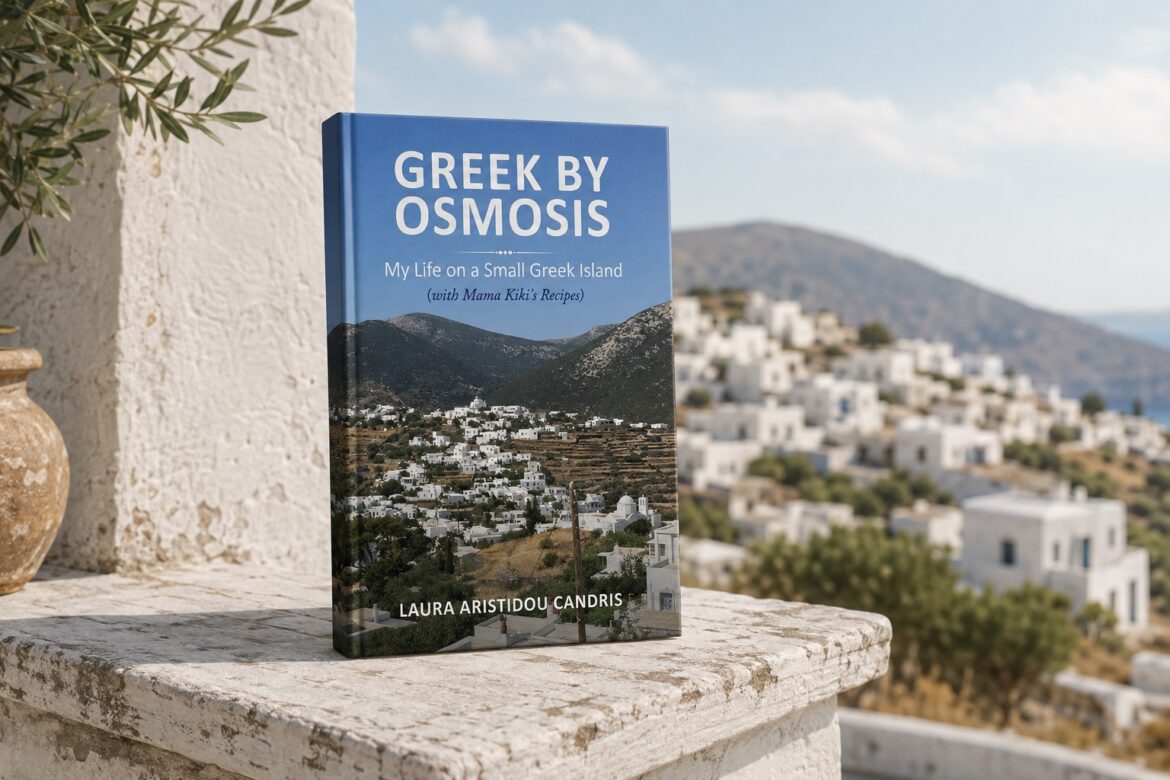
In Greek by Osmosis: My Life on a Small Greek Island (with Mama Kiki’s Recipes), Laura Aristidou Candris writes about Greece as it revealed itself to her gradually—through marriage, family, language, food, construction disasters, maddening bureaucracy and decades spent returning to the same small island in the Cyclades.
Candris was raised in Louisville, Kentucky, without any Greek background. She met Aris Candris, a Greek student, while attending Transylvania University in Lexington and married him at age 19. She first traveled to Greece in 1978 to meet his family and would continue returning for summers before the couple eventually built a house on the island in 2003.
By the time they retired there for extended stays in 2012, Candris had spent more than three decades practicing law, primarily in Pittsburgh. She was hardly arriving in Greece as an impulsive newcomer chasing a Mediterranean reinvention. She had already been observing, participating and occasionally stumbling her way through island life for decades.
That long perspective gives the book its appeal.
This is Greece encountered in small, accumulating lessons: how business gets done when there is no obvious system, how a house gets built through faxes and faith, how quickly private matters become community knowledge and how the phrase “Island Time” can be either charming or infuriating, depending on what needs to be repaired.
There are cement-eating ants, wandering goats, aggressive crows, unreliable appliances and roads that do not always survive the weather. There are cultural misunderstandings and the particular frustrations of trying to express yourself in a language that everyone around you seems to speak at twice the normal speed.
Candris writes about these episodes with affection, but she does not reduce the island to a fantasy. Her Greece is beautiful, generous and deeply social, but it can also be inconvenient, unpredictable and resistant to anyone’s carefully prepared schedule.
The stories that eventually became Greek by Osmosis began as emails Candris sent to cheer an ill friend. That origin helps explain the book’s conversational quality. The chapters feel less like a formal account of expatriate life and more like stories told across a table—usually after someone has brought out another plate of food.
Food, naturally, becomes one of the ways Candris finds her place within the family.
The book includes recipes associated with her mother-in-law, Kiki, alongside stories of learning to prepare Greek dishes under her guidance. The recipes are more than a cookbook addition attached to a memoir. They represent one of the oldest and most effective forms of cultural transmission: standing beside someone in a kitchen, watching what she does and learning the measurements that were never written down.
Mama Kiki’s presence gives the book an emotional center. Through her kitchen, Candris begins to understand not only how Greek food is made, but how care, hospitality and family memory are expressed through it.
There is a familiar category of Mediterranean memoir in which an outsider arrives, encounters an eccentric cast of locals and emerges transformed beneath an obliging southern European sun. Candris’ story is quieter and more convincing because her transformation takes place over a lifetime.
She does not become part of the island through a dramatic declaration or a single perfect summer. She gets there through repetition: returning, listening, cooking, misunderstanding, trying again and eventually becoming woven into the routines of a family and a place.
That is the “osmosis” of the title.
The book is also a portrait of a long cross-cultural marriage. Greece enters Candris’ life through Aris, but her relationship with the country eventually develops its own history—one filled with people, rituals, recipes, frustrations and loyalties that cannot be separated neatly from the marriage that first brought her there.
Published in late 2025, the 336-page memoir will feel familiar to anyone who has loved Greece long enough to recognize both sides of the bargain: the extraordinary generosity and beauty, along with the delays, detours and occasional goat standing precisely where it should not be.