
Every vintage collection needs its defining discovery — the moment that says, “Alright, this is real now.” For The Pappas Market, that moment arrived the day I found a set of four original 1960s lithographs by the great Greek printmaker A. Tassos. They were tucked quietly inside a shop, framed exactly as they were half a century ago, and radiating that unmistakable aura of something genuine, something cared for, something worth preserving.
A. Tassos — Anastasios Alevizos — wasn’t just another mid-century printmaker. He was a visual historian. His engravings chronicled a Greece that was still connected to its villages, its textiles, its folklore, its rituals, and its regional pride.
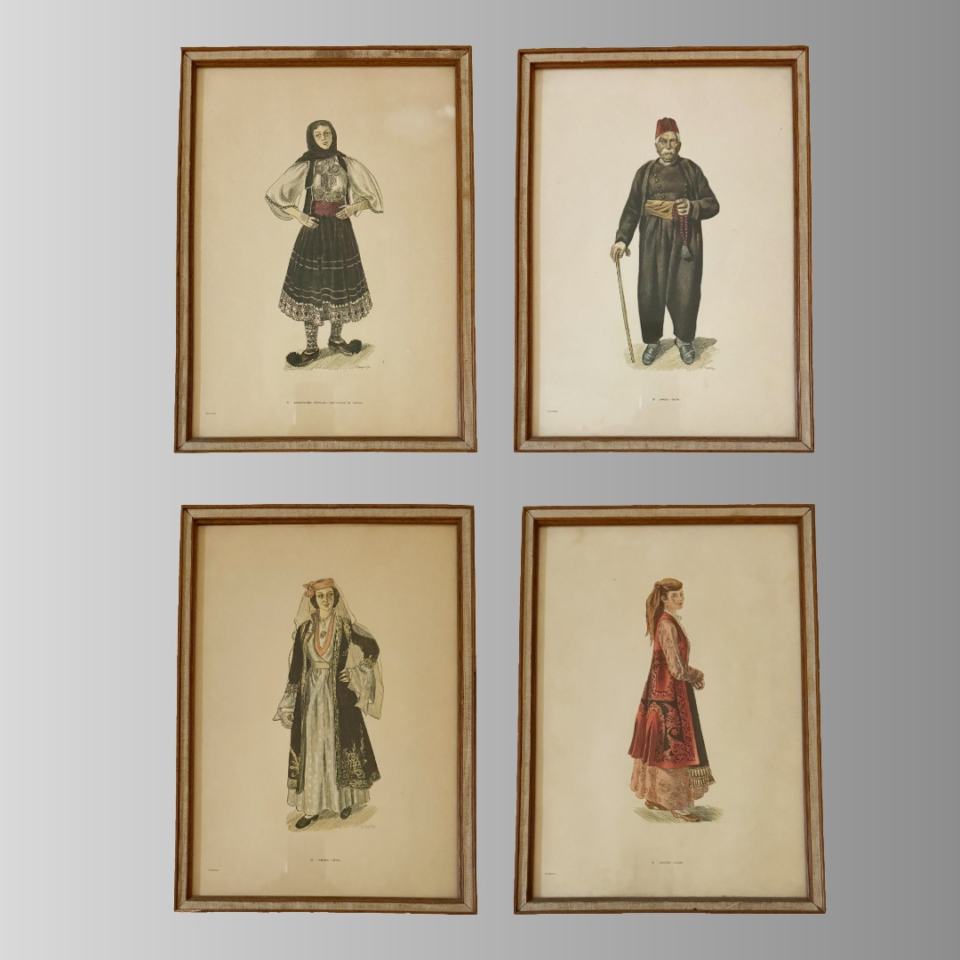
The four prints I discovered, each illustrating a traditional Greek folk costume, capture that world with stunning precision. The postures are dignified, the lines crisp, the embroidery meticulously observed. They’re ethnography rendered as art.
But their condition is what makes them extraordinary. The original mid-century wooden frames are still intact. The glass is clean. The paper has aged gracefully. Nothing has been “updated” or restored into sterility. They feel authentic because they are. Finding one would have been lucky. Finding four, still together, felt like stumbling onto a forgotten chapter of Greece’s cultural story.
These lithographs are the centerpiece of something I’ve been slowly — and somewhat accidentally — building: a Vintage Collection at The Pappas Market. It’s not a category created to fill a website. It’s a collection born from wandering. From stepping into second-hand shops in Chania. From digging through flea markets in Athens. From turning over boxes in old bookshops. From conversations with sellers who start their sentences with, “This one has a story…”
The Tassos set reminded me that Greece is overflowing with pieces like this — objects that have lived real lives and carry real heritage. The Hermes scarves from the 1980s, for example, designed by Julie Abadie to commemorate the Greek Revolution. They surfaced in pristine condition, folded with military precision for decades, waiting for someone who understands their significance to find them. Their artistry, their rarity, their unmistakable Hellenic symbolism — these scarves are collectible in the truest sense of the word.

And then there are the quiet discoveries that hit you in a different way — like the first English edition of Nikos Kazantzakis’ Christ Recrucified that I found and added to the collection. It’s not just a novel; it’s a cornerstone of modern Greek literature.
Kazantzakis’ exploration of faith, suffering, justice, and moral duty resonates now just as sharply as when the book was first published. To hold an early edition of something so culturally seismic is to feel the pulse of 20th-century Greece in your hands.

All of these pieces — the A. Tassos lithographs, the Hermes scarves, the Kazantzakis novel — form the foundations of what I hope will become a meaningful and ever-expanding part of The Pappas Market. A place where objects with soul, history, and craftsmanship are preserved and shared, one discovery at a time.
The truth is, I don’t go looking for “inventory.” I go looking for stories. And when I find something worth saving, something that deserves another life, it comes with me — from village stalls, from antique shops, from the back rooms of book dealers, from conversations that drift into the past.
The Vintage Collection is the natural result of those wanderings.
And this set of Tassos prints is its opening chapter — a beautiful reminder that Greece’s artistic, cultural, and literary heritage is still out there, waiting to be rediscovered by someone who cares enough to slow down, look closely, and say, “Yes. This belongs in our story.”