
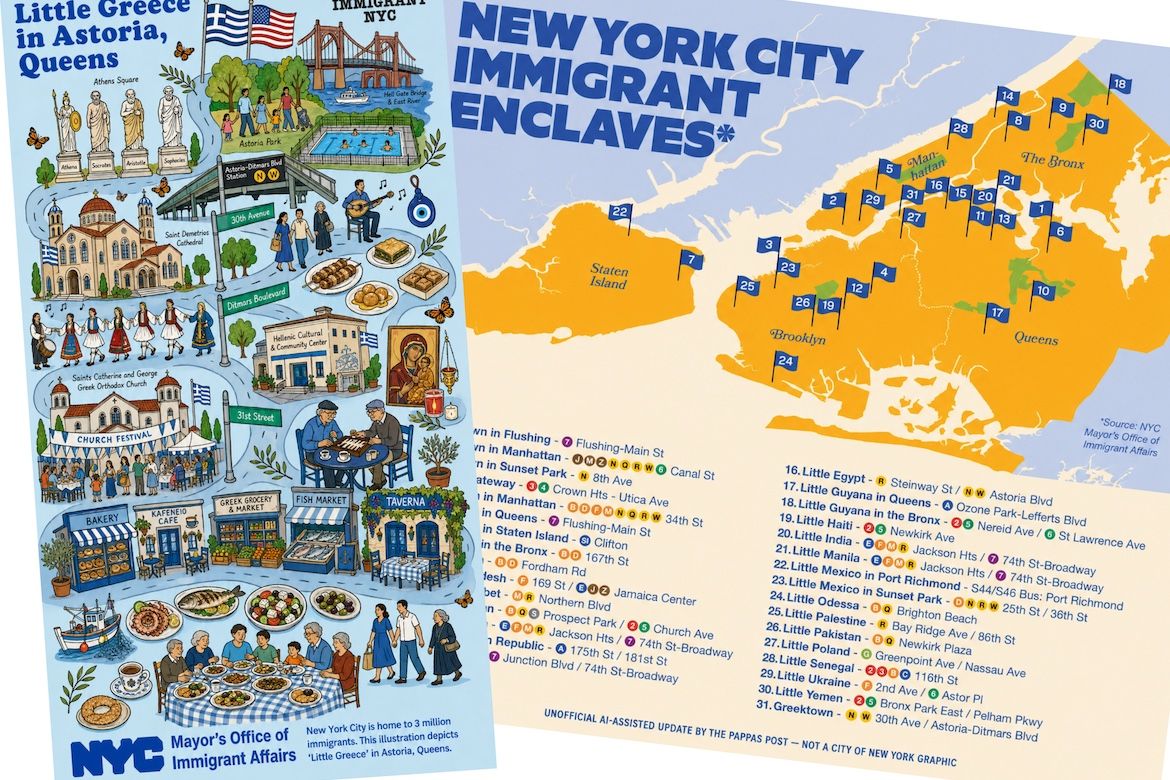
I recently came across the New York City Mayor’s Office of Immigrant Affairs’ map and wonderful series of illustrations celebrating New York City’s immigrant neighborhoods.
The graphics are colorful, affectionate and filled with the places, foods, traditions and everyday characters that make each community unmistakably its own.
According to the city, the Mayor’s Office of Immigrant Affairs team launched the Immigrant Enclave Illustration Series as part of its annual Immigrant Heritage Celebration. Its goal was to highlight the contributions, histories and cultures of immigrant communities throughout the five boroughs.
It is a worthy project meant to celebrate the extraordinary ethnic diversity that makes New York City the capital of the world.
I loved it.
But I also noticed one small omission.
Astoria’s Greektown— one of New York’s most historic and recognizable immigrant communities—was nowhere to be found on the map or among the collection of illustrations. The omission resonated with me because when I first moved to New York City, I lived on the corner of Crescent and Newtown Avenue, just steps from the Hellenic Cultural Center, minutes from numerous shops, bakeries and cultural centers that made Astoria Greektown. It’s why I moved there in the first place.
An inadvertent oversight? Surely.
Astoria was not the only community left wondering what had happened. The map prompted criticism from Italian, Jewish and Irish New Yorkers, among others. Mayor Zohran Mamdani later explained that the map was created by the previous administration in 2023, was never intended to be an exhaustive list of the city’s more than 200 ethnic communities and would be updated.
He specifically promised that Little Italy would be added.
Before that response, I had already written to the mayor about Astoria’s absence, pointing to City Hall’s own statistics about the continued prevalence of the Greek language in the neighborhood.
You can read that original article here.
I understand that running the world’s greatest city must keep the Mayor’s Office rather busy. There are budgets to balance, trains to lament, potholes to contemplate and at least several ribbon-cuttings to attend before lunch.
With so much going on, it is entirely understandable that Little Greece in Astoria might have temporarily slipped off the map.
So, in the spirit of civic cooperation—and with only the mildest amount of Greek indignation—I decided to lend City Hall a helping hand.
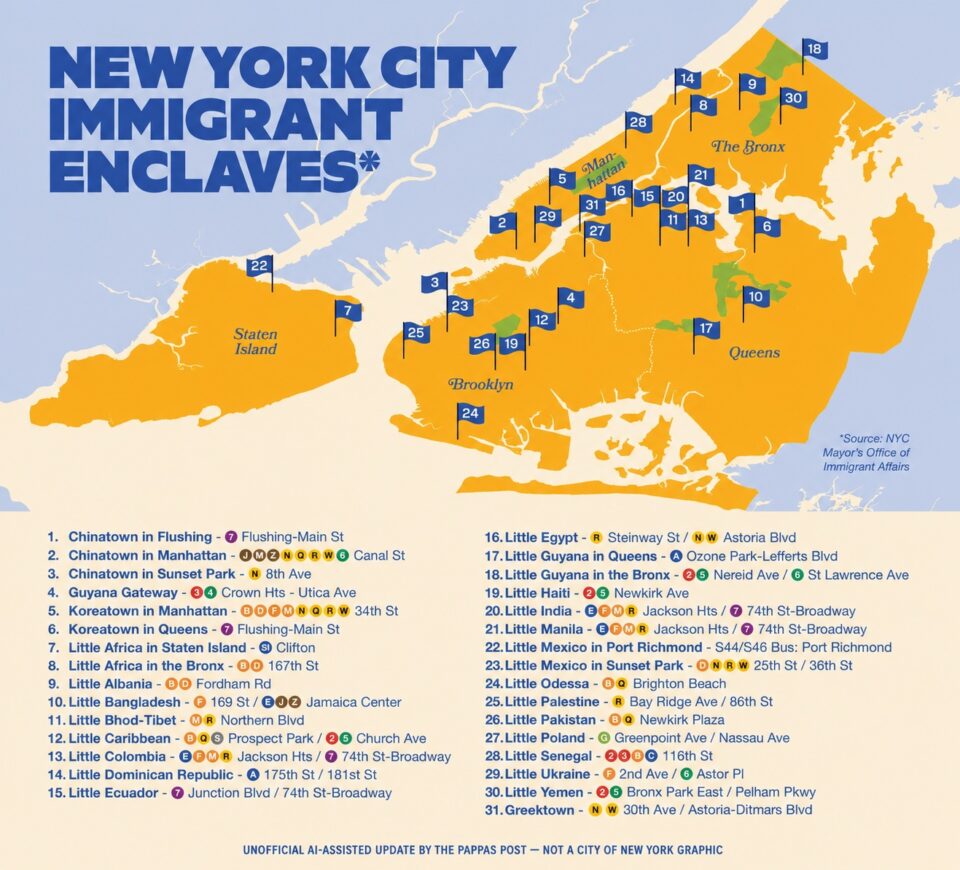
Working with our AI creative friends, I created an unofficial update to the map, placing Greektown where it belongs in Astoria.
I also created an unofficial addition to the illustration series: “Little Greece in Astoria, Queens.” The illustration brings together some of the people, places and traditions that have shaped Greek Astoria: Athens Square, Saint Demetrios Cathedral, Saints Catherine and George Greek Orthodox Church, Astoria Park, the Hell Gate Bridge, the N and W trains, neighborhood bakeries, cafés, fish markets and tavernas.
Naturally, there is also souvlaki, spanakopita, baklava, Greek coffee, grilled octopus, bouzouki music, folk dancing, backgammon, blue-and-white flags and a large family gathered around a table covered with considerably more food than anyone could reasonably finish.
In other words, Astoria.
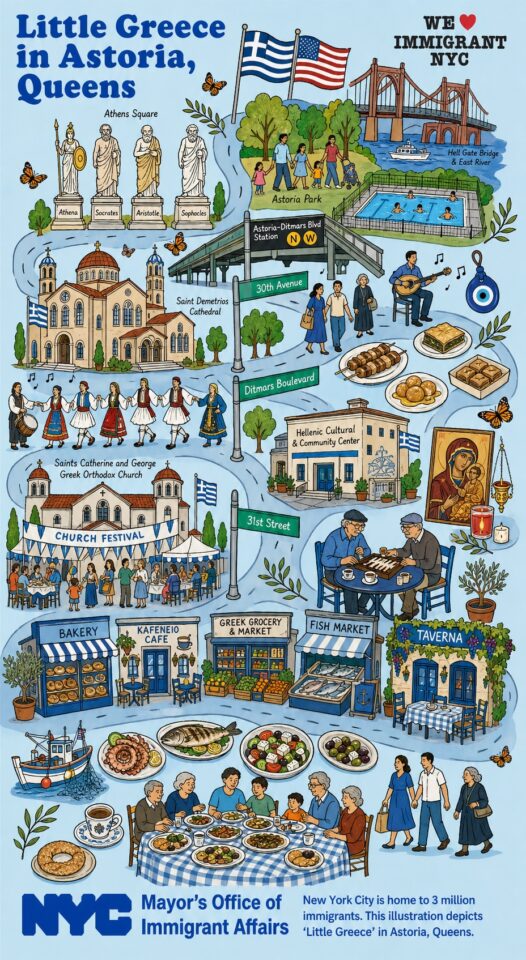
Neither the updated map nor the Astoria illustration is an official City of New York graphic, and I am not suggesting otherwise. They are affectionate, tongue-in-cheek tributes inspired by the Mayor’s Office series—and a friendly reminder that the story of immigration in New York City would be incomplete without the generations of Greeks who made Astoria their home.
No community should have to replace another on the map. New York’s immigrant history is far too rich, layered and complicated to be reduced to 30 numbered markers.
But if City Hall is already planning an update, perhaps it can make room for number 31.
We know the Mayor’s Office has a lot on its plate.
We simply thought we would add a little feta.
You’re welcome, Mr. Mayor.
FULL DISCLOSURE: The updated map and “Little Greece in Astoria, Queens” illustration accompanying this article are unofficial images created with the assistance of generative artificial intelligence. AI was used to interpret the visual language of the existing immigrant-neighborhood series and produce an original representation of Greek Astoria. The concept, cultural direction, landmark selection, prompts and final creative guidance were provided by The Pappas Post. The underlying map and the original immigrant-enclave illustrations are credited to the New York City Mayor’s Office of Immigrant Affairs. The AI-assisted images are intended as good-natured civic and cultural commentary. They are not affiliated with, endorsed by or produced by the City of New York or the Mayor’s Office of Immigrant Affairs.