
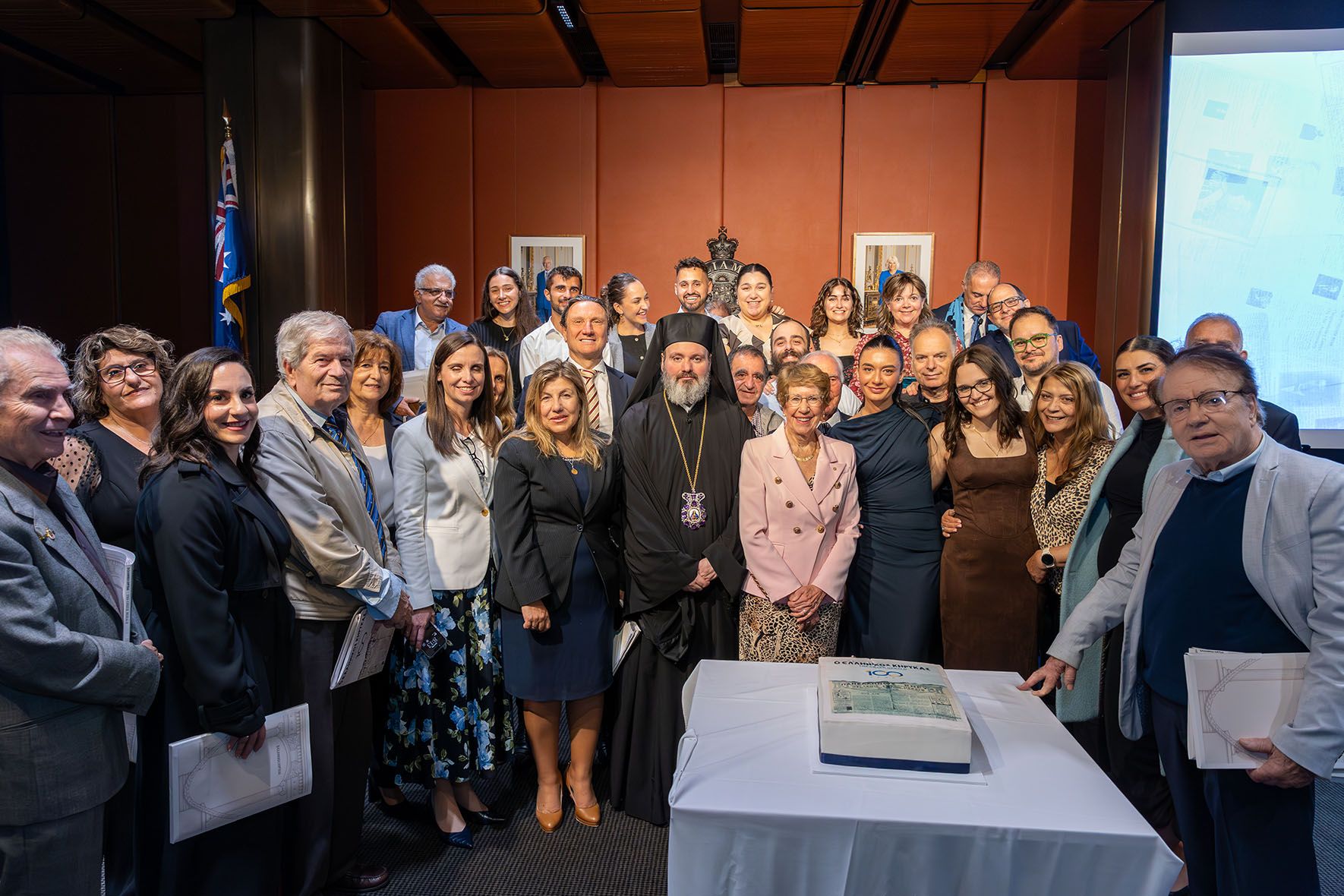
The Greek Herald (Ελληνικός Κήρυκας) recently celebrated its 100th anniversary with a formal event at the New South Wales Parliament that was attended by dignitaries including Australian NSW Governor Margaret Beazley, Cyprus High Commissioner Antonis Sammoutis, and Greece’s Consul General George Skemperis.
At the event, the historic Greek newspaper also received written accolades from the national leaders of both Australia and Greece. Australian Prime Minister Anthony Albanese praised the publication for enriching the lives of its readers and adding to “the cohesion of our nation,” while Greek Prime Minister Kyriakos Mitsotakis commended the paper for having forged a “living bond between Greece and Australia”.
The Greek Herald’s century of continuous publication began in Sydney on November 16, 1926, when founders George Marcellos and John Stilson launched the paper under its original name, Πανελλήνιος Κήρυξ (Panellinios Kiryx).
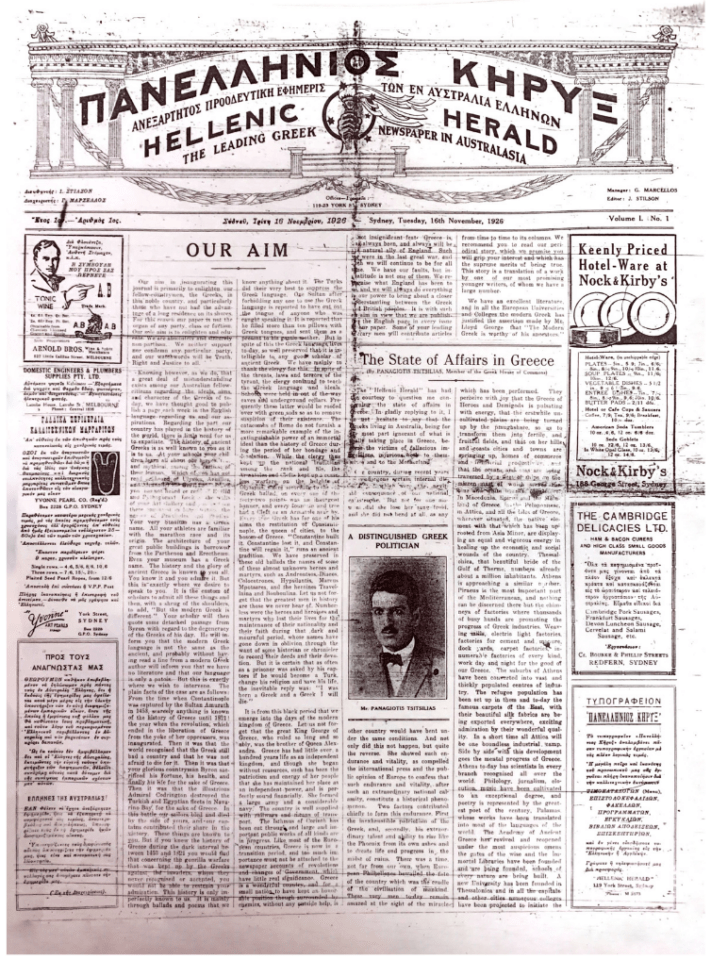
The front page of The Hellenic Herald, November 16, 1926 / Photo Credit: Hellenic Herald
In its inaugural English-language article titled “Our Aim”, the newspaper outlined its mission to “enlighten our fellow-countrymen, the Greeks, in this noble country, and particularly those who have not had the advantage of long residence on these shores… and our watchword will be ‘Truth, Right and Justice to all'”.
The newspaper challenged authority structures, mediated disputes and promoted political reconciliation within the community itself, providing the platform by which difficult or even divisive topics were discussed. The Greek Herald never shied away from adopting a forceful, political and often confrontational style that resonated strongly with the working-class diaspora – the ξυπόλυτοι (Barefooted) whom the newspaper defended from domination by the clergy, diplomats and the wealthy communal elites.
The newspaper’s advocacy role expanded significantly during World War II, when The Greek Herald championed the fighting ANZACs and celebrated the sacrifices of Australian and New Zealand soldiers on Greek soil. It documented the first victory of the Greeks against fascists and Nazis in the mountains of Albania, while its Greek-language editorials were even republished by The Sydney Morning Herald, in a call on all Australian citizens to celebrate “Greece Day” with parades.
Following the war, The Greek Herald served as a compass for a massive wave of new migrants. It meticulously documented the establishment of Greek schools, churches, and associations. To achieve this, the publishers appointed correspondents, representatives, and journalists who broadcast from 48 different locations across Australia, reporting on local social, political, cultural, and sporting events for the rapidly growing diaspora.
Beyond news reporting, The Greek Herald actively shaped the Greek diaspora by launching the very first correspondence-style Greek language learning initiative in 1961. By this time, the publication also served as a dedicated center for the protection of immigrants against mistreatment, xenophobia and racism.
In 1971, The Greek Herald was acquired by Theodoros Skalkos, initiating a 55-year period of leadership by the Skalkos family. In his four-decade-long tenure, the Greek-Australian entrepreneur modernised the newspaper, introducing phototypesetting and color editions. Skalkos’ printing capabilities became so robust that, during an Australian paper shortage, he stepped in to print media mogul Rupert Murdoch’s publications for a whole seven weeks.
During Greece’s seven-year military dictatorship, the newspaper stood its ground and defended democracy, even though it lost 30% of its advertising revenue in just a couple of months due to pressure from the Greek government.
By the late 2010s to 2020s, The Greek Herald evolved into a bilingual, digital newsroom while also preserving its historic Greek-language print edition. Following her father’s passing, Dimitra Skalkos took over The Greek Herald as Publisher and Managing Director.
Together with Digital Editor Andriana Simos, the newspaper has sought to achieve the immediacy of modern news outlets, while at the same time maintaining that tangible emotional connection that comes with physical print—and not just for the older generation of readers.
Today, having printed over 550,000 pages since its inception, The Greek Herald ranks as the eighth oldest newspaper of ecumenical Hellenism in the world. It also remains the only Greek-language daily newspaper published outside of Greece and Cyprus.
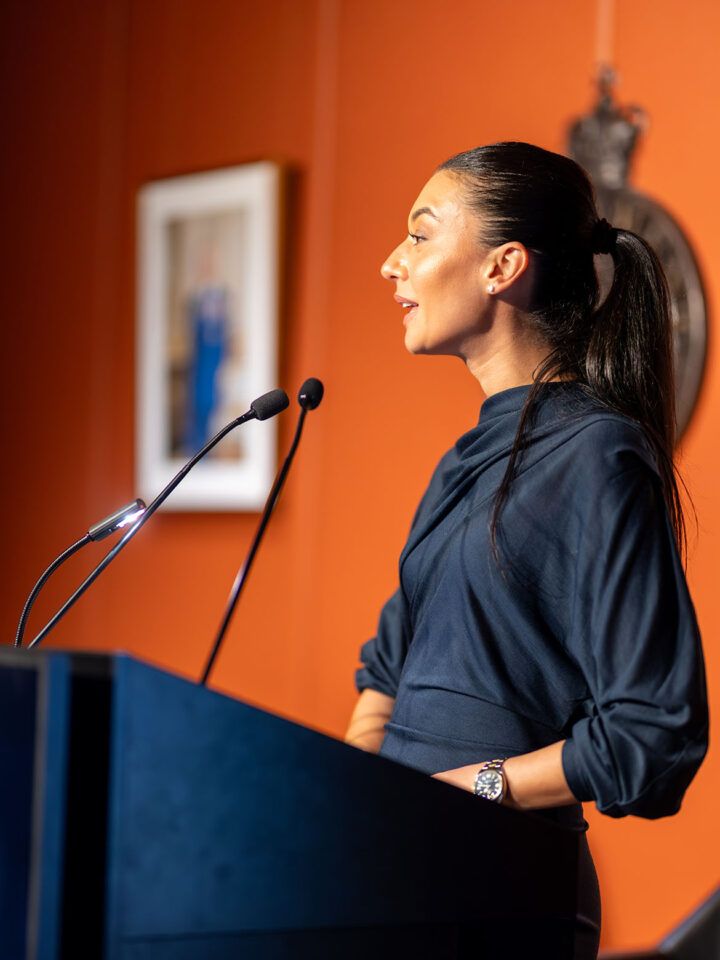
Dimitra Skalkos / Photo Credit: The Hellenic Herald
Reflecting on the newspaper’s endurance, Dimitra Skalkos noted that The Greek Herald does not just record history, but also preserves identity—making its legacy worth carrying forward.
“This entire centenary is not about one person alone, it belongs to our community, to the people before us, who built something from nothing, and to those that carried it forward decade after decade… if we’re being honest the Greek Herald was built by a community and sustained by the community and standing here tonight 100 years later that is something very special.”
“If a story of ours has ever informed you, entertained you, advocated for something you care about, connected you to a thought or community, made you feel or care about something, even once, then that is enough to understand why institutions like us continue to matter,” she concluded.
Cover Photo Credit: The Hellenic Herald