
A major conservation project will add 45,000 cubic meters of sand and gravel to Navagio Beach before restoration begins on the rapidly deteriorating shipwreck. The landmark, however, will remain closed to visitors throughout the 2026 summer season.
One of the most recognizable landscapes in Greece is about to undergo its most dramatic transformation in decades.
Greek authorities have launched a multi-million-euro effort to protect Navagio Beach on the island of Zakynthos, where coastal erosion, powerful winter waves and the gradual collapse of the rusting shipwreck have threatened the future of the internationally famous landmark.
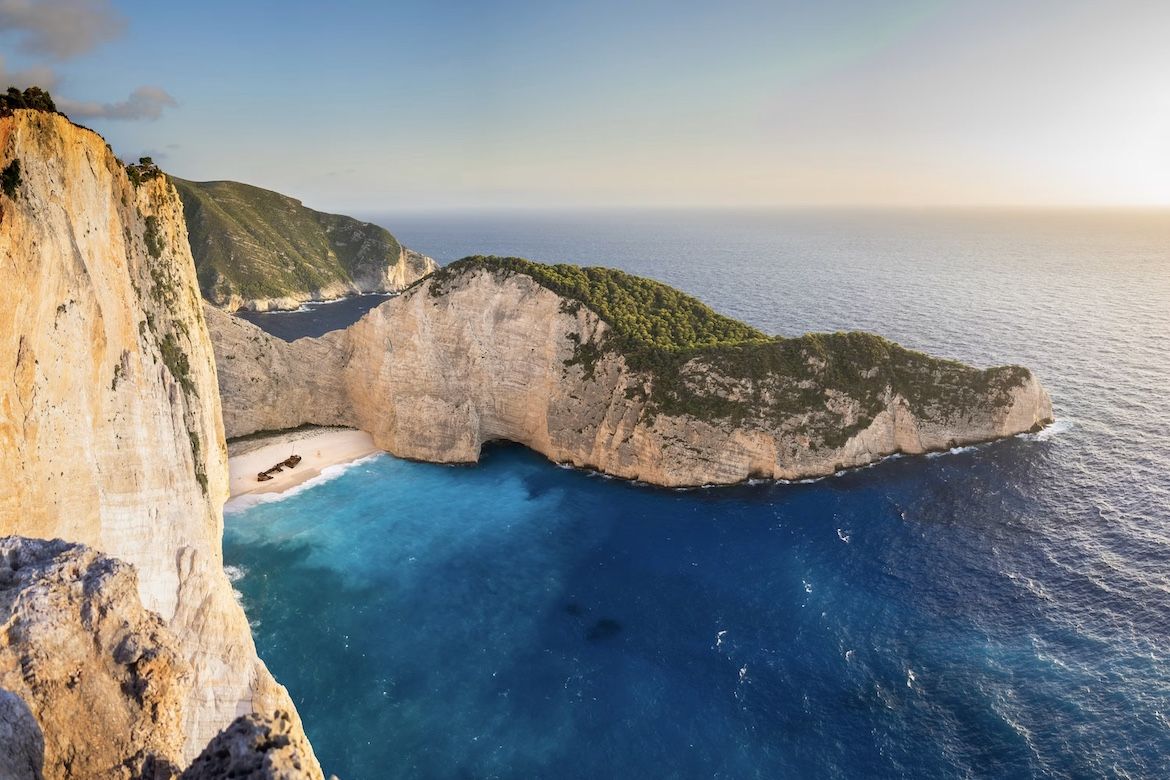
The first phase of the project calls for extending the beach approximately 30 meters toward the Ionian Sea by adding about 45,000 cubic meters of coarse sand and gravel along its 193-meter shoreline. The work is intended to create a larger buffer between the sea and the remains of the cargo ship Panagiotis, which currently sits only about 25 meters from the water.
The €3.9 million project was recently put out to tender by Greece’s Growthfund on behalf of the Municipality of Zakynthos. It is based on a coastal engineering study completed without charge by an interdisciplinary team from the National Technical University of Athens.
Researchers studied the site’s waves, currents and underwater topography before recommending what engineers describe as “beach nourishment”—the placement of new sediment along an eroding shoreline.
Because conventional structures such as breakwaters or artificial reefs are not considered suitable for the enclosed cove, engineers concluded that enlarging the beach would provide more space for the energy of incoming waves to dissipate before reaching the shipwreck.
The sand and gravel will be transported by barge from the port of Agios Nikolaos Volimon and deposited near the shoreline. Floating cranes will then distribute the material along the length of the beach and into the sea, reaching approximately 30 meters offshore and depths of up to seven meters.
Silt curtains are expected to surround the construction area in an effort to limit clouding and reduce the project’s impact on the surrounding marine environment. Because the cove lies within a protected Natura area, a special ecological assessment will also be conducted.
Once the shoreline expansion is completed, authorities plan to open a second tender for the conservation and partial reconstruction of the Panagiotis. Sections of the ship have already collapsed, while decades of exposure to saltwater, storms and sea air have severely corroded its hull.
That second phase is expected to reinforce the remaining structure and replace missing sections in an effort to return the ship closer to the form visitors recognize from millions of photographs. The restoration has been estimated at approximately €2.5 million, although final costs will depend on the tender and the extent of the deterioration discovered during the work.
The vessel ran aground in the secluded cove in October 1980. Frequently described as a cigarette-smuggling ship, the wreck transformed an isolated strip of coastline on northwestern Zakynthos into one of the most photographed beaches in the world and an enduring symbol of Greek tourism.
Forty-six years later, however, the image that made the beach famous is steadily disappearing. Large portions of the ship’s metal frame have disintegrated, while waves have continued to reshape the narrow shoreline surrounding it.
The intervention is not without controversy.
Some scientists have questioned whether placing tens of thousands of cubic meters of quarry material in the cove can truly be characterized as a gentle environmental intervention—or whether the material will simply be carried away by the same forces that have shaped the beach for centuries.
Manolis Vassilakis, a geology professor at the University of Athens who has studied the area’s unstable cliffs, has described the project as a significant human intervention designed primarily to preserve a tourism symbol. Engineers behind the plan acknowledge that the new material must be monitored for at least two years to determine how quickly it is displaced by waves and currents.
The project also should not be confused with efforts to make the beach safe for visitors.
Navagio remains closed throughout the 2026 summer season because of the danger posed by rockfalls and landslides from the towering limestone cliffs surrounding the cove. Visitors are prohibited from entering the beach or swimming near it, and boats must remain at least 50 meters from shore through October 31.
The restrictions followed assessments by Greece’s Earthquake Planning and Protection Organization, which classified the area as carrying a high risk of extensive landslides. Seven people were injured when part of the cliff collapsed in 2018, while a magnitude 5.4 earthquake triggered another landslide in 2022.
For now, the beach can be viewed only from the designated observation platform above the cove, subject to fencing and other safety measures. Authorities reassess conditions twice each year, but the shoreline conservation project does not guarantee that visitors will soon be permitted to return to the sand.
Responsibility for the wider management of Navagio has now been transferred to the Municipality of Zakynthos. In January, the municipality signed an agreement with the Ministry of National Economy and Finance giving it responsibility for supervising and accepting the restoration work.
Zakynthos Mayor Giorgos Stasinopoulos said the municipality intends to pursue an integrated plan combining environmental protection, visitor safety and the preservation of the shipwreck.
“The Navagio is not only the leading tourist attraction of Zakynthos,” Stasinopoulos said. “It is a global symbol of our island, a unique natural and cultural asset that we must protect and pass on safely and upgraded to future generations.”
The engineering challenge is considerable. Authorities are attempting to preserve a decaying human-made object inside a landscape that is itself constantly changing—and whose cliffs, waves and winter storms cannot simply be engineered away.
Still, after years of closures, disputes over responsibility and warnings that the wreck could eventually collapse beyond repair, Greece finally has a funded plan in motion to protect the image that put Zakynthos on postcards around the world.