
From DESTE’s former slaughterhouse on Hydra to museums and galleries in Athens, Poros, Andros and beyond, a new cultural itinerary is drawing major artists—and the collectors, curators and travelers who follow them—to Greece.
For generations, the cultural pilgrimage to Greece followed a familiar path: the Acropolis, the National Archaeological Museum, Delphi, Olympia and the country’s extraordinary collections of ancient and Byzantine art.
That journey remains essential. But another itinerary is now taking shape—one that may begin inside a converted factory in an Athenian neighborhood, continue to an abandoned slaughterhouse overlooking the sea on Hydra and lead onward to contemporary installations appearing inside archaeological museums, medieval cities and island schools.
A recent report in Galerie explored why the international art world is increasingly converging on Greece, attracted not only by the country’s islands and hospitality but by a rapidly expanding contemporary art landscape.
The development is more than a fashionable summer trend. Greece is becoming a place where major artists create work specifically for the country, international collectors organize their travel around exhibition openings and historic spaces are reimagined as settings for contemporary ideas.
At the center of this transformation is the DESTE Foundation for Contemporary Art, established in 1983 by Greek Cypriot collector Dakis Joannou. Its name derives from the Greek word deste—“look” or “see”—an appropriate command for an institution that has spent more than four decades challenging audiences to look beyond conventional definitions of Greek culture.
DESTE’s Athens headquarters is itself part of the story. Located in Nea Ionia, away from the traditional museum corridor of central Athens, the institution occupies a former sock factory built in 1931 and renovated by Greek architect Christos Papoulias.
Since moving there in 2006, DESTE has presented exhibitions drawn from the Dakis Joannou Collection alongside commissions, collaborations and projects involving some of contemporary art’s most influential figures.
This summer, DESTE’s programming stretches across Athens and Hydra with three markedly different exhibitions.
At the foundation’s Athens space, “Gen X: Tales from the Forgotten Generation” brings together works from the Dakis Joannou Collection by artists born between 1960 and 1980.
Curated by Massimiliano Gioni, artistic director of New York’s New Museum, together with Calvin Wang and Taeyi Kim, the exhibition explores a generation shaped by economic uncertainty, changing media and the transition from an analog world dominated by television, video and cinema into one transformed by the internet and digital technology.
Its title draws from Douglas Coupland’s influential 1991 novel Generation X: Tales for an Accelerated Culture. Rather than treating the generation merely as a demographic category, the exhibition examines the instability, detachment and dark humor that emerged between the optimism associated with the postwar baby boom and the digitally saturated culture inherited by millennials.
DESTE has also extended its presence into the Benaki Museum of Greek Culture, where the haunting paintings of Polish artist Aleksandra Waliszewska have been placed among objects spanning Neolithic Greece, Classical Antiquity, the Byzantine era and modern Greek history.
Curated by Alison M. Gingeras, “Irruption of Antiquity” presents contemporary paintings across two floors of the museum. Ancient myths, gods, symbols and visual forms appear not as relics isolated in the past but as forces that continue to enter—and sometimes disturb—the modern imagination.
The exhibition captures one of the most compelling characteristics of Greece’s contemporary art movement. New work is not attempting to escape the enormous weight of antiquity. Artists and curators are confronting it, questioning it and placing the past into direct conversation with the present.
The Slaughterhouse That Changed Hydra
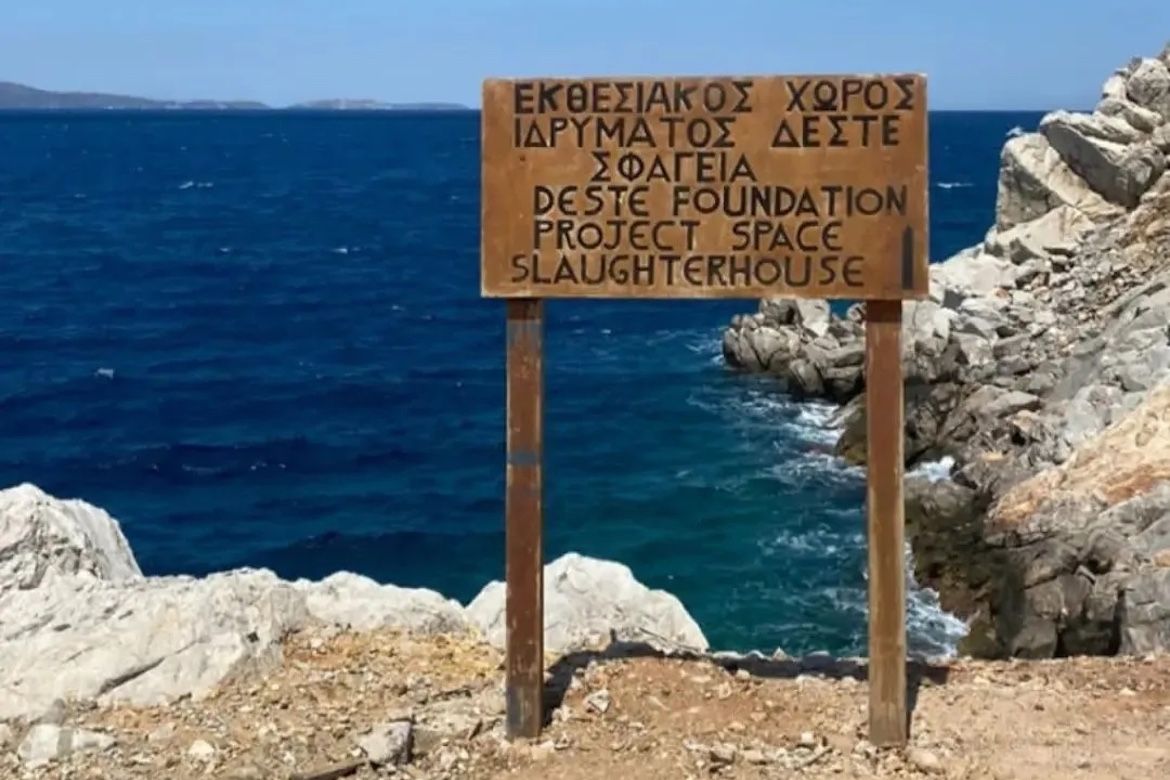
DESTE’s most internationally recognized contribution to Greece’s contemporary art identity may be found on Hydra, where a former slaughterhouse perched above the sea has become one of the art world’s most anticipated summer destinations.
Every summer since 2009, DESTE has invited an artist or group of artists to create a project for the raw stone building. The DESTE Slaughterhouse project space has hosted work by Maurizio Cattelan, Urs Fischer, Kara Walker, Kiki Smith, Jeff Koons, George Condo and Andra Ursuţa, among others.
The building’s isolation, physical history and relationship with the surrounding sea make it more than an exhibition room. Artists must respond to a space that remains inseparable from the island around it.
The annual opening, traditionally held soon after Art Basel concludes in Switzerland, has developed into an international ritual. Artists, museum directors, curators, gallery owners and collectors travel from Athens to Hydra, turning the island into a temporary meeting place for some of the most influential figures in contemporary art.
What began as an unconventional island project has helped position Hydra alongside established summer art destinations in Europe and the Mediterranean.
This year, Jamaican-born, New York-based artist Nari Ward has transformed the Slaughterhouse with “Until That Day”, a site-specific exhibition addressing migration, racial identity, memory, labor and belonging.
Ward is known for turning discarded and everyday materials into monumental sculptural installations. On Hydra, fire hoses, luggage, emergency blankets, keys, copper, scorched wood and other found objects carry the traces of movement, crisis and displaced lives.
Among the works are Fire Hose Man, a towering form built from old luggage bound together with fire hoses, and Power Anchor (For Jack Whitten), dedicated to the influential African American artist whose own work examined memory, transformation and the African diaspora.
The exhibition’s title refers to Ethiopian Emperor Haile Selassie’s 1963 address to the United Nations calling for equality and international solidarity—a speech later adapted into Bob Marley’s song “War.”
Ward connects that history with the experiences and contributions of African and Afro-Greek communities, bringing questions of migration and belonging into a country that has long stood at a crossroads between continents.
For the opening, Ward collaborated with Athens-based singer Aggelos Aggelou and other Afro-Greek performers, bringing rebetika into conversation with African diasporic musical traditions. The result transformed the Slaughterhouse from an exhibition site into a place of performance, remembrance and communal participation.
Athens Builds a Contemporary Cultural Capital
DESTE is only one part of a much larger transformation taking place across Athens.
The National Museum of Contemporary Art Athens, known as EMST, now operates from the former FIX brewery, one of the capital’s most recognizable modern industrial buildings.
After years of delays, the museum fully opened its permanent home in 2020 and has increasingly positioned itself as a cultural bridge between Greece, Southeastern Europe, the Balkans, the Middle East and the wider Mediterranean.
Its exhibition “South by Southeast: Re-Orienting the Collection” includes more than 100 works by 50 artists from over 20 countries.
The exhibition consciously rejects the idea of Greece as a peripheral edge of Western Europe. Instead, it presents the country as a central point within a region shaped by migration, exchange, displacement, conflict and overlapping identities.
Nearby in Pangrati, the Basil and Elise Goulandris Foundation has given Athens a permanent museum where works by Cézanne, Van Gogh, Gauguin, Monet, Picasso, Braque, Miró and Giacometti appear beside major Greek artists including Parthenis, Bouzianis, Hadjikyriakos-Ghika, Tsarouchis, Moralis and Tetsis.
The museum’s temporary exhibitions further connect internationally significant modern art with Greece’s own artistic history. Its presentation of “Jannis Psychopedis: Landscapes of Memory—The Ones I Kept”, for example, traces the artist’s life through the political upheavals of the 1960s, Greece’s military dictatorship, his years in Germany and his eventual return to Greece.
The privately operated George Economou Collection has also become an important stop on the Athens art circuit, presenting exhibitions built around major international artists and movements from the 20th and 21st centuries.
Its programming places artists such as Louise Bourgeois, David Hockney, Charles Ray, Lorna Simpson and Katharina Fritsch within conversations about contemporary life, history, identity and mythology.
Athens also draws galleries, collectors and curators through Art Athina, one of Europe’s longest-running contemporary art fairs.
The fair gives Greek galleries and independent spaces access to an international audience while bringing collectors into direct contact with the country’s active gallery scene.
Contemporary Art Moves Across the Islands
The contemporary art movement is no longer confined to Athens and Hydra.
The Museum of Contemporary Art in Andros, established by the Basil and Elise Goulandris Foundation in 1979, was Greece’s first museum devoted to contemporary art.
Long before island exhibitions became fashionable, the Goulandris Museum of Contemporary Art in Andros was presenting internationally important artists including Matisse, Kandinsky, Giacometti, Chagall, Rodin, Picasso and Miró in the Cyclades.
Its exhibitions continue to turn Andros into an important cultural destination, giving travelers another reason to experience a Greek island beyond the familiar summer itinerary of beaches, restaurants and nightlife.
On Poros, CITRONNE Gallery has built a summer program that moves contemporary art into both a dedicated gallery and the island’s archaeological museum.
Since 2013, CITRONNE and the Ephorate of Antiquities of Piraeus and Islands have invited Greek artists to create contemporary interventions responding to objects in the Archaeological Museum of Poros.
In “Traces,” by Nikos Podias, delicate materials including paper, used tea bags and aluminum foil are placed beside ancient marble, metal and clay.
Fragility meets endurance, while light and shadow connect objects separated by centuries.
CITRONNE’s presence on Poros demonstrates how contemporary art can become rooted in an island without overwhelming its existing cultural identity. Rather than competing with archaeology or history, the gallery’s exhibitions encourage visitors to see familiar objects and landscapes through a different lens.
One of the most significant forces behind the broader expansion of contemporary art in Greece has been NEON, founded by collector and philanthropist Dimitris Daskalopoulos.
Rather than maintaining a single permanent museum, NEON has used Athens and the rest of Greece as its exhibition space.
The organization has presented contemporary work inside archaeological sites, historic buildings and public spaces, helping dismantle the idea that contemporary culture belongs only inside conventional galleries.
NEON also supported the renovation of the former Public Tobacco Factory in Athens, transforming the industrial building into an important setting for exhibitions and cultural events.
This approach has helped create an art landscape that is decentralized and deeply connected to place. A visitor may encounter contemporary art in a former factory, an archaeological museum, a school building, an island port, a historic mansion or a structure once used as a slaughterhouse.
The setting is not merely decorative. It becomes part of the artwork and part of the experience.
A New Reason to Travel to Greece
Greece’s greatest advantage as a contemporary art destination may be its refusal—or perhaps its inability—to separate the present from the past.
Its artists and institutions are turning history, landscape, abandoned industry, island architecture and archaeological collections into active elements of contemporary creation.
The result is not a rejection of antiquity, but an expansion of Greece’s cultural story.
Visitors are still coming for the Parthenon, Delphi and the masterpieces of the ancient world. Increasingly, however, they are also arriving for exhibition openings in Hydra, installations in Poros, museum programs in Andros, art fairs in Athens and projects presented in unexpected locations across the country.
The collectors, curators and artists who follow these events bring international attention, cultural investment and a different kind of traveler—one who may organize an entire Greek journey around an exhibition calendar.
Greece has always been one of the world’s great destinations for understanding where Western art began.
It is now becoming one of the places where people come to see where art is going next.