
After Easter, Pontian families gather in cemeteries with food, wine, red eggs and stories. The custom may look unusual from the outside, but it carries more than a century of displacement—and a much older understanding that the dead remain part of the family.
In cemeteries across Greece, Pontian families observe an Easter tradition that can be startling to those seeing it for the first time.
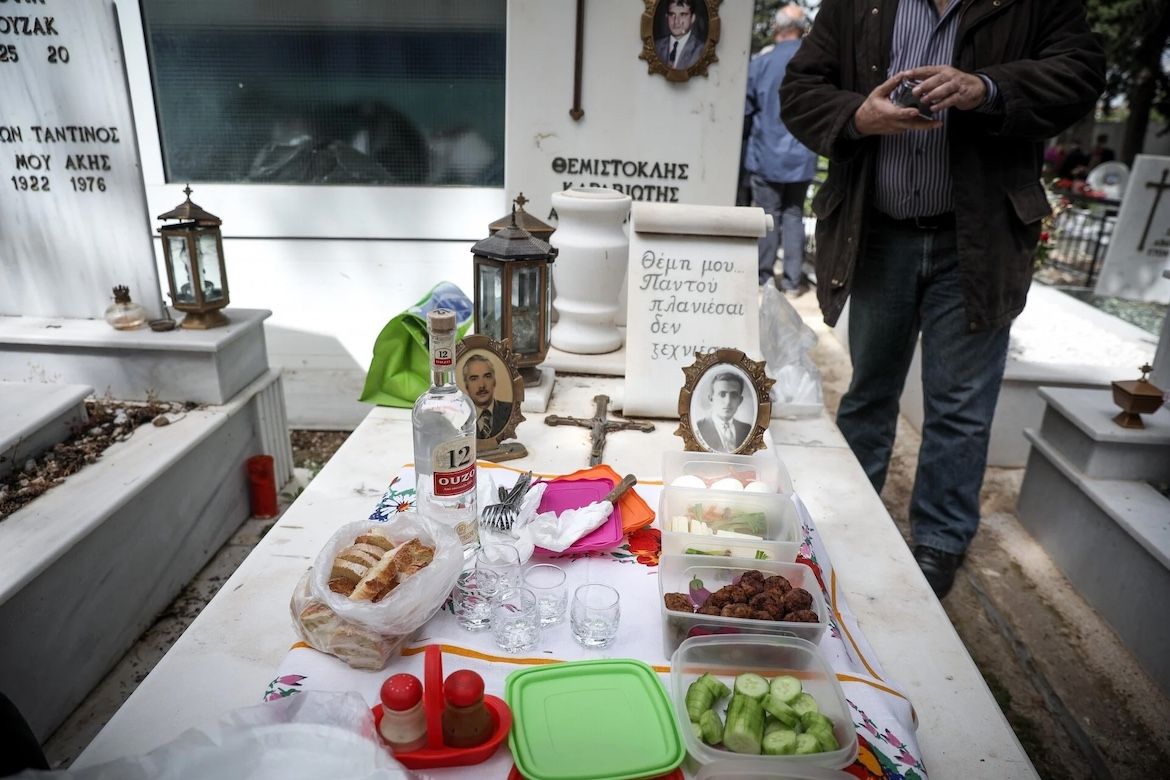
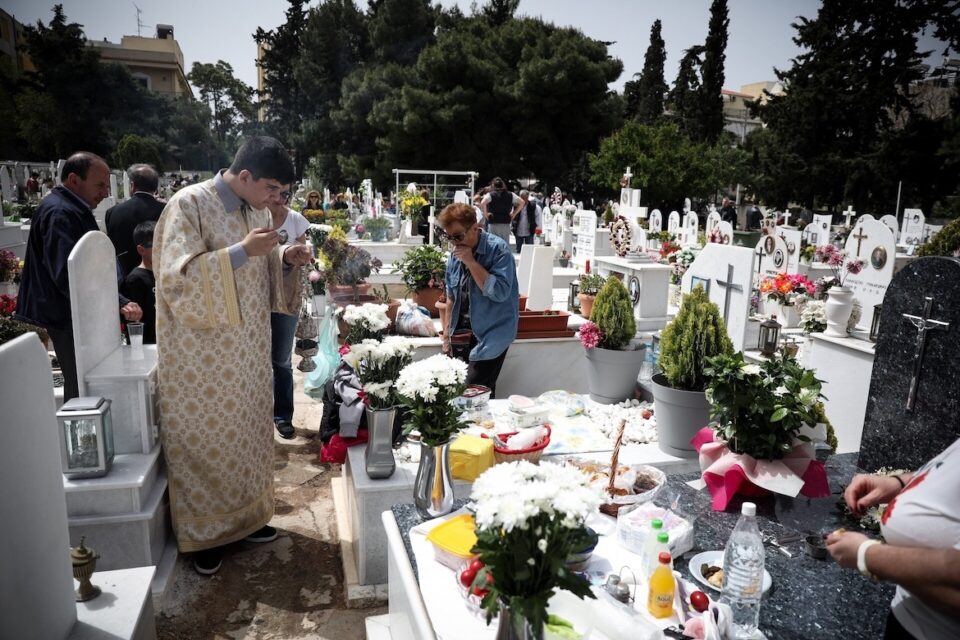
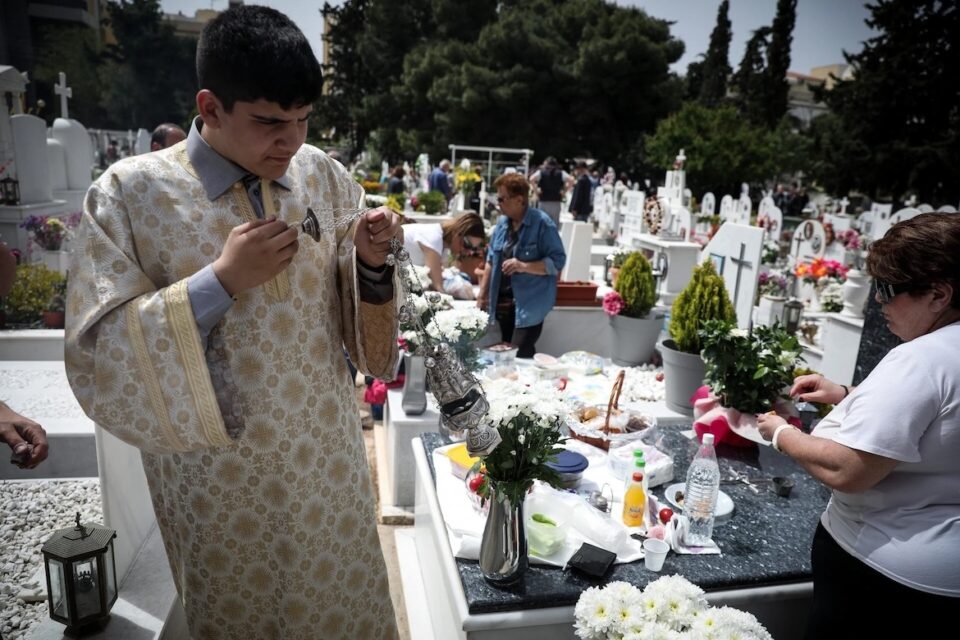
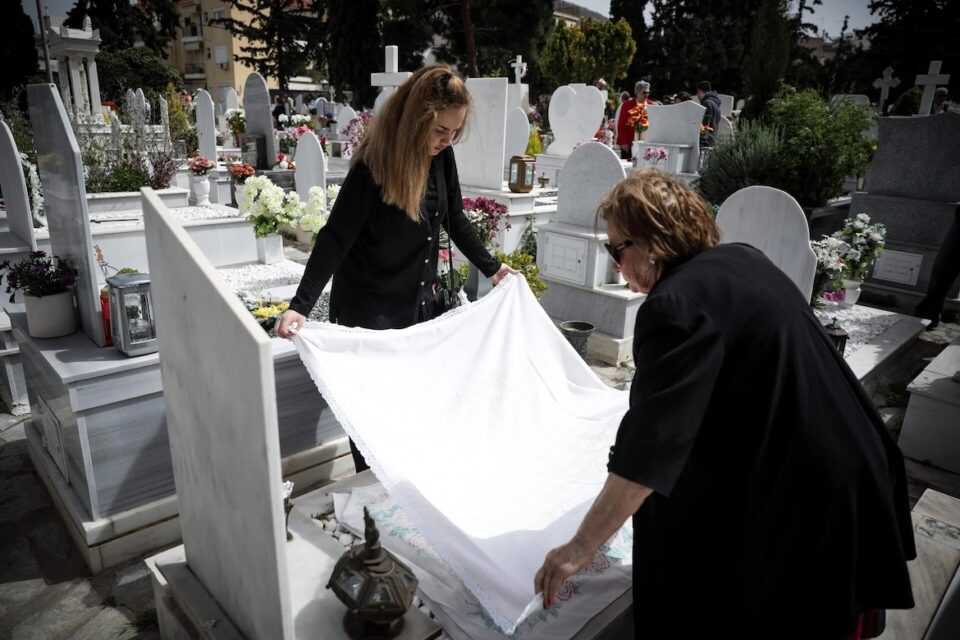
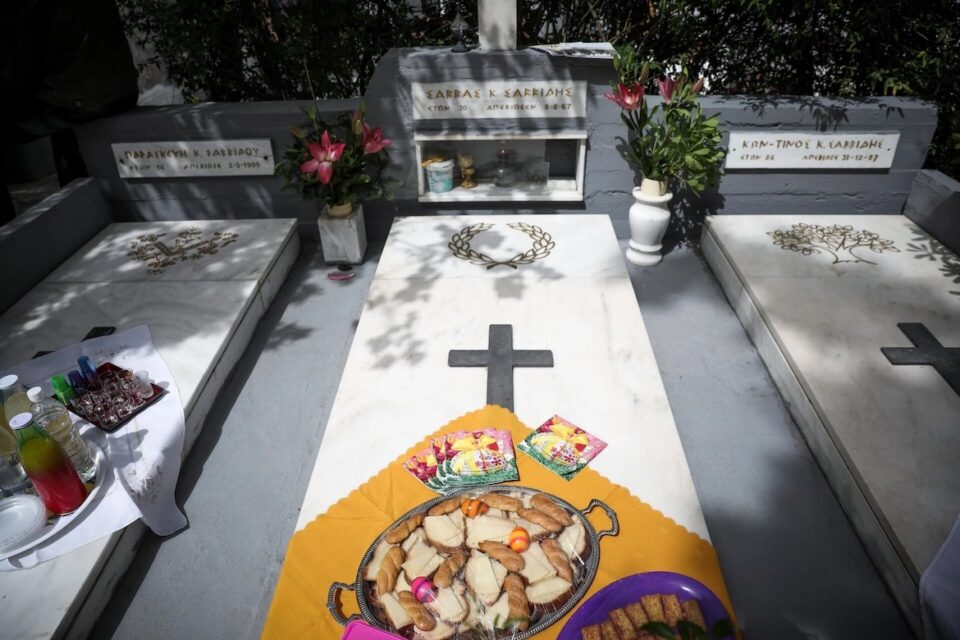
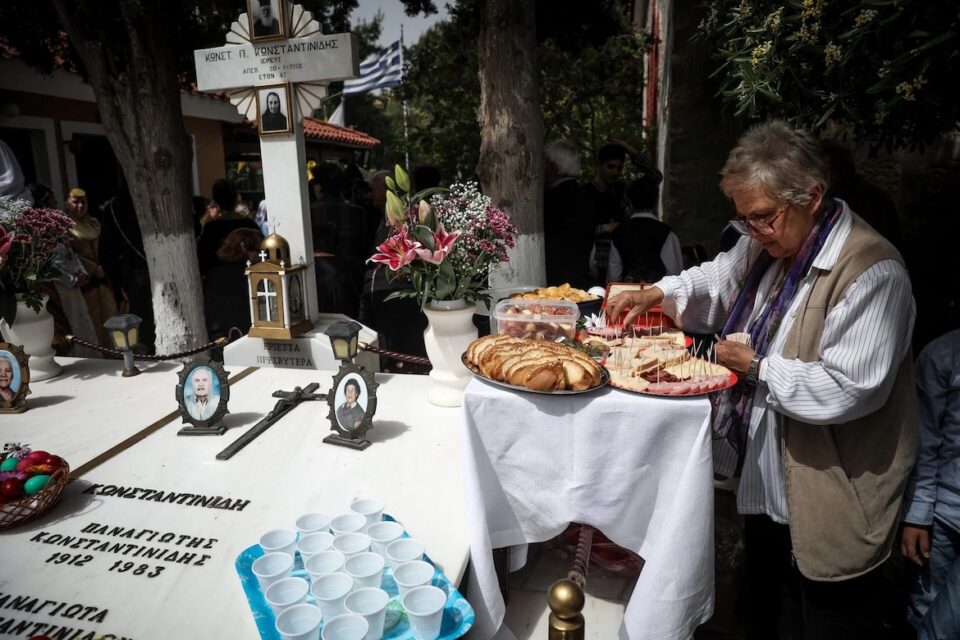
White cloths are spread across marble graves or nearby tables. Families unpack red Easter eggs, tsoureki, cheeses, pies, meatballs and other dishes prepared at home. Wine, ouzo or vodka may be poured. Priests offer memorial prayers, stories are told and food is passed from one person to another.
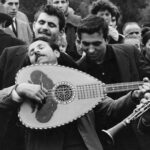
In some communities, the Pontian lyra is played. Songs may follow. What appears from a distance to be a picnic among the tombs is, in fact, one of the Pontian Greek community’s most deeply rooted traditions.
It is commonly known as the tafiko ethimo, the funerary custom, or in Pontian Greek as “sa tafia”—at the graves.
The custom is not about turning a cemetery into a place of casual entertainment. It is about returning the dead to the family table.
An Easter meal shared across generations
The ritual is usually observed during the period immediately following Orthodox Easter. In many communities today, families gather on the Sunday of Thomas, one week after Easter. In historic Pontus, the observance was often held on the second day of Easter, although dates and local practices varied.
The timing is central to its meaning.
This is the season in which Orthodox Christians celebrate the Resurrection and proclaim that death is not the end. The red eggs and Easter bread placed at the graves are therefore not simply refreshments. They connect the remembrance of the dead with the Christian promise of resurrection.
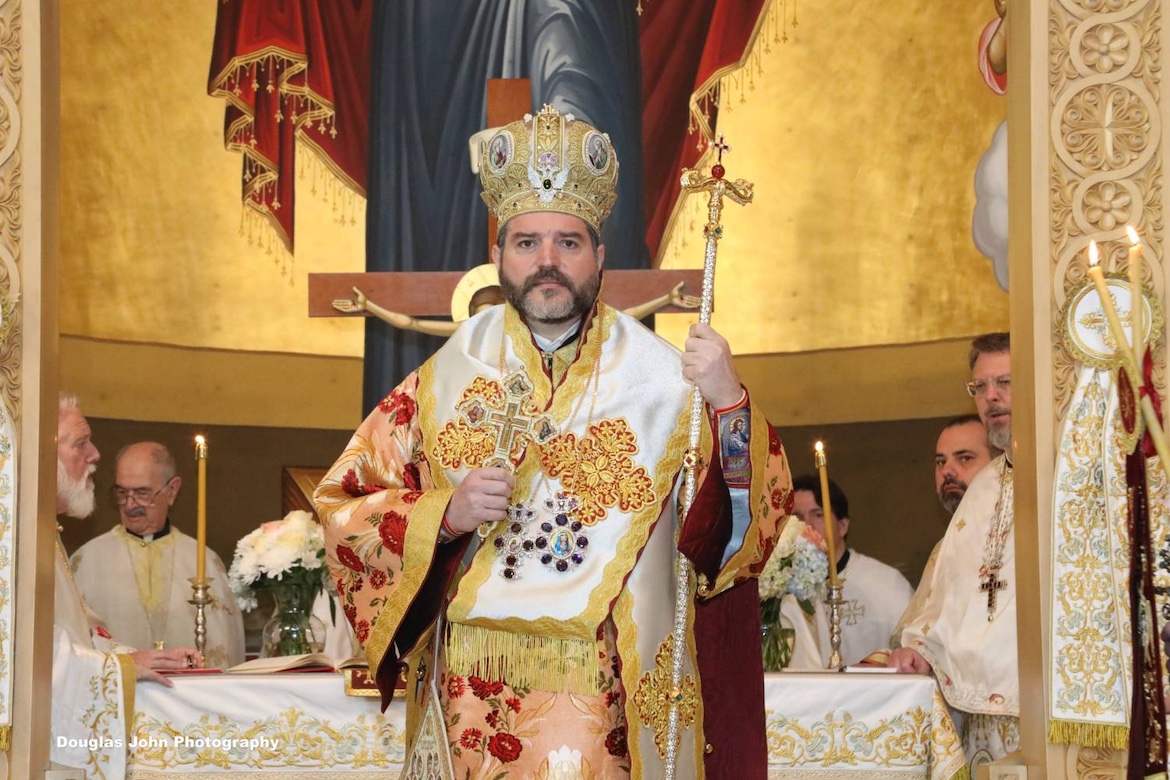
Families attend a church service or memorial prayer before gathering at individual graves. Food is placed on the tomb or arranged nearby, and the names of the deceased are spoken aloud. Relatives remember their character, their habits, their kindnesses and the stories that made them part of the family.
The atmosphere is not without sadness, but neither is it meant to be consumed by grief.
The Pontian Union of Sourmena, which preserves one of the best-known forms of the custom in Athens, describes it as a day of joy rather than painful remembrance—a day dedicated to the resurrection of the dead and to the feeling that departed loved ones remain present among the living.
That idea explains why eating at the graves is not considered disrespectful by those who observe the tradition.
The meal does not take place despite the presence of the dead. It takes place because of them.
A tradition carried out of Pontus
The custom cannot be separated from the history of the Pontian Greeks themselves.
Pontus was the historic Greek-inhabited region along the southern coast of the Black Sea, in what is now northern Turkey. Pontian Greek communities developed their own language, music, cuisine, religious traditions and local customs over centuries of life in the region.
During the final years of the Ottoman Empire and the conflicts that followed, Pontian Greeks endured mass violence, deportations, forced labor, hunger and displacement. Greece officially recognizes these events as the genocide of the Pontian Greeks and has designated May 19 as a national day of remembrance.
Those who survived were scattered.
Some fled toward Russia and the Caucasus. Others reached Greece before or during the compulsory population exchange formalized by the 1923 Treaty of Lausanne. Large numbers eventually settled in Macedonia and Thrace, while other Pontian communities were established in and around Athens and elsewhere in the country.
They arrived as refugees, often with little property and no possibility of returning to the villages, towns and cities their families had known for generations.
But they brought their culture with them.
They carried the Pontian lyra, dances such as the tik and serra, distinctive foods, religious icons, family stories and a language that preserved traces of an older Greek world. They also brought the custom of gathering at the graves after Easter.
For a displaced people, traditions such as this were more than folklore. They created continuity where history had produced rupture.
A community might lose its house, its village and even the graves of its ancestors. But it could rebuild the ritual through which those ancestors were remembered.
The cemetery as a place of belonging
Pontian Greeks did not preserve the custom in only one neighborhood or town.
It is most widely associated with places where large Pontian refugee communities were established, particularly in northern Greece and the Athens area. The observance at Sourmena, the historic Pontian neighborhood within Elliniko, has continued in its new homeland for more than a century. In Kalamaria, near Thessaloniki, the Brotherhood of Kromnians has organized the custom at the municipal cemetery for more than five decades.
Versions of the tradition are also practiced by Pontian communities elsewhere in Greece and among families whose histories passed through Russia and the Caucasus. The precise date, foods and form of the gathering may differ, but the central idea remains the same: the dead are remembered communally, through prayer, food and the retelling of their lives.
The cemetery becomes a place where several layers of memory meet.
There are the people buried beneath the individual stones. Behind them are earlier generations whose graves were left behind in Pontus. And behind those generations is the wider history of a community that survived persecution, exile and the loss of its homeland.
This is one reason children are an important part of the gathering.
They hear names they may never have heard at home. They learn who their great-grandparents were, where they came from and why the family ended up in a particular village or neighborhood in Greece.
The history is not delivered as a formal lesson. It is passed across a tablecloth, through a photograph, a recipe, a song or a story about someone whose name is carved into the marble.
Food as memory
The foods brought to the cemetery vary from family to family.
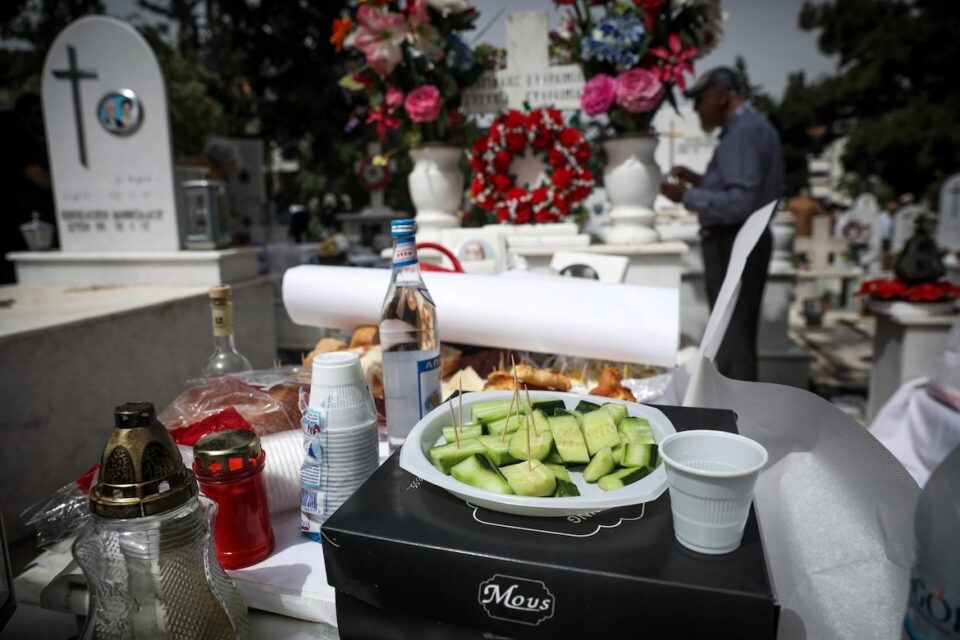
Red eggs and tsoureki reflect the Easter season. Other spreads may include cheeses, pies, cured meats, meatballs, sweets and Pontian dishes associated with a particular household. Wine, ouzo or vodka may also be shared, especially among families whose Pontian history included generations in the Caucasus or the former Soviet Union.
The food is often offered beyond the immediate family—to friends, priests, neighboring families and visitors.
This hospitality is an essential part of the ritual. Memory is not treated as private property. A person is remembered before the wider community, and the meal becomes an act of connection between households as well as generations.
Sometimes the food itself carries the memory.
A particular pie may be prepared because a grandmother always made it. A drink may be poured because it was a father’s favorite. The meal says what words alone cannot: you still have a place here.
Ancient echoes, but a living Christian custom
The practice of bringing food and drink to graves has parallels in the ancient Greek world. Archaeological and literary evidence shows that ancient families made offerings at tombs and held rituals intended to honor and maintain bonds with the dead.
That resemblance has led some accounts to describe the Pontian custom as a direct survival from antiquity.
Such claims should be treated cautiously.
Similarities do not prove that a ritual has continued unchanged for thousands of years. The custom practiced by Pontian Greeks today is clearly shaped by Orthodox Christianity, the Easter calendar and the historical experiences of Pontian communities.
It may contain echoes of older Mediterranean ideas about food, burial and remembrance, but its surviving form is a Pontian Christian tradition—not a reconstructed ancient ceremony.
A living part of Greece’s cultural heritage
In 2025, the version of the custom practiced at Sourmena was added to Greece’s National Inventory of Intangible Cultural Heritage.
The Greek Ministry of Culture described the heart of the observance as the gathering of families at the graves, the offering of memorial prayers and the sharing of symbolic Easter foods in a setting where participants feel that they coexist with their departed loved ones.
The recognition does not mean the custom has been inscribed separately on UNESCO’s international heritage list. It is a national designation made through Greece’s program for safeguarding living cultural traditions.
“Living” is the important word.
The tradition has not survived because it was documented in a book or placed inside a museum. It has survived because families continue to practice it.
They continue to cook the food, clean the graves, call the priest, bring the children and repeat the names.
For Pontian Greeks, a people whose modern history includes the destruction of communities and the loss of an ancestral homeland, remembering the dead is not simply a private expression of grief.
It is an act of cultural survival.
The white cloth spread over the marble becomes a family table. The cemetery becomes a gathering place. And the dead, for a few hours after Easter, are not treated as absent.
They are welcomed home.