
A forgotten system brought young Greeks to the United States under borrowed identities, passage debts and promises of money for the families they left behind.
Where This Story Began
Years before I moved to New York, I visited the city often and spent considerable time with the late Minas Polychronakis, a fellow Cretan who became like family to me.
I was especially close with his son, and their home was always open to me. Minas was deeply involved in the Cretan community, but downtown New Yorkers knew him for something else: he was the legendary cobbler behind the shoe repair and shoeshine shop beneath the World Trade Center.
Whenever I was in New York, I would visit him there. His shop was a small world unto itself—the smell of polish and leather, Wall Street executives coming and going, and Minas holding court in the middle of it all. Many of the men working beside him had come from Brazil, Puerto Rico and Mexico. He spoke to them with respect, treated many like family and often invited them into his home for meals.
Minas survived the attacks of September 11, 2001, although the business he had spent decades building was destroyed beneath the towers. He eventually returned to Lower Manhattan and rebuilt, becoming something of a local celebrity and a symbol of the immigrant determination that New York so often celebrates.
It was during my visits to his shop that Minas first told me about the Greek bootblacks. Perhaps because I had witnessed the kindness he showed his own workers, his stories about an earlier generation stayed with me. These were young boys who had come from Greece to shine shoes in American cities, only to be mistreated and exploited by the very men who controlled their work, their wages and, in some cases, their lives. Often, the men exploiting them were also Greeks. That was unsettling to me.
Some had been recruited in impoverished villages. Their passage was paid by Greek businessmen, their labor promised before they ever crossed the Atlantic and their wages supposedly sent home to families who had entrusted their sons to the American dream.
I never forgot those stories.
The more I learned, the more I understood that the Greek bootblacks represented something much larger than an old occupation. Their experiences revealed an organized system of passage debt, false identities, withheld wages, punishing workdays and newly successful Greek immigrants exploiting other, more vulnerable Greeks.
We rightfully celebrate the immigrants who began with almost nothing and built successful businesses in America. Minas himself embodied that resilience. But the history of Greek America cannot be told only through the people who eventually owned the shop. We must also remember the boys who spent fourteen—sometimes sixteen—hours a day bent over other men’s shoes.
This story began for me many years ago in Minas’s shop beneath the World Trade Center. I publish it now in his memory—and for the countless young Greeks whose names and stories were left behind on the floors of America’s shoeshine parlors.
He arrived in America with another man’s name.
When Stylianos Katsandonis crossed the Atlantic from Greece in 1906, the documents identifying him called him Stylianos Karas. The man traveling with him, Marianos Karas, was presented as his brother.
Neither claim was true.
The false identity was part of the arrangement that brought Stylianos to the United States. According to the account preserved in his federal immigration case file, he met Antonopoulos in the New York metropolitan area the morning after his arrival. The employer said he had been expecting him and ordered him to begin work immediately.
Years later, when federal immigration officers questioned him, Stylianos described the instructions he had been given before leaving Greece. He was to repeat the family story. He had been warned that if he failed to do so, he could be deported.
Once admitted, there was little ceremony.
“He told me to start to work immediately,” Stylianos recalled of his new employer, Anastasios Antonopoulos.
For the next two years and seven months, according to his testimony, he worked under an agreement made before he arrived. His passage had been advanced. Money was supposedly being sent to his mother in Greece, although Stylianos could not say with certainty whether she had received what had been promised.
Less than three years after arriving, he left Antonopoulos’s establishment with $50 and went to Chicago. Federal investigators had begun examining Antonopoulos’s business for importing contract laborers, but they were unable to locate Stylianos after his departure. They eventually found him in Chicago and questioned him at the immigration office on June 21, 1909.
Stylianos’s surviving immigration file offers a rare view into a system that once operated in Greek communities across the United States. Young Greeks—many of them boys or teenagers, others slightly older—were recruited from poor villages, transported across the Atlantic and placed in shoeshine parlors, restaurants, factories and other low-wage work controlled by fellow Greeks.
America was presented to their families as an opportunity. For some, it became a debt.
For others, it became a trap.
Antonopoulos was not an isolated employer, and Stylianos’s experience was not simply a private arrangement gone wrong. Federal investigators and reformers found versions of the same system in shoeshine parlors from New York and Chicago to Boston, St. Louis, Denver and Indianapolis.
The details varied, but the pattern repeated: passage was advanced, a young newcomer arrived already indebted, and the same proprietor often controlled his work, housing and wages. What survives in Stylianos’s file as one man’s testimony was part of a practice authorities were uncovering across the country.
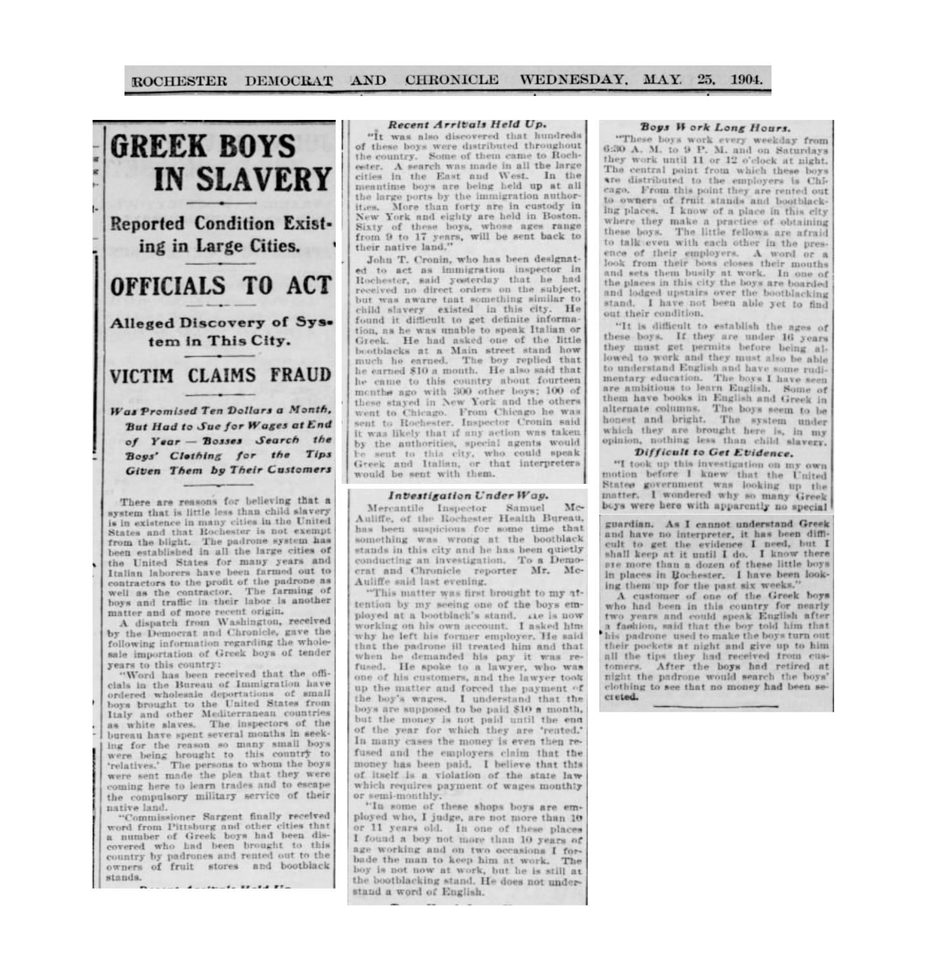
By the early 1900s, newspapers were already describing the system in explosive terms. In Rochester, the Democrat and Chronicle ran the headline “Greek Boys in Slavery.” The report said there was reason to believe that “a system that is little less than child slavery” existed in many cities. It also described boys promised ten dollars a month who had to sue for wages, and employers who searched their clothing for tips left by customers.
The dream sold in the villages
At the beginning of the twentieth century, mass migration was transforming Greece.
Poverty, limited land, debt and a lack of opportunity pushed tens of thousands of people toward the ports and in search of a better life. In 1907 alone, more than 46,000 Greek immigrants were admitted to the United States. The migration was overwhelmingly male, and America was already acquiring an almost mythical power in villages where one successful departure could change the fortunes of an entire family.
A son in America did not represent only one less mouth to feed at home. He represented wages in dollars, money for sisters’ dowries, debts that could be paid and land that might be saved.
Ruthless businessmen in the United States understood the desperation, not to mention the potential to profit from the exploitation.
According to federal investigators and contemporary reformers, agents working through Greek villages offered families a package that sounded almost irresistible: a steamship ticket, a job upon arrival, food, lodging and wages that would be sent home.
The arrangements varied. Sometimes the employer advanced the fare and the newcomer was expected to work it off. In other cases, investigators reported that family property was pledged as security. A boy might be supplied with a few dollars to show immigration inspectors so he would not appear destitute. He might also be coached to describe an employer as a relative and to deny that any job had been arranged.
The family believed it was sending a son into opportunity. The employer received a worker who arrived already owing money, dependent on him for housing and frightened of the authorities.
The American dream had been converted into a labor contract before the boy ever saw America.
The Greeks who owned the shine
The system was commonly described at the time as the Greek “padrone” system.
The word “padrone” was already familiar to American reformers. Decades earlier, it had been used for Italian intermediaries who recruited immigrant children to beg, perform music or work in the streets. By the early 1900s, federal officials were using the same language to describe Greek labor brokers and business owners who recruited immigrants, advanced their passage and controlled where they lived and worked.
The Greek version spread through a rapidly growing immigrant economy.
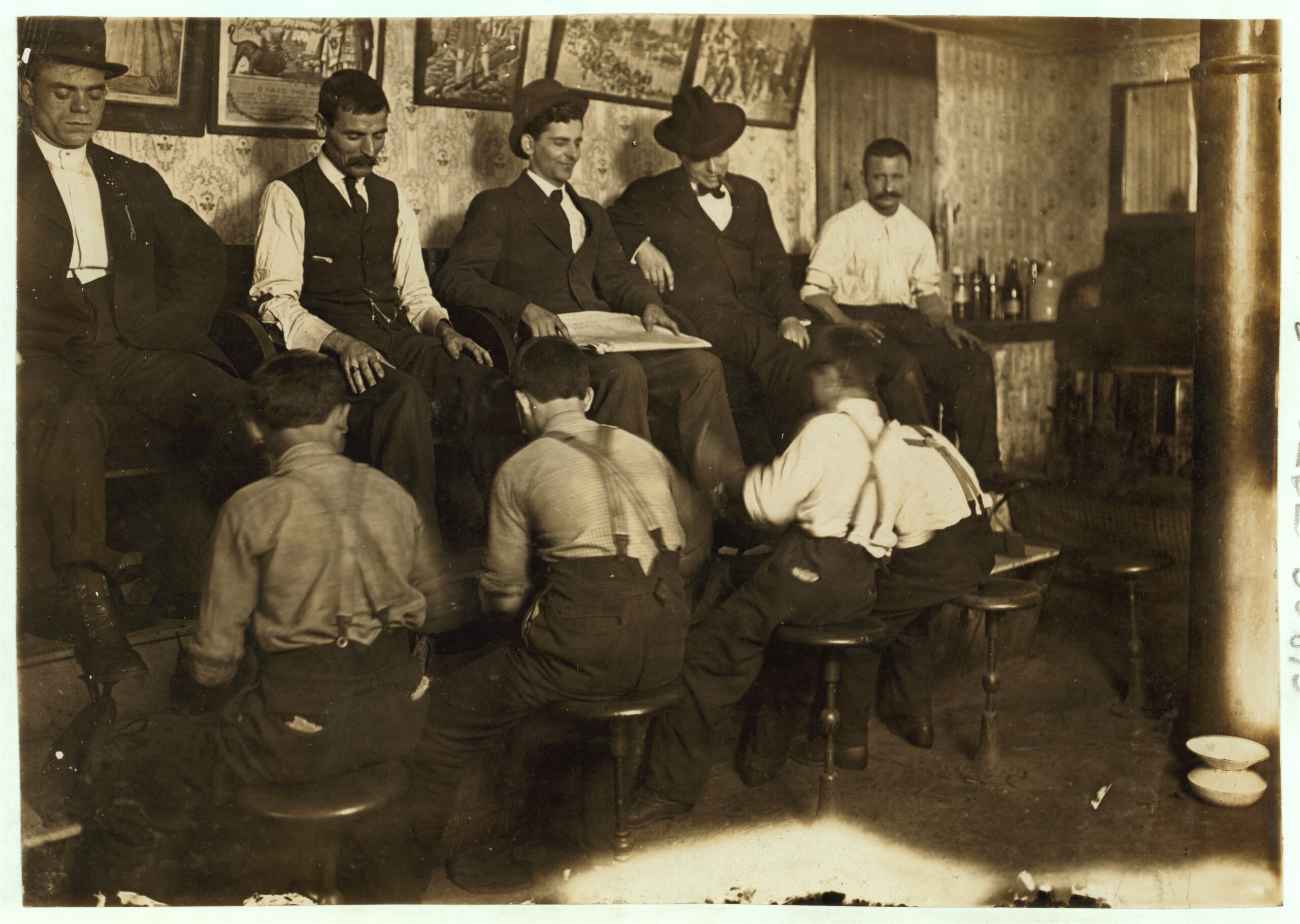
Shoeshine parlors were especially suited to it. They required little English, relatively little training and long hours of repetitive labor. A proprietor could place several boys in chairs, provide a bed and meals, and maintain control over wages and tips. The business presented a respectable face to the street while the labor arrangement behind it remained almost invisible.
And the men running it were often immigrants themselves.
This is the part of the story that sits uneasily beside the version of Greek American history most often celebrated. The padrone was not always an anonymous American industrialist taking advantage of foreigners. He could be a Greek who had arrived earlier, accumulated money and discovered that the vulnerability of the next wave of Greeks could be turned into profit.
Shared language and village connections did not necessarily protect the newcomers. They could make the system easier to operate.
Recruiters could approach families in Greece, while supposed relatives helped boys pass through immigration inspection. Once in America, an employer could also control the young worker’s housing, wages and daily life.
The exploitation worked not in spite of ethnic bonds, but sometimes through them.
Fourteen hours beneath other men’s shoes
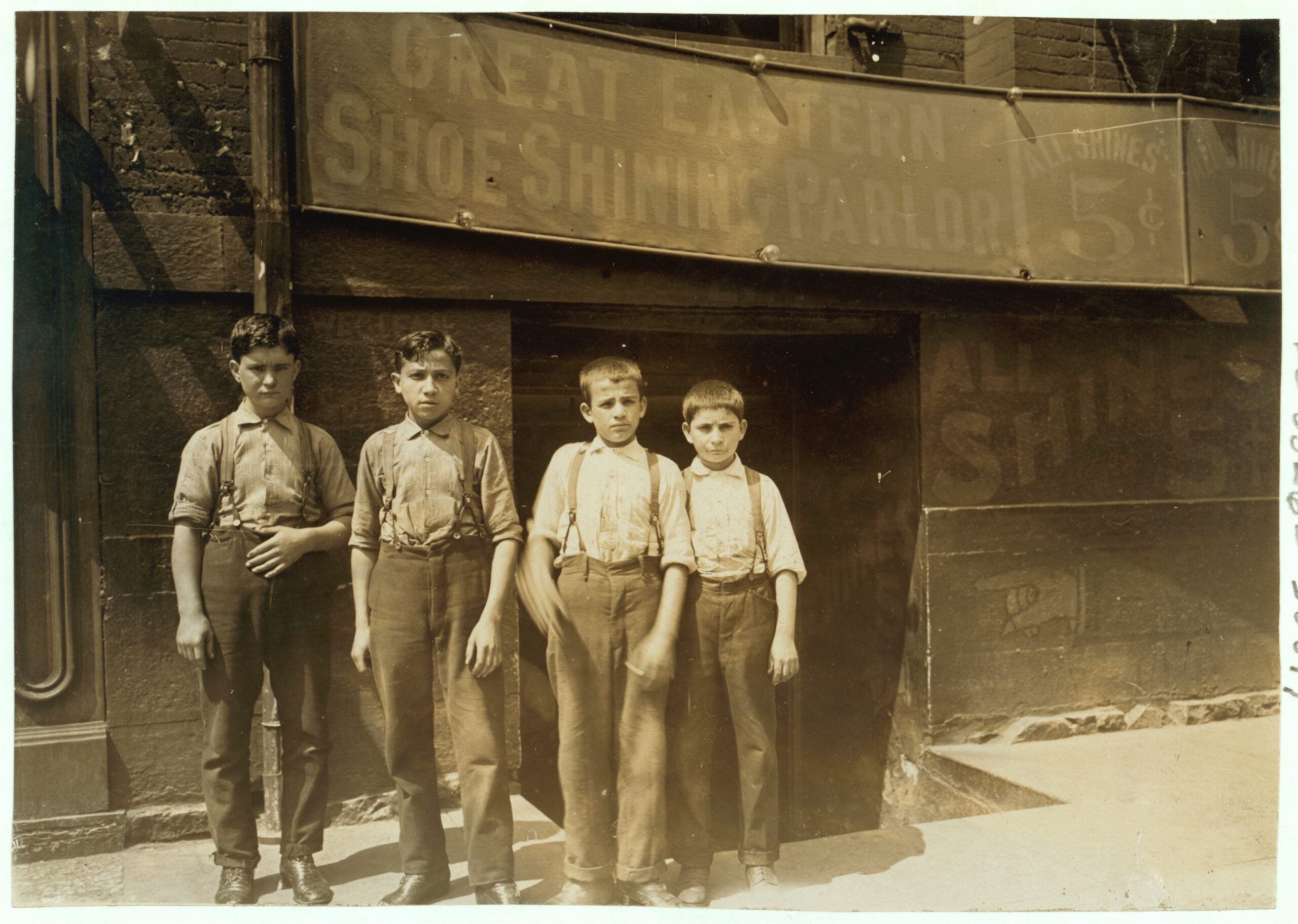
The surviving photographs are difficult to forget.
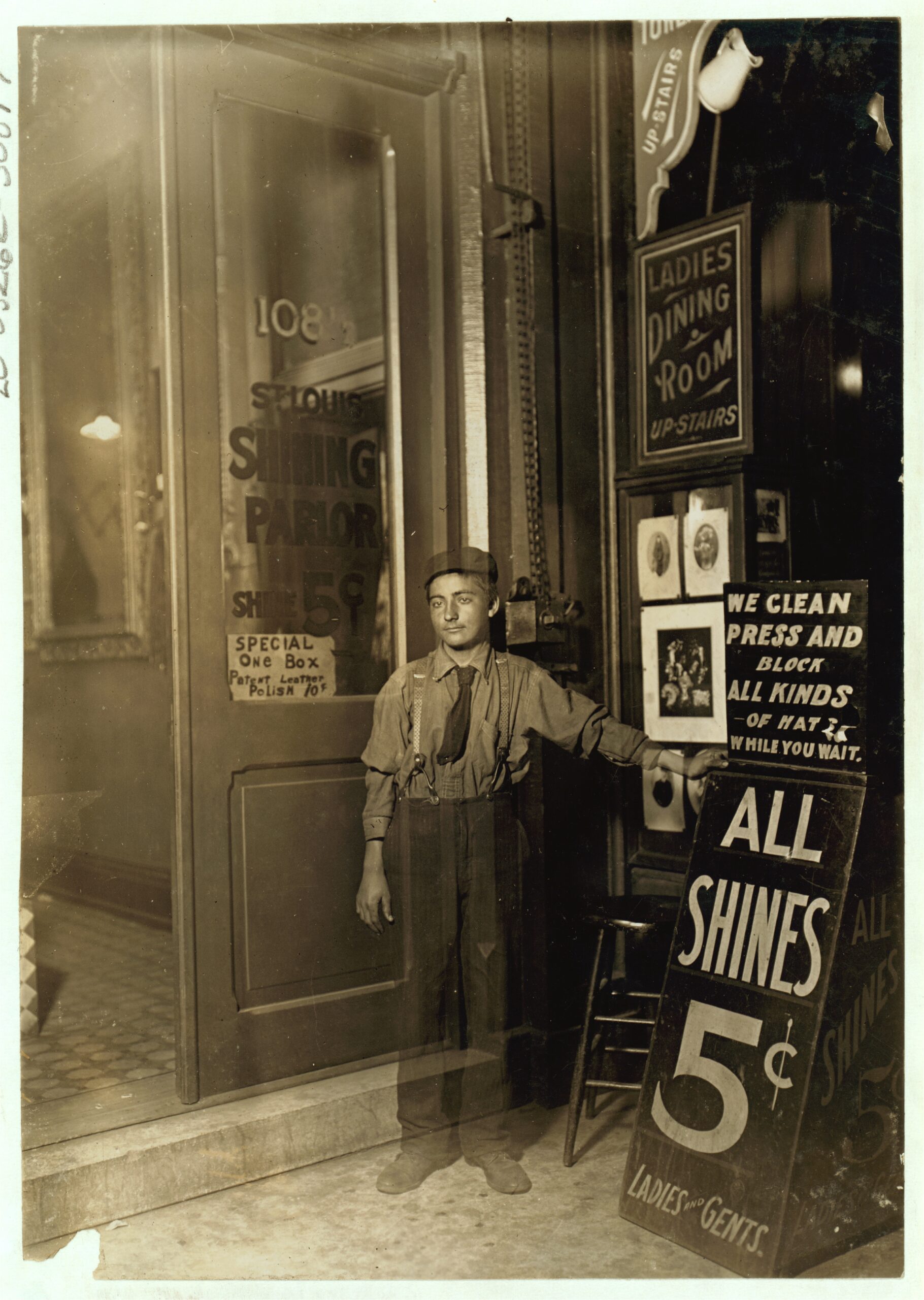
In August 1908, the social reform photographer Lewis Hine found Greek bootblacks working in Indianapolis. One of his photographs shows a boy at work at 10 o’clock at night. In 1912, Hine photographed Ciriakos Keiradimos at a shoeshine shop on Pennsylvania Avenue in Washington, D.C.
Hine’s caption said Ciriakos was reported to be 16 years old, had been in the United States only two months and was unable to read or write. He worked until 9 p.m. every day and until 11 p.m. on Saturdays.
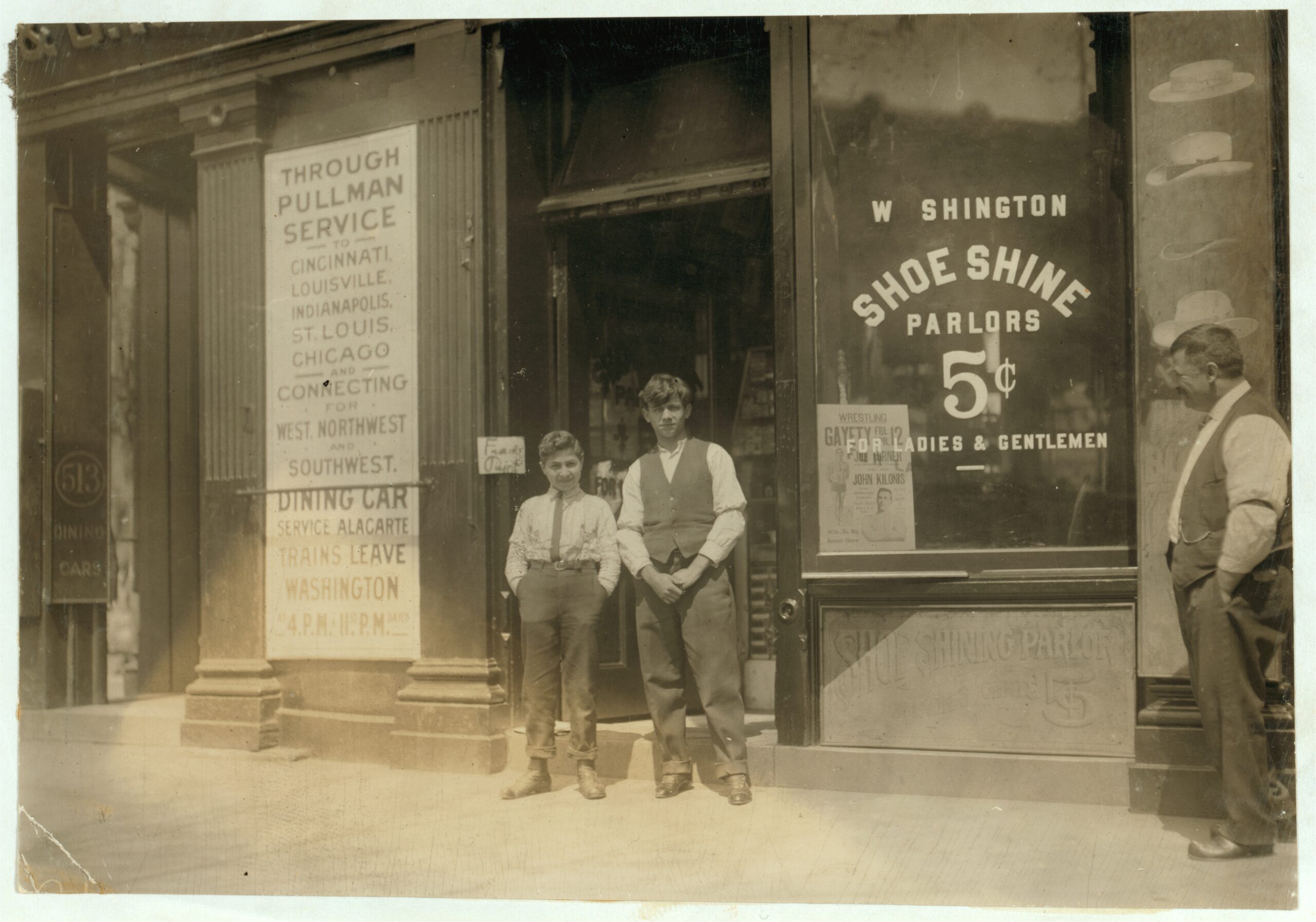
The photographs reveal the workers’ youth, while their documented schedules make the long hours clear.
Grace Abbott, the pioneering social reformer associated with Hull House, studied 41 Greek bootblacks working in Chicago’s Loop. Their reported weekday schedules ranged from nine to sixteen hours. Twenty-seven of the 41 worked at least twelve hours on an ordinary day. Saturday was often longer. Sunday, when it offered relief at all, was usually only a shorter working day.
Three reported receiving no wages.
For others, board and clothing were included in the arrangement, making the actual value of their pay difficult to measure. Tips could be taken by the proprietor. The employer who controlled the work also frequently controlled the bed, the meals and the money.
In New Orleans, a court dispute opened another window onto the money. The Times-Democrat summarized the case in a blunt headline: “Greek Bootblack’s Suit Reveals Tip Division—Employer Gets More.” The article reported that the employer took the larger share of the tips and the worker the smaller one.
Housing conditions varied. Abbott found one large residence that was clean and adequately furnished. She found another that was dirty, sparse and crowded. Twenty workers slept in eleven rooms and returned from the parlors late at night to eat soup and stewed corn under the supervision of an older Greek cook.
Other investigators described poor ventilation, inadequate food, long hours of stooping, dust from shoes, chemicals from polish and little opportunity to wash properly. A Greek physician and consul in Chicago warned immigration officials that the work was damaging the boys’ health.
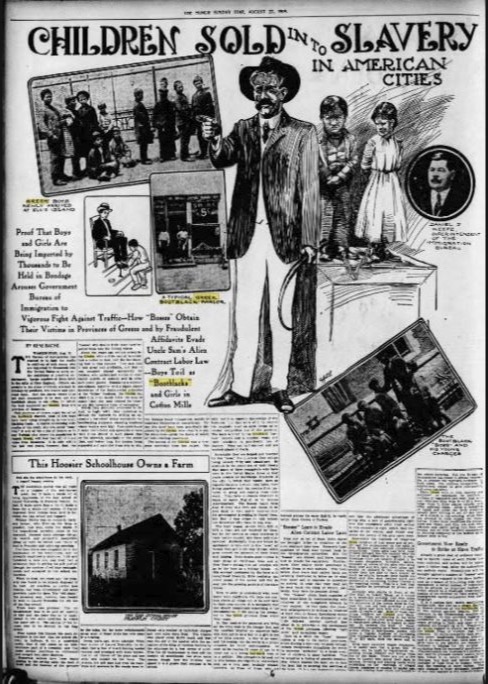
The national press could be sensational, but its language shows how far the scandal had entered public view. A full-page feature in The Indianapolis Sunday Star declared “Children Sold Into Slavery in American Cities.” The spread claimed that boys and girls were being imported by the thousands and held in bondage; among its examples was a storefront labeled “A Typical Greek Bootblack Parlor.” The rhetoric was dramatic. But its inclusion of Greek bootblacks did not come from nowhere: their working conditions were already the subject of immigration investigations and reform campaigns.
The darkness of the system did not depend on every shop being identical or every boss being cruel. It rested on the amount of power concentrated in one man’s hands. He could be employer, landlord, guardian and keeper of the accounts at once.
“The money was sent to Greece”
For many of the boys, the most important part of the bargain was happening thousands of miles away—or was supposed to be.
Their families had not sent them to America merely to feed and clothe themselves. The point was to send money home.
That promise gave employers a powerful explanation for why a worker saw little or none of his own wages. The money, he might be told, had already gone to his parents. The debt for the ticket was still being repaid. Food and lodging had to be deducted. The boss kept the accounts.
The boy often had no independent way to verify whether the promised money had crossed the Atlantic.
According to his 1909 testimony to immigration officials, Stylianos Katsandonis could not confirm that his mother had received what his employer claimed to have sent.
A contemporary account published in 1916 described another young Greek who had worked for relatives in Buffalo for three years without receiving wages directly. His relatives said the money was being sent to his family in Greece. By the time illness left him unable to work, according to the account, they bought him a ticket to Chicago and told him to find other work. He reportedly died within a week.
His name has not yet been recovered from the record. His anonymity is part of the story.
The archive preserved the machinery more readily than it preserved the boys.
When the law punished the victim
The federal government knew that imported contract labor existed. Congress had prohibited the practice in 1885, penalizing importers and making contract laborers subject to exclusion or deportation.
The result gave those workers a terrible reason to remain silent.
If a young Greek admitted that a job had been arranged before he entered the country, his testimony could help expose the employer. It could also prove that his own entry violated immigration law.
The boss might face prosecution. The worker might face deportation.
That contradiction helps explain the borrowed names, false brothers and rehearsed stories. It also explains why federal investigators struggled to prove coercion even when they believed the conditions resembled peonage.
Contemporary newspapers used the same language. The Brooklyn Daily Eagle reported “Greek Youths Held Under Peonage Plan,” while the Camden Courier-Post published “Ill Treatment of Greek Boys” beneath the subhead “Evils of the Padrone System Exposed by the Immigration Commission.” These were not labels imposed on the past decades later. They were the words readers encountered while the system was still operating.
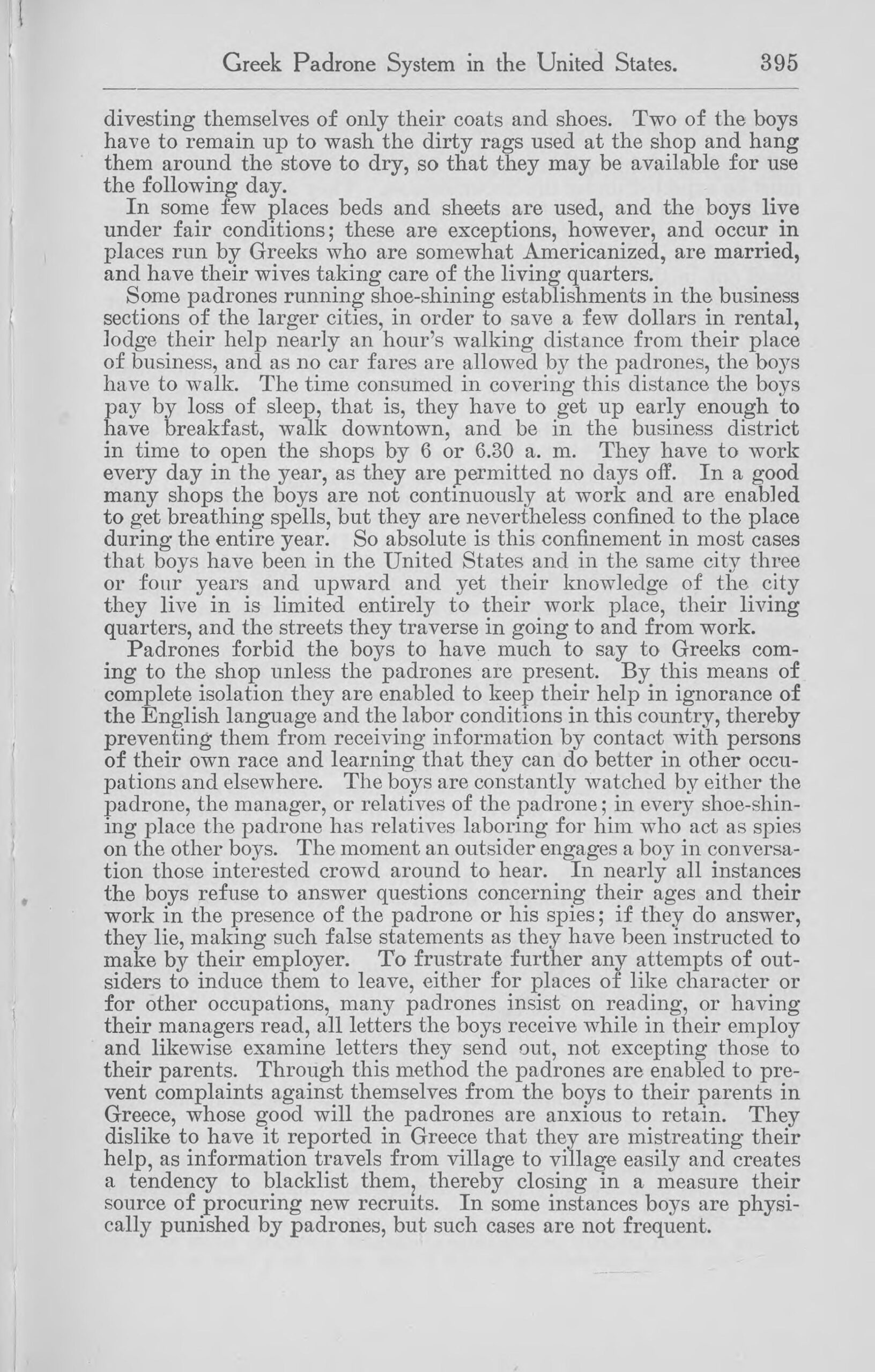
The chains were not always physical. They were debt, dependence, isolation and fear.
The federal investigations that began in 1907 did produce results. Contemporary reporting identified two guilty pleas in Boston and fourteen indictments in Chicago. Six Chicago defendants pleaded guilty and two more were convicted after trial, while six cases were still pending when officials reported the figures.
But prosecutions did not dismantle the economic conditions that made the system possible. Nor did they remove the risk carried by the people whose testimony was needed.
By the time immigration authorities located Stylianos, the three-year limitations period for deporting him on contract-labor grounds had expired.
The investigation reached him too late for deportation on that ground.
The boys were not silent forever
It would be easy to tell this history as if the young Greeks simply endured what was done to them.
They did not.
Some left their employers and changed cities. Others testified before investigators or joined organizing campaigns. Former bootblacks also became business owners themselves.
In Chicago, a former bootblack named George Prasinos became the proprietor of a shoeshine and hat-cleaning establishment. But he did not simply repeat the system that had employed him. He became an advocate for organizing the workers.
In 1915 and 1916, a campaign connected to Hull House was drawing letters from Greek bootblacks describing their conditions. More than 300 letters reportedly arrived. A mass meeting attracted approximately 600 boys and bosses.
The gathering brought workers and proprietors into the same room, including people demanding reform and employers whose income depended on the existing arrangement.
Some bootblacks wanted shorter hours, better wages and control of their tips. Some bosses resisted. The struggle was not Greeks against Americans. It unfolded within Greek America itself.
That makes the episode more uncomfortable—and more honest.
The road from worker to proprietor was one of the great engines of immigrant mobility. A boy could begin at the chair, save money, buy a stand and eventually employ others. That journey deserves recognition.
But success did not erase exploitation. Sometimes it reproduced it.
Epilogue: The polished version
Greek American history has often been told as an ascent. A poor immigrant arrived with nothing, accepted difficult work, opened a business, educated his children, built a church and entered the American middle class. It is a powerful story because it is true for countless families.
But it is not the entire truth.
Over time, the shoeshine parlor became a symbol of humble beginnings. The boy with the rag and polish could be folded neatly into the immigrant-success narrative: look how low he started, and look how high the family climbed.
What disappeared were the arrangements behind the chair. The advanced ticket. The false surname. The supposed brother. The family waiting in Greece for money that never came. The wages controlled by the boss. The long nights. The threat that telling the truth could send the worker back across the ocean.
Communities do not always erase painful history deliberately. Sometimes they polish it. They keep the sacrifice and remove the exploitation. They remember the proprietor who built successful businesses and forget the boy who worked for him, on whose back that success came.
That selective memory has consequences.
It allows us to speak about Greek immigrants only as victims of discrimination by others, while avoiding the moments when Greeks held power over more vulnerable Greeks. It turns every hardship into a prelude to success, even when some people did not succeed, did not escape or did not live long enough to tell the story themselves.
Stylianos’s story cannot tell us exactly how many Greek boys endured the same conditions. No reliable national count has emerged, although federal officials described the practice as widespread and contemporary reformers spoke of thousands.
Nor does his story prove that every Greek shoeshine proprietor was a padrone or that every young worker was held against his will.
It proves something more specific—and more than sufficient.
There was an organized system in which young Greeks were recruited from impoverished communities in the mother country, transported through arrangements they did not control, coached to deceive immigration officers and placed into labor controlled by fellow Greeks. Their debt, housing, wages and fear of deportation could all be used to keep them working.
They had been promised America.
What many received was an obligation.
For generations, Greek America has celebrated the men who rose from the shoeshine chair to own the shop. Indeed, many did it properly. But many did not, using the sweat of thousands of boys to achieve their wealth.
It is time to remember the boys who spent their youth bent over other men’s shoes—and to ask what, exactly, was required of them before the American dream finally belonged to them.