
Conversations like these happen pretty infrequently in a 2,000-year-old institution such as the Orthodox Christian Church which is known for its continuity and adhering to traditions. But that isn’t to say that Orthodox Christianity hasn’t changed, or adapted to the times.
Years ago, the the Orthodox Christian Church held steadfastly to the doctrine that it was a mortal sin to pay or charge interest on a loan. Divorce was out of the question. Even the “mixing of families” when separated spouses met new mates was forbidden. Holy Communion was served to faithful from a single common cup directly to the mouth. And inter-church marriages were strictly prohibited.
But as society changed, so did the Church. Today, who doesn’t use a credit card? Parishes even accept them for donations. Divorce is common and those divorced are allowed to remarry. The Church has also bended its rules and allowed faithful to marry non-Orthodox Christians from “approved” Christian traditions. And for the past thousand years, communion has been served with a spoon.
These changes didn’t happen overnight. In some cases they took centuries to become the established practice of Orthodox Christianity— but they began out of necessity and pastoral sensitivity— a concept called ‘economia’ in the Orthodox Christian tradition. And they all resulted in a major change in church doctrine and the way things are done.
The Orthodox Church may very well be experiencing the beginning of a similar seismic shift.
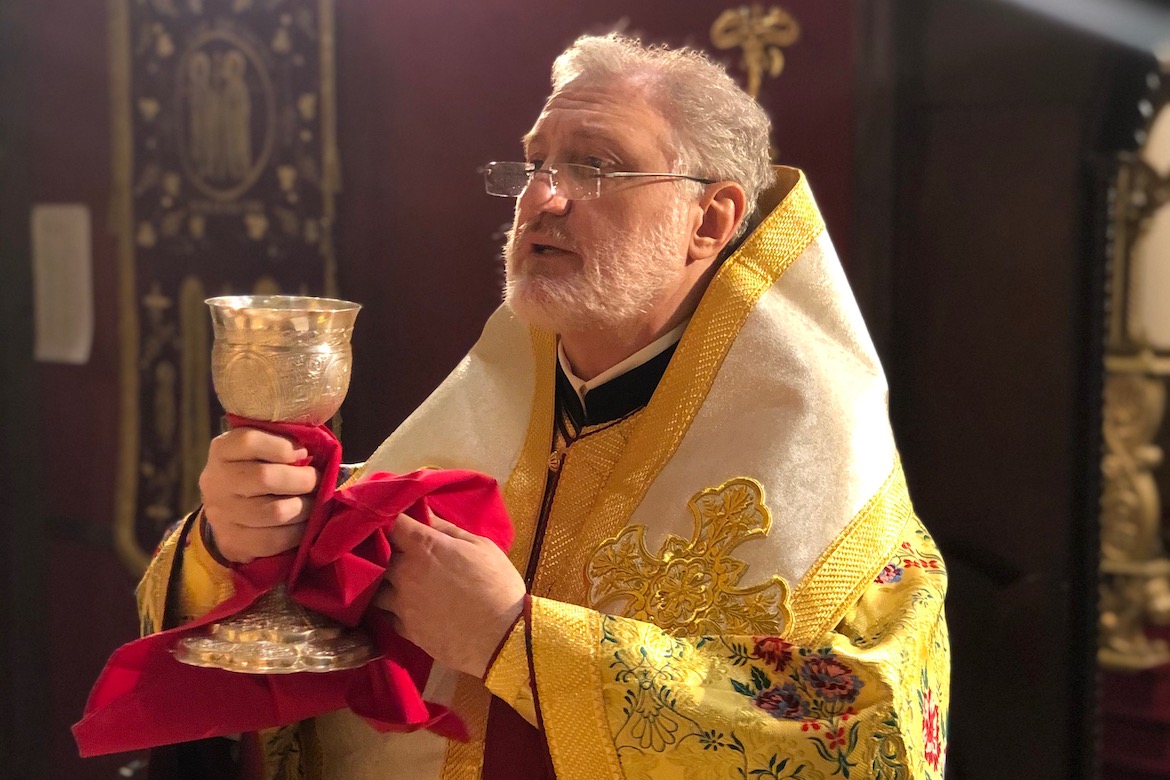
The Orthodox Church of Finland has been using single-use bamboo spoons for more than a month and the Church of Romania has planned to adopt a similar model. But Archbishop Elpidophoros of America— who is the exarch— or representative of the Ecumenical Patriarch of Constantinople in the America— has escalated the Church’s conversation about how to distribute Holy Communion to faithful.
It’s the first time in 1,000 years that a conversation like this is taking place.
In a directive sent to priests of the New York parishes over which he has direct ecclesiastical authority, Archbishop Elpidophoros instructed priests to use single-use metallic spoons to distribute Holy Communion.
The COVID-19 pandemic has created a complex problem for Orthodox Christian Churches which serve their most important sacrament from a common spoon and cup.
On the one hand, Churches have to maintain the basic belief and tenet of the Church that the wine and bread become the body and blood of Jesus Christ during a special part of the Divine Liturgy.
But on the other hand, Church officials were in a difficult position to protect their faithful from a virus which spreads from person-to-person through microscopic droplets.
The Archdiocese of America has begun a strategic educational campaign for its faithful which tells the history of the use of the communion spoon. The campaign also reminds faithful that it’s a relatively new practice.
In an a widely-circulated article, theologian Fr. Alkiviadis C. Calivas recounts the history of the spoon’s use and reminds the faithful that it is a relatively new innovation.
“Before the eleventh/twelfth century, everyone, clergy and people alike, received the Holy Gifts separately, in the manner the clergy do to this day,” Calivas writes. “When the people approached, they extended their hands, right over left with palms open, on which the priest placed a portion of the Holy Bread. After consuming the Bread, the communicants were offered the Cup by the deacon.”
It’s unclear if other Metropolitans in the United States— who govern their own regions— will pick up on the Archbishop’s cue to use single-use metallic spoons.
In a news report in the Pittsburgh Post Gazette, the Metropolis of Pittsburgh states that it will not incorporate one-use spoons, opting instead for a different method of serving Communion.
The Archdiocese directives did say this would remain a temporary measure as Churches ride out the pandemic and life returns to normal.
But the mere fact that a high-ranking leader of one of the world’s largest Orthodox jurisdictions— a leader whose roots come directly from Constantinople, considered to be the “thought leader” for global Orthodoxy— instructed priests use single-use spoons, speaks volumes for the prospects of a potentially new, practical way the Church is responding to the needs of contemporary society— as it did in the past.
John G. Panagiotou, a theologian and professor at Erskine Theological Seminary and Cummins Memorial Theological Seminary, called this “a defining time” in the Orthodox Church.
“What we are seeing in 2020 in the wake of the coronavirus pandemic is a defining time once again in the history of Orthodox Christianity in which the liturgical practice of the common communion spoon is now being seriously debated after a thousand years of its standardized usage,” Panagiotou said. “The significance of this is more than the Orthodox Churches’ ability to adapt to socio-cultural pastoral concerns which it has done repeatedly in its history. What this discussion has prompted in our day is the fresh articulation in very real terms of one’s essential belief in the nature of the Eucharist itself in relation to the balance of faith and science. Either way, this will shape ecclesiological understanding for generations to come,” Panagiotou concluded.
George E. Demacopoulos, the Co-Director of Orthodox Christian Studies Center and Professor of Theology at Fordham University, agreed that Archbishop Elpidophoros’ proposed adaptation “is consistent with the way that the Church has historically responded to changing circumstances.”
“There is nothing theologically meaningful in the use of a common spoon or a single-use spoon for the distribution of the Holy Eucharist. None of the early theologians who developed our theology of the Eucharist used spoons themselves–it was a later development born of practical consideration,” Demacopoulos told The Pappas Post.
“The theological significance lies in the belief that the bread and wine becomes the body and blood of Jesus Christ. To my mind, Archbishop Elpidophoros’ proposed adaptation is consistent with the way that the Church has historically responded to changing circumstances,” Demacopoulos concluded.