
The global blockbuster is selling Greek books, inspiring language study, launching university courses and sending travelers toward Greece—all while placing a nearly 3,000-year-old Greek poem at the center of a worldwide cultural conversation.
I have watched the complaints about Christopher Nolan’s “The Odyssey” pile up for months.
The armor is wrong. The accents are wrong. The casting is wrong. The dialogue is too modern. The costumes are too dark. So is Helen of Troy. There are no Greek actors. Odysseus is not complicated enough. Penelope is not portrayed properly. The gods are too visible—or perhaps not visible enough.
Some of the criticism is thoughtful and legitimate. Some of it is petty. And some of it has become so fixated on boots, helmets, accents and casting decisions that it completely misses the extraordinary story unfolding before us.
A nearly 3,000-year-old Greek poem is currently one of the most talked-about cultural works on the planet.
Not a superhero franchise. Not a comic book sequel. Not another reboot produced from the leftovers of Hollywood’s intellectual-property cupboard.
Homer. A Greek storyteller.
Christopher Nolan’s film has earned nearly $640 million around the world less than two weeks after its release. But its influence is increasingly being measured far beyond movie theaters.
People are buying and listening to Homer’s “Odyssey,” searching for Greek-language lessons, joining university reading groups and planning trips inspired by the world of Odysseus.
The phenomenon is becoming known as the “Odyssey effect”—a cultural ripple that is introducing millions of people to Greek literature, mythology, history and language, often for the first time.
And frankly, while the naysayers continue inspecting the historical accuracy of every sandal, the rest of the world is discovering Greece.
The Biggest Effect May Be the Conversation Itself
Before considering the book sales, language searches and travel bookings, we should acknowledge something that is much harder to measure but perhaps even more important.
The entire world is talking about a Greek story.
Before the film was even released, the first official trailer for “The Odyssey” was watched 121.4 million times during its first 24 hours across social media platforms. It was the strongest trailer debut of Christopher Nolan’s career and more than doubled the first-day audience for the original “Oppenheimer” trailer.
Think about what those numbers actually mean.
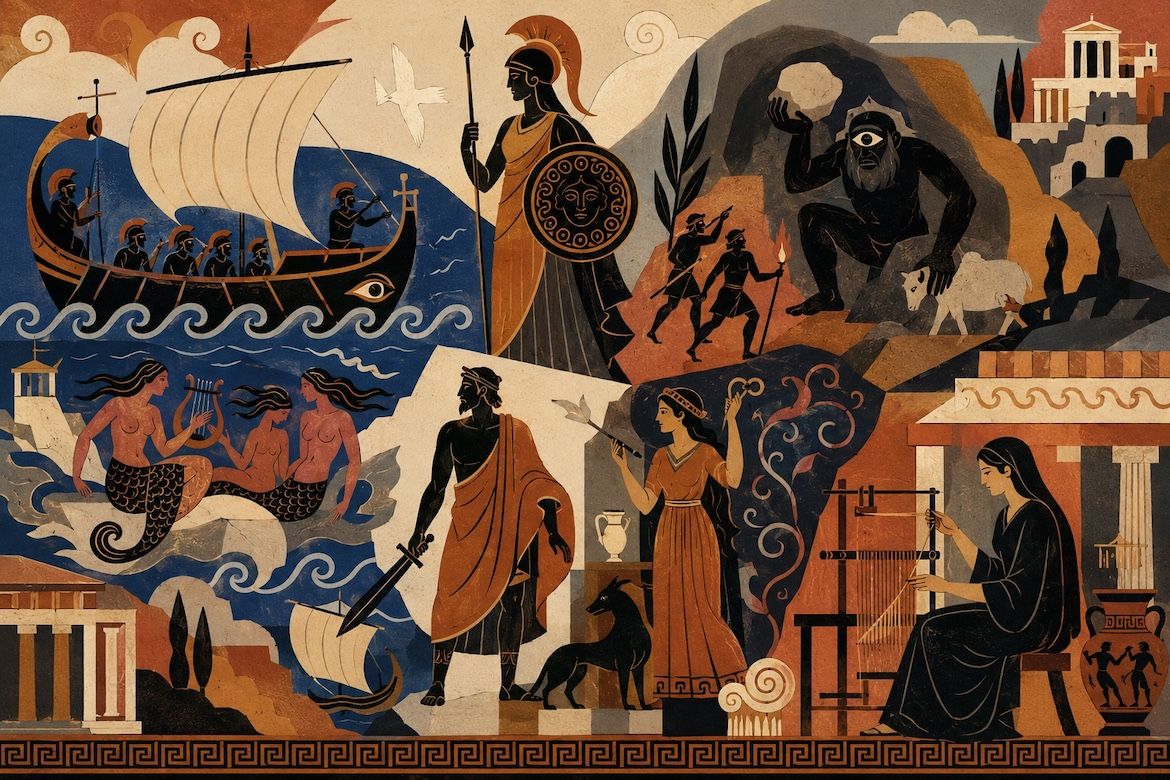
More than 121 million views of images and characters originating in a Greek poem composed nearly three millennia ago. Odysseus. Penelope. Telemachus. Athena. Ithaca. Troy. The Cyclops. The Sirens. The journey home.
Since then, the film has generated an avalanche of reviews, interviews, opinion pieces, historical explainers, casting debates, travel features, memes and social media arguments.
Reuters, Associated Press and other syndicated news services introduced audiences around the world to Nolan’s attempt to adapt Homer’s ancient Greek epic poem. France’s Le Monde has published not only a review comparing Nolan’s interpretation with Homer, but additional articles about the poem’s history, its women and its influence on cinema.
The South China Morning Post called the film an adaptation of Homer’s foundational Greek epic. The Australian Broadcasting Corporation has published reviews, historical examinations and online debates about the adaptation. In India, The Economic Times joked that everyone has suddenly become a Homer expert, describing conversations about Greek literature taking place in Delhi and Kolkata.
The stories may praise the film, criticize it or tear it apart. It almost does not matter.
To explain Nolan’s movie, virtually every serious news article must first explain Homer. It must tell readers that this blockbuster began as an ancient Greek poem. It must introduce Odysseus, Ithaca, Troy, Penelope and the long journey home.
Every time one of those articles is shared on Facebook, Instagram, X, TikTok or another platform, the Greek story travels with it.
Even the controversies send people back to Greece.
Someone reads an argument about the actor playing Helen of Troy and searches for the original myth. Someone else sees a debate about Athena and discovers her role in the poem. Someone laughs at an Odysseus meme and learns why he was tied to the mast. Someone hears that Nolan changed the ending and decides to read Homer’s version.
That is cultural recognition on a scale no tourism advertising campaign could manufacture.
Greece could spend hundreds of millions of dollars promoting its heritage and still struggle to generate the sustained global attention that Nolan’s film has created organically.
Whether people love the movie or hate it, they are saying Greek names, discussing Greek characters and tracing the story back to a Greek poem.
That is not a minor footnote to the film’s success.
That may be its greatest success.
Homer Returns to the Bestseller Lists
The clearest measurable evidence can be found in bookstores.
According to Circana BookScan figures reported by Publishers Weekly, print sales of “The Odyssey” across all editions have increased 76 percent in the United States so far this year.
The renewed interest began building after Nolan announced the film in December 2024. Sales grew 42 percent in 2025 compared with the previous year before accelerating again as the movie’s release approached.
Emily Wilson’s widely praised translation is currently the bestselling edition, followed by Robert Fagles’ translation and Gareth Hinds’ graphic novel adaptation.
Wilson’s publisher, W.W. Norton, reported that paperback sales of her translation have risen nearly 40 percent compared with last year. Domestic sales across all formats surpassed one million copies in 2026—an extraordinary milestone for a modern translation of an ancient Greek epic.
Wilson has been one of Nolan’s harshest critics. She has criticized the screenplay, characterization and the film’s treatment of Homer’s central themes.
She is entitled to do so. That is what serious scholars and critics do.
But even Wilson has acknowledged that the movie’s enormous popularity could encourage people to read Greek literature and strengthen public interest in the humanities.
There is something wonderfully ironic about a scholar’s attack on the film becoming another internationally circulated story reminding millions of readers that the movie comes from Homer.
Even criticism sells more books.
I’ve experienced this explosion of interest in the Odyssey in The Pappas Post’s own bookshop, where sales of all Odyssey-related titles have increased ten-fold since the film was released.
The revival is also not confined to printed editions.
On July 17, the day Nolan’s film opened, listens to audiobook versions of “The Odyssey” jumped by more than 500 percent on Spotify.
Spotify offers 91 different audiobook editions of the epic in ten languages. Collectively, listeners have now streamed the story for the equivalent of more than 43 years of continuous playback.
The audience is also remarkably young. Spotify reported that 36 percent of listeners were members of Generation Z and another 45 percent were millennials.
In other words, a story composed centuries before the birth of Christ is finding an enormous new audience among people born in the age of smartphones and streaming.
We can complain about Matt Damon’s armor all we want. But millions of young people are listening to Homer for the first time.
I know which development matters more.
More People Are Searching for Greek Lessons
The film also appears to be creating interest in the Greek language.
An analysis by the online tutoring platform Preply found that Google searches in the United Kingdom for the phrase “learn Greek” increased by 550 percent in a single month, reaching approximately 6,000 monthly searches.
Modern Greek is, of course, very different from the Homeric Greek in which “The Odyssey” was composed. Learning how to order coffee in Athens will not immediately allow someone to read Homer in the original.
That observation has already been repeated by the usual collection of people eager to explain why someone else’s curiosity is somehow misguided.
But the technical distinction is less important than the impulse behind the searches.
The film is prompting people to look beyond the English-language adaptation and seek a more direct connection with the culture that produced the story.
Perhaps someone begins with a few modern Greek phrases. Perhaps that curiosity develops into an interest in Greek history, travel, mythology or literature. Perhaps a student decides to study ancient Greek. Perhaps a 3rd generation Greek American who never learned the language finally enrolls in a class.
Curiosity has to begin somewhere.
Nolan’s film may now be giving Greek—both its ancient and modern forms—a comparable moment of global visibility.
Anyone who considers that insignificant is not looking at the big picture.
Universities Are Joining the Conversation
There are also unmistakable signs that universities are embracing the moment.
The University of California at Berkeley organized an entire season of events centered on “The Odyssey”, including a virtual alumni book club featuring faculty experts from its Department of Ancient Greek and Roman Studies. Berkeley described the program as attracting a “large number” of participants and created dedicated Facebook and Slack groups where readers could continue discussing the poem between sessions.
The University of California, Santa Cruz held a free online “Odyssey” reading group examining all 24 books of the epic in advance of the film.
At Yale, a course titled “Odyssean Receptions: A Journey Through the History of Literature and Film” explored how the character and story of Odysseus have been reimagined across centuries.
Hillsdale College released a free twelve-part online course examining the poem’s themes of loyalty, identity and homecoming just days before the film’s premiere.
Classics scholars at Oxford, Cambridge, New York University, Pomona College and other institutions have also published commentaries, organized discussions and appeared in public programs examining what Nolan changed, preserved or misunderstood about Homer’s story.
Universities are clearly recognizing that millions of people who might never have attended a classics lecture are suddenly debating Odysseus, Penelope, Athena and the meaning of homecoming.
At a time when classics departments and humanities programs are routinely asked to defend their relevance—and sometimes their very existence—one of the world’s biggest filmmakers has delivered them an extraordinary global audience.
That deserves more than a shrug or a quick Instagram complaint reel bashing Nolan for not casting Christophoros Papakaliatis or Melina Kanakaredes in his film. (Hmm… come to think of it, I do think Melina would have played a damn good goddess Athena).
The Journey Is Becoming Literal
For some viewers, reading or studying the story is not enough. They want to travel through its landscape.
Flight booking platform CheapOAir reported a sharp increase in searches for Greece following the film’s release. According to data published by TravelAge West, searches for Athens increased 153 percent while bookings rose 151 percent.
Searches also increased for Santorini, Kos, Mykonos and Crete. Most were for travel between July and September, suggesting that at least some viewers were looking to turn their cinematic experience into an immediate Greek vacation.
Tour operators are moving quickly to meet that demand.
Travel companies have introduced “Odysseus’ Journey” itineraries through the Peloponnese and customizable journeys connected to places traditionally associated with the epic.
One company launched a twelve-day trip called “Footsteps of the Odyssey in Greece,” visiting Kefalonia, Ithaca, Corfu and other Ionian destinations. The company said it developed the itinerary after research found that 81 percent of surveyed travelers expressed at least some willingness to visit Greece in connection with the film.
The relationship between Homer’s imagined geography, archaeological history and Nolan’s filming locations is not always straightforward. The movie was filmed across several countries, and scholars have debated the real-world locations behind Odysseus’ journey for centuries.
Again, here come the purists.
That is not the real Ithaca. That scene was not filmed in Greece. Homer may not have intended that island. Odysseus probably did not take that route.
Most travelers are not preparing a doctoral dissertation. They are seeking landscapes, ruins, islands and experiences that allow them to feel closer to the world of the story.
They want to stand beside the sea, visit Mycenaean sites, walk through Pylos, see Ithaca and imagine the journey home.
Greece should welcome them—and prepare intelligently for them. And TikTok activists should realize that even though the Trojan Horse beach scene was shot in Morocco, millions of travelers will go in search of that scene on a beach in Greece.
We Are Missing the Forest for the Olive Trees
Let me be clear: Nolan’s “The Odyssey” is not beyond criticism. No adaptation is. I have my own opinion about the film, but it is irrelevant when staring out at the Odyssey abyss that has covered the planet.
Scholars should debate it. Greeks should question how our stories are represented. Critics should examine what was changed, simplified, modernized or misunderstood.
But perspective matters.
When criticism becomes an endless argument about accents, sandals, armor, skin color or whether every scene follows a particular translation, we risk missing the astonishing cultural moment taking place around us.
There is no single, uncontested version of these stories frozen forever in marble. Greek myths have been retold, rewritten, performed and reinterpreted for thousands of years.
Ancient playwrights changed them. Roman writers changed them. Medieval storytellers changed them. Renaissance painters changed them. James Joyce changed them. Hollywood has changed them repeatedly.
The fact that people are arguing about Nolan’s choices is not proof that the film has failed.
It is proof that the story is alive.
And while critics are busy cataloging everything Nolan supposedly got wrong, millions of people are learning that Homer existed. They are buying the poem. They are listening to it. They are discussing Athena, Penelope and Odysseus. They are searching for Greek lessons. They are joining reading groups. They are considering trips to Greece.
That is the big picture.
We Greeks are often our own worst enemies when something connected to our heritage achieves international success. Rather than recognizing the opportunity, we begin guarding the gates, issuing purity tests and searching for reasons to be offended. One guy I stumbled across online actually spoke about intellectual property and how Greece should ask for… compensation. Seriously?
We should absolutely protect our history from falsehood and distortion.
But we should also recognize a gift when one lands in our lap.
Christopher Nolan has taken one of Greece’s foundational stories and placed it at the center of global popular culture.
He did not replace Homer. He sent millions of people looking for him.
A Greek Story Returns to the Mainstream
The lasting significance of Nolan’s film may have little to do with whether every costume, character or plot decision is faithful to the original.
Its greater achievement may be that millions of people are once again talking about a Greek poem that has traveled across languages, civilizations and nearly three millennia.
They are comparing translations, arguing about the character of Odysseus, questioning the role of the gods and examining how ancient Greek stories should be adapted for modern audiences.
They are doing what generations before them have done: returning to Homer and interpreting the epic through the concerns of their own age.
Nolan created his own “Odyssey.”
It may be imperfect. It may infuriate scholars. It may send purists climbing the walls of Troy.
But it has also sent readers into bookstores, listeners toward audiobooks, students toward classrooms and travelers toward Greece.
And every review, argument, meme, headline and social media post points backward through the centuries—to Homer, to the Greek imagination and to a story born in our cultural world.
While everyone else is arguing over the details, Homer is winning.
And so is Greece.