
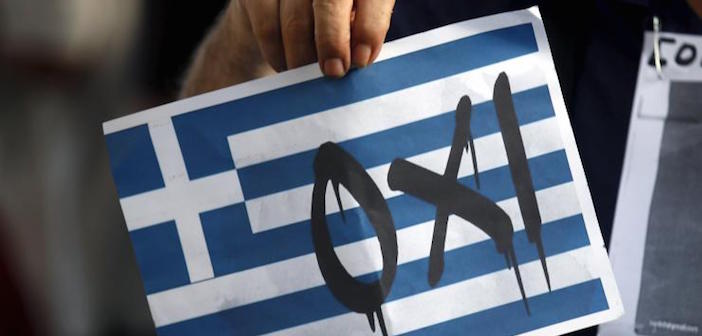
The Greek people overwhelmingly rejected more austerity from their European lenders, sending shockwaves throughout Europe and the world. The overwhelming results— which came as a surprise even to members of the Syriza ruling party— are a blow to the insistence of European leaders— namely German Chancellor Angela Merkel, Dutch Finance Minister Jeroen Dijsselbloem and German Finance Minister Wolfgang Schäuble– who have been maintaining a hard line with Tsipras’ government for months.
The big question remains on everyone’s mind— Now what?
Tsipras has promised voters a deal with creditors within 48 hours and has promised that banks will open on Tuesday with a solid “no” vote in hand.
Eurozone finance ministers have scheduled a call on Monday morning to discuss the matter. German Chancellor Angela Merkel will travel to Paris on Monday for talks with French President Francois Hollande to map out the way forward for Greece.
A former United States Ambassador to Greece, R. Nicholas Burns wasn’t optimistic.
After accusing EU of blackmail, Tsipras has little leverage with Merkel. EU won't bend much. Default and Grexit still possible. #Greece
— Nicholas Burns (@RNicholasBurns) July 5, 2015
There is optimism in Greece that there could be a breakthrough with the creditors. Marina Stevis of the Wall Street Journal confirmed this.
https://twitter.com/MatinaStevis/status/617761774230745089
Many global economists are cautious and others expressed worries for Greece’s future, while the government argues it has a better bargaining position.
Wolf Piccoli of Teneo Intelligence believes that there is now a 75% that Greece will eventually leave the eurozone.
“This will further raise doubts over whether all of Greece’s big commercial banks will be able to survive the coming week; their remaining liquidity buffers are likely to last until Tuesday, at best. Within the ECB, there may even be a push to consider a further increase in the haircut on the collateral accepted in return for ELA access, although Monday may be too early for such a move given that the further course of negotiations is still unclear.”
Piccoli also predicts that Greece’s creditors will maintain a hard line:
“Once Athens and its lenders resume talks, Tsipras is likely to point to the IMF’s recent debt sustainability analysis (which has effectively once more made the case for debt relief) and tonight’s “No” vote. But calls to respect the democratic will of the Greek people and offer a better deal will likely be answered by reference to the – in substance very different – democratic will in creditor countries.
“Instead, the lenders will likely argue that given the by now worsened economic situation, further efforts will be required to get the country back on track. This may translate into further cuts and/or additional revenue-raising measures to meet primary surplus targets.”
Kathleen Brooks of Forex.com also fears for Greece’s banking sector.
“A win for the No camp also makes negotiations with Greece’s creditors substantially harder, and thus, it cannot be assumed that Greece will get any more money from the EU, ECB or IMF. This makes further defaults, including on some large sums owed to the ECB later this month, even more likely. Overall, those who thought the chances of Grexit were at 60% last week, must now be revising them up to 80%.”
Greece’s labour minister Panos Skourletis has reacted to the results, and hailed the outcome as a very good thing for democracy.
“The government can go now with a very strong card to continue negotiations [with creditors],” he told reporters outside the the prime minister’s office.
Germany’s Christian Social Union called Tsipras a liar in a Tweet.
Tsipras und seine Linksregierung haben das Volk belogen und vorgegaukelt, es gäbe Euros ohne Reformen. #Greferendum pic.twitter.com/jRzBLgxr9w
— CSU (@CSU) July 5, 2015
A senior German conservative lawmaker Hans Michelbach said that Greece might be better off outside the single currency after referendum results showed the country rejected euro zone bailout terms.
“Now one has to ask the question whether Greece would not be better off outside the euro zone,” said Michelbach, a hardline member of the Bavarian Christian Social Union (CSU) and part of Chancellor Angela Merkel’s conservative bloc.
“Unfortunately, Greece has chosen a path of isolation,” he said, adding that if a ‘No’ vote won, as results indicate, he saw no basis for further aid for Greece.
German media and politicians have begin calling on Angela Merkel to begin organizing a Greek exit from the Eurozone, or a Grexit.