
Odysseus spent ten years trying to get home.
Nearly three thousand years later, while audiences debate Christopher Nolan’s casting choices and filming locations, scholars are still engaged in far more substantive arguments about where that home actually was.
For most of us, the answer seems obvious. Odysseus was king of Ithaca, and Ithaca is the small Greek island that still carries his name today.
Case closed.
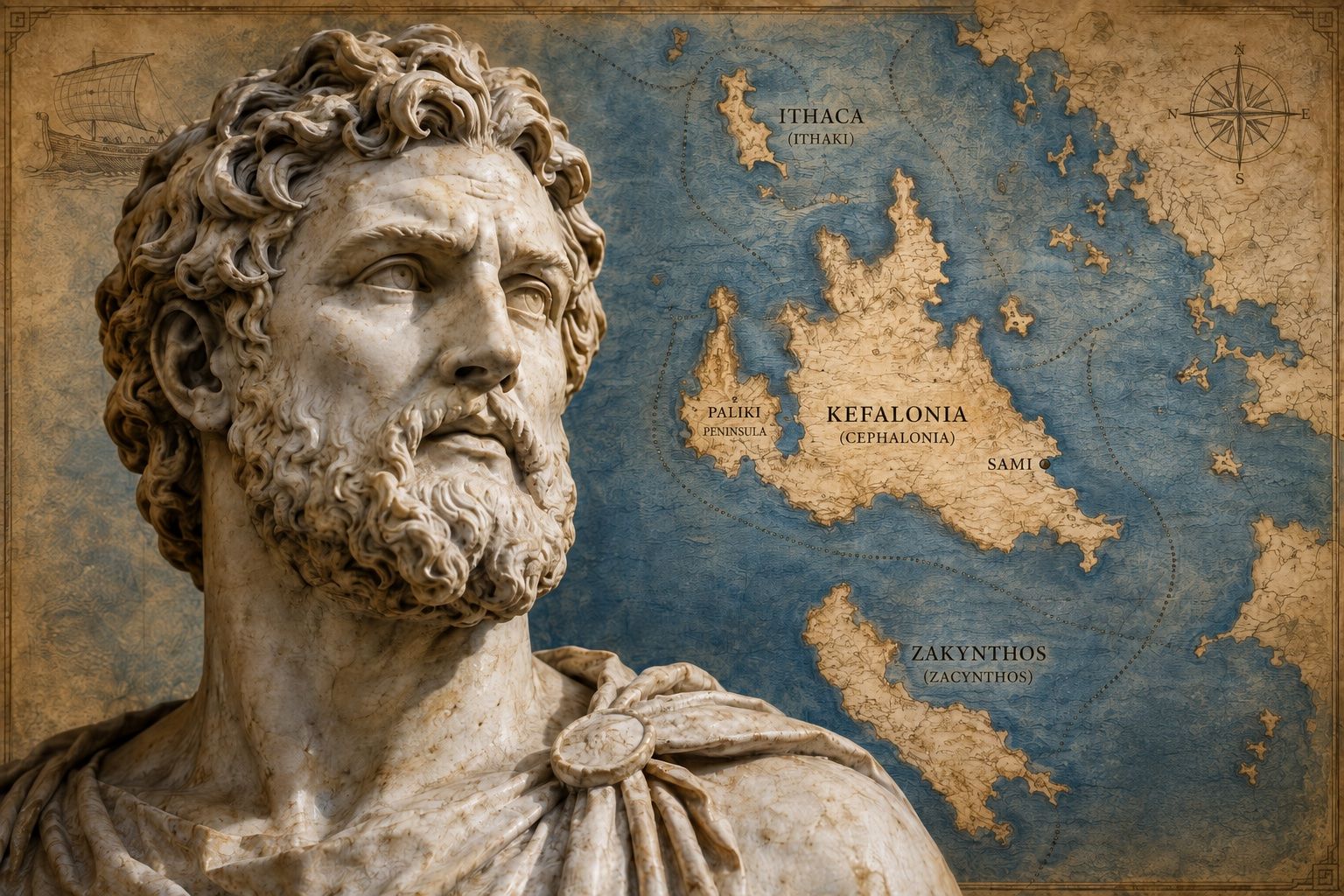
Except Homer’s description of Ithaca does not line up perfectly with the island on the modern map. And that has led some researchers to make a provocative claim: the real homeland of Odysseus may have been part of neighboring Kefalonia.
More specifically, they believe it may have been Paliki, the large peninsula on the western side of Kefalonia.
The argument has created a very Greek kind of dispute, mixing ancient poetry, archaeology, geography, local pride and two neighboring islands that would both very much like to claim one of the most famous heroes in Western civilization.
The Problem With Homer’s Directions
The mystery begins with a passage in The Odyssey in which Odysseus describes his homeland.
He says Ithaca lies near several other Ionian islands. He also describes it as low-lying and positioned farthest toward the west.
That is where things become awkward.
Modern Ithaca is not west of Kefalonia. It lies to the east. It is also not particularly low-lying. Anyone who has visited knows that Ithaca is steep, rugged and mountainous.
Paliki, on the other hand, is a broad peninsula on the western side of Kefalonia—today firmly connected to the main island by a narrow isthmus, though some researchers have argued it may once have been a separate island in antiquity—and it has a noticeably gentler, more open landscape.
That does not prove Paliki was Homer’s Ithaca. But it does mean that some of Homer’s directions appear to fit Paliki better than they fit the island known as Ithaca today.
There is another problem. Homer names several islands in Odysseus’ kingdom, but scholars still disagree about which modern islands match all of those ancient names. For example, “Dulichion” is sometimes linked to a cluster of small islets off western Greece, but no one agrees which ones; “Sami” is variously identified with either modern Kefalonia or a nearby offshore island; and “Zacynthos” clearly matches modern Zakynthos, but its exact role in Odysseus’ realm is still debated.
In other words, the map has never been as neat and obvious as it appears.
The Kefalonia Theory
The idea that Odysseus may have ruled from Kefalonia has been around for more than a century.
It gained new attention in 2005 with the publication of Odysseus Unbound, a book arguing that Paliki was once a separate island and was later joined to Kefalonia by earthquakes and landslides.
The theory offered a tidy explanation. If Paliki had been an island during the time associated with Odysseus, it could have been the Ithaca Homer described.
Researchers spent years studying the landscape, drilling into the ground and examining whether an ancient sea channel had once separated Paliki from the rest of Kefalonia.
Eventually, the evidence showed that it had not.
Paliki was connected to Kefalonia during the period in question, just as it is today.
For critics, that discovery should have ended the theory.
But instead of walking away, the researchers asked a different question.
What if Homer never actually said Ithaca was an island?
Was Ithaca a Place, Not an Island?
When scholars returned to the original Greek text, they noticed something surprising.
Homer often refers to Ithaca as a homeland, a territory or a community. But according to supporters of the Paliki theory, he never clearly calls Ithaca an island.
That distinction matters.
Their argument is that Ithaca may not have been the name of an entire island. It may have been the name of a region located on a larger island.
Under that interpretation, Paliki could have been the kingdom or territory called Ithaca, while the larger island was what we now know as Kefalonia.
There are passages in The Odyssey where Homer appears to mention “the island” and “Ithaca” separately. Supporters of the theory say this could mean Odysseus landed on a larger island and then entered the territory known as Ithaca.
They also point to The Iliad, where the people ruled by Odysseus are called Cephallenians—a name that sounds suspiciously close to Kefalonians.
None of this is definitive. Ancient Greek words do not always fit neatly into modern categories, and Homer was writing poetry, not issuing property records.
But it is enough to keep the argument alive.
Ithaca Has Its Own Evidence
Modern Ithaca is not surrendering Odysseus without a fight.
Archaeologists have discovered important ancient remains on the island, including a large site in northern Ithaca often called the “School of Homer.”
The ruins show that a significant settlement existed there during the ancient period traditionally connected to the world of Odysseus.
Researchers have found large stone walls, staircases, storage areas and other evidence suggesting that the site may once have been an important center.
Objects found there also show that people on Ithaca worshipped Odysseus as a hero many centuries after the events described by Homer would have taken place.
Pieces of pottery and roof tiles carrying versions of his name have been discovered, along with coins, offerings and a small bronze image that may represent him.
Similar objects connected to Odysseus were also found in a cave on the island.
This is strong evidence that ancient Ithacans believed their island was connected to the hero.
But it still does not prove that archaeologists have found Odysseus’ palace—or even that Odysseus was one real historical person.
The discoveries show that the story of Odysseus was deeply rooted on Ithaca in ancient times. They do not settle exactly where Homer imagined his kingdom to be.
Kefalonia Has Ancient Clues Too
Kefalonia has also produced major archaeological discoveries from the period associated with the world behind Homer’s stories.
Ancient tombs, settlements and burial sites have been found across the island. One particularly impressive royal-style tomb was discovered near Poros in southeastern Kefalonia.
That discovery led to yet another theory: perhaps Odysseus lived in southeastern Kefalonia rather than Paliki.
So even among those who believe Homer’s Ithaca was on Kefalonia, there is no single agreed location.
Paliki has geography that appears to match Homer’s description.
Southeastern Kefalonia has important ancient remains.
Modern Ithaca has the name, the tradition and clear evidence that Odysseus was worshipped there.
Everyone has clues. Nobody has the smoking gun.
Homer Was Not Writing Google Maps
There is also a simpler possibility.
Homer may never have intended his geography to be followed with complete precision.
The Odyssey was shaped through generations of oral storytelling before it was written down. The poem may contain real places mixed with older memories, changing coastlines, poetic invention and details borrowed from different islands.
Homer was telling one of the greatest stories ever created. He was not preparing directions for future tourists.
It is also possible that the name Ithaca moved over time, or that ancient territories did not match the island boundaries and place names we use today.
And, of course, there is still no proof that Odysseus existed exactly as Homer described him.
He may have been inspired by a real ruler. He may represent several ancient figures combined into one hero. Or he may belong entirely to the world of myth.
So Where Did Odysseus Come Home?
Modern Ithaca remains the traditional home of Odysseus. It has carried the name for centuries and possesses ancient evidence showing that people there strongly claimed the hero as their own.
But Kefalonia presents questions that are difficult to dismiss.
Why does Homer describe Ithaca as lying toward the west when modern Ithaca lies east of Kefalonia?
Why does he describe it as low-lying when the island is mountainous?
Why does he call Odysseus’ people Cephallenians?
And why, despite many opportunities, does Homer apparently never state plainly that Ithaca itself was an island?
Those questions do not prove that Odysseus came from Kefalonia.
They do prove that one of the best-known addresses in Western literature may not be as settled as everyone assumes.
Christopher Nolan has brought The Odyssey roaring back into global popular culture, introducing Homer’s wandering hero to a new generation.
But the most enduring mystery remains the same one that drove the ancient story.
Odysseus is still trying to find his way home.