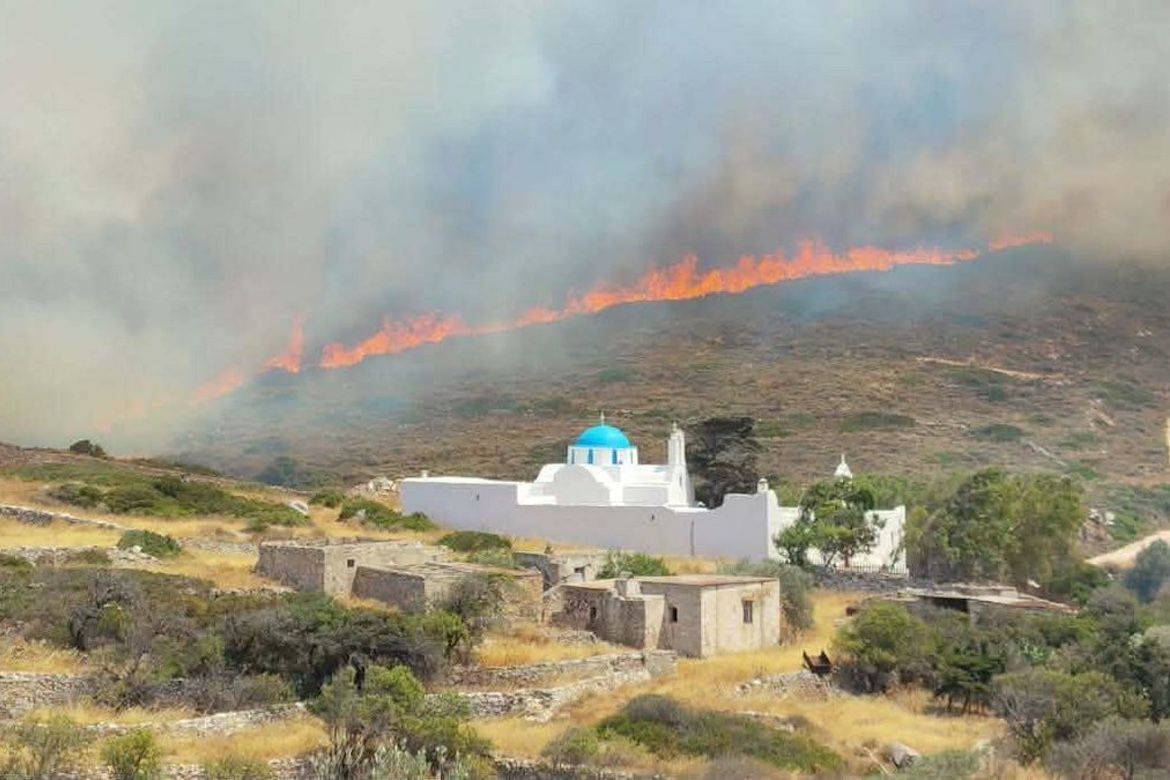

The fire that began at the island’s landfill affected nearly 2,400 acres. It was not simply another summer wildfire. It was a warning about what happens when five-star development is built on infrastructure that cannot support it.
Paros is selling paradise to the world.
Five-star hotels. Private villas. Beach clubs. Infinity pools. Celebrity visitors. Record arrivals. More construction, more investment and more money pouring into an island that has become one of the hottest destinations in the Mediterranean.
Then the garbage dump caught fire.
According to preliminary findings from fire investigators, the blaze that tore through southern Paros began inside the island’s landfill, in an area where branches, household refuse and other waste had accumulated.
Strong winds carried the fire out of the facility and across the surrounding landscape, forcing evacuations and affecting approximately 975 hectares.
That is more than 2,400 acres—almost three times the size of Central Park and close to five percent of the entire island of Paros. The measurement reflects the area reached by the fire, with the final burned area still subject to more detailed satellite analysis. But whichever way the figure is eventually refined, the magnitude is clear.
This was a major environmental disaster that began in the island’s garbage.
And that is what makes it more than another story about a Greek wildfire.
The Paros fire exposed the basic contradiction at the heart of the Cyclades’ luxury boom. Greece is approving and promoting enormous amounts of new development on islands where the roads, water systems, sewage networks, waste facilities and emergency services were never built to handle it.
The mayor of Paros told Kathimerini that the landfill’s area had recently been expanded after reaching capacity. The island produces approximately 13,000 metric tons of waste every year, with 70 to 80 percent of it arriving during the summer tourist season.
Research by Common Seas has estimated that the volume of waste produced on Paros increases by at least 350 percent between April and October.
So while Paros is adding hotel rooms, villas, restaurants and pools, the island is also producing mountains of additional garbage during a few short months—and sending it to a landfill that was already full.
When that landfill caught fire, neighboring Antiparos announced that it could no longer send its own waste to Paros for disposal.
That single detail tells the larger story better than any government study. One fire at one overloaded facility left two major tourist islands scrambling to figure out where to put their garbage at the height of summer.
Meanwhile, construction continues.
State figures reported earlier this year showed that 459 building permits were issued on Paros during the first ten months of 2025. Not every permit represents a massive hotel, but that is still a staggering amount of building on an island of fewer than 200 square kilometers.
One nearly completed five-star development near Marcello beach reportedly includes 46 private swimming pools and two more communal pools.
Forty-six private pools at one hotel, while the island is already confronting serious questions about water, sewage, waste management and overdevelopment.
Nobody is suggesting that a swimming pool caused the landfill fire. That would be ridiculous. But the hotel is a perfect example of the disconnect between what is being built and what the island can realistically carry.
Every pool needs water. Every hotel room produces sewage. Every restaurant produces garbage. Every villa built on a remote hillside needs a road that can accommodate not only delivery vans and rental cars, but an ambulance or fire truck when something goes wrong.
Those things are not optional extras. They are part of the development.
Yet we continue to act as though the hotel, villa or resort ends at the property line—and everything that happens beyond it is the municipality’s problem.
This is not only happening on Paros.
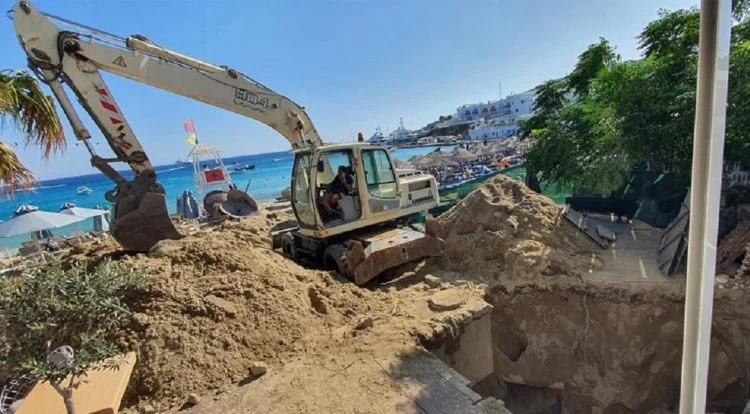
Mykonos received its own warning in July 2021, when failures at municipal pumping stations sent untreated sewage into Megali Ammos and Platis Gialos. Swimming was prohibited at Platis Gialos, a red flag was raised on the beach and tourists reportedly left nearby accommodations because of the sewage and stench.
Think about that for a moment.
One of the most expensive tourist destinations in the world—an island where visitors can spend thousands of dollars a night for a hotel room—could not keep raw sewage from pouring toward one of its most famous beaches.
The Mykonos sewage failure and the Paros landfill fire are not identical events. But they come from the same arrogance: the belief that we can keep building the glamorous parts of tourism while postponing the expensive and unglamorous infrastructure needed to make them work.
And roads may be the most dangerous part of this equation.
Across the islands, villas and hotels are spreading into areas once served by narrow rural lanes. Those roads may be charming on an Instagram video. They are less charming when two cars cannot pass, traffic is backed up for kilometers or a fire engine cannot reach a burning property.
The fire on Paros moved through difficult terrain and ravines. The next fire may move toward an area packed with newly built villas, with hundreds of residents and visitors trying to leave on roads that were never designed for that kind of traffic.
We keep talking about tourism growth as though arrival numbers and hotel capacity are the only measurements that matter.
How many people can the island supply with water?
How much sewage can it treat?
How much garbage can it process?
Can firefighters reach every development being approved?
Can residents still move around their own island in August?
These should not be questions asked after a landfill catches fire or sewage reaches a beach. They should be answered before another building permit is issued.
This is not an argument against tourism. Paros depends on tourism, as do Mykonos, Santorini and most of the Cyclades. Hotels, restaurants and rental properties provide jobs and support thousands of Greek families.
But development without infrastructure is not progress. It is simply passing the cost to somebody else.
The developer sells the villas. The hotel collects the room revenue. The beach club charges €30 for a cocktail. And the island is left with the garbage, sewage, traffic, water shortages and emergency risk.
The profits are private. The mess becomes public.
A technical report released by Europa Nostra and the European Investment Bank Institute warned last year that mass tourism and the proliferation of secondary homes were already placing severe pressure on water supplies and waste-management systems across the Cyclades.
The Paros fire was that warning in real life.
Nearly 2,400 acres were affected after a fire began inside a landfill that had already reached capacity. Garbage production on the island explodes during the tourist season. Construction continues at a furious pace. Large new hotel developments keep appearing while the public systems underneath them struggle to keep up.
The investigation will determine exactly how the fire began and who may be legally responsible.
But we already know why this disaster matters.
Paros is being developed like a world-class destination while too much of its infrastructure remains an afterthought.
We cannot keep approving five-star hotels and luxury villas without building the roads, water systems, sewage networks, waste facilities and emergency services required to support them.
That is not anti-development. It is common sense.
Greece has become very good at creating and selling paradise.
The Paros fire showed how quickly paradise can become hell when nobody takes care of what lies underneath it.