
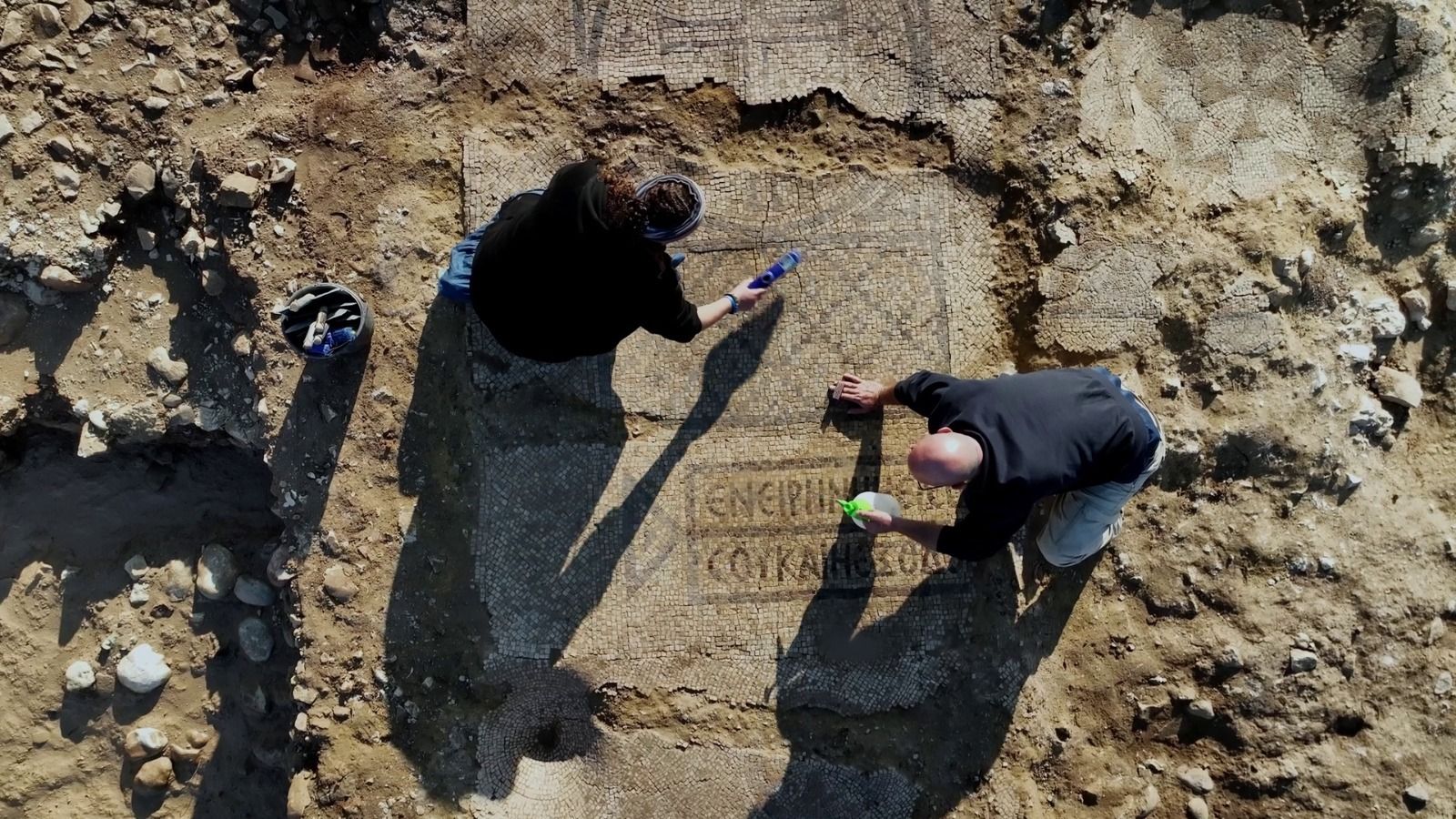
A Byzantine-era mosaic floor bearing a Greek biblical inscription has been uncovered north of Kiryat Gat, Israel. The excavation, led by the Israel Antiquities Authority as part of the development for the new “Karmey Gat North” neighborhood, revealed a sprawling monastery complex dating back to the 5th-6th centuries AD.
At the heart of this discovery is a Greek inscription from Deuteronomy 28:6, reading, “Blessed are you when you come in and blessed are you when you go out,” embedded in the monastery’s intricate mosaic floor. The floor features elaborate designs with crosses, lions, doves, amphorae, flowers, and geometric patterns, crafted with tiny mosaic stones that accentuate its cross-shaped decorations.
The monastery complex includes a sophisticated winepress, a large warehouse, and at least ten other structures. The winepress, notable for its blue and white mosaic flooring and red-painted collecting vats, shows signs of multiple renovations, indicating continuous use and significant investment.

Photo Credit:Emil Aladjem, Israel Antiquities Authority
Excavation managers Shira Lifshitz and Maayan Margulis highlighted the site’s strategic placement at a major crossroads linking mountain region to the coastal plain, serving both local settlements and travelers passing by. The discovery is considered by researchers as the largest and most important Roman and Byzantine site in the region.
Artifacts recovered from the site—imported pottery, coins, marble fragments, metal and glass vessels—point to a wealthy and active community that already existed during the Roman period and continued to thrive for about 600 years.
Cover Photo Credit: Emil Aladjem, Israel Antiquities Authority