
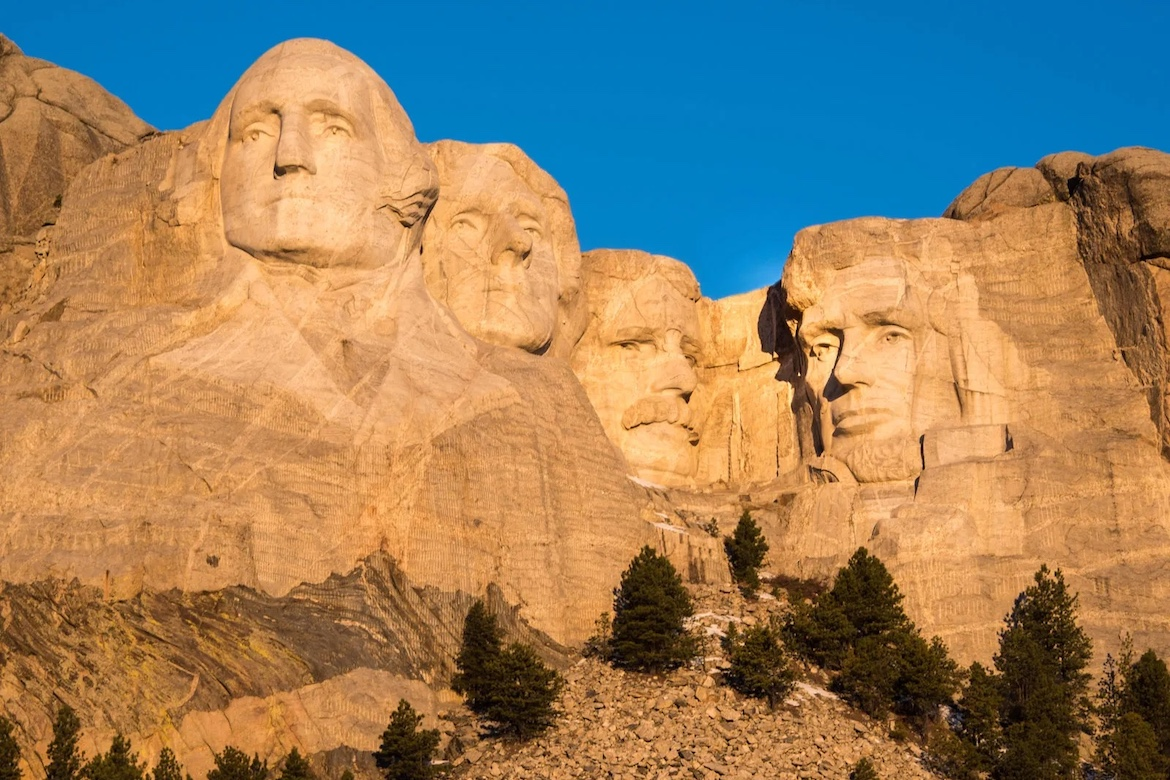
When America’s Founding Fathers dreamed up their new republic, they looked to ancient Greece for inspiration. That influence carried on in surprising ways—including in the creation of one of America’s most famous landmarks: Mount Rushmore.
The project began in the 1920s as a plan to honor Wild West heroes in South Dakota. Sculptor Gutzon Borglum convinced officials to think bigger: a national monument to four presidents—George Washington, Thomas Jefferson, Abraham Lincoln and Theodore Roosevelt.
But carving 60-foot faces into a granite cliff came with a problem. How could workers suspended on ropes know exactly where to drill?
Borglum’s solution came from antiquity. He adapted an ancient Greek technique known as the “pointing machine,” once used to replicate statues. The device could measure precise points on a small model and transfer them onto a much larger scale.
With a giant version of the pointing machine fixed to the mountain, workers could drill with accuracy—turning Borglum’s miniature model into the massive stone faces we know today.
Construction went on for 14 years. It was never fully completed, cut short by Borglum’s death and World War II. Still, the work done was enough to create one of the most recognizable monuments in the world—made possible thanks to a touch of ancient Greek ingenuity.