

2025 is a landmark year for Greece’s energy sector, cementing the country’s status as an energy hub in Southeastern Europe.
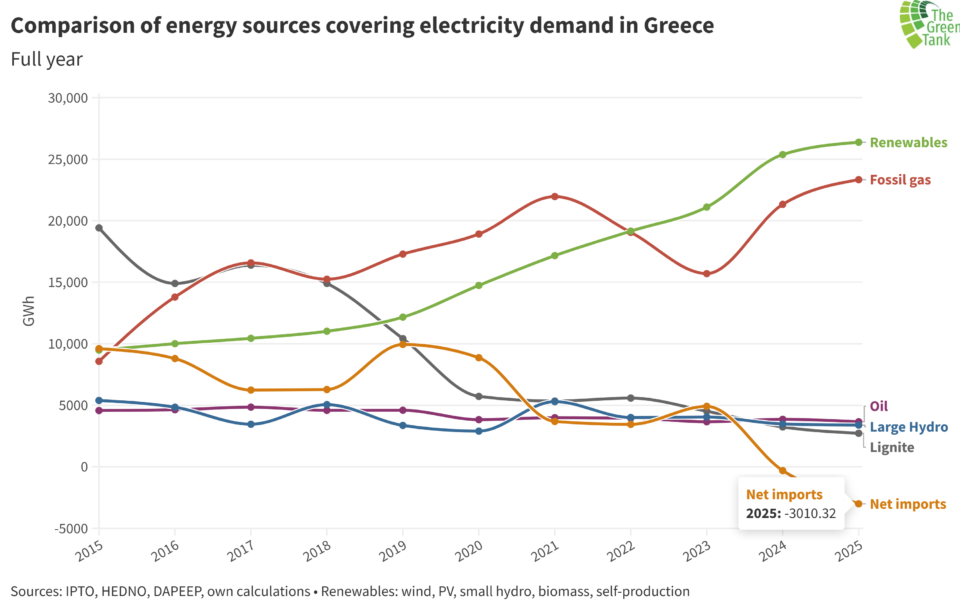
According to a new analysis by the Green Tank, Greece achieved historic highs in both electricity export and electricity production. For the first time, Greece operated as a net electricity exporter for 11 out of 12 months, achieving an export volume of approximately 3 TWh.
This surge was fuelled largely by fossil gas, which reached a record production high of 23.3 TWh, and which also covers 41.3% of domestic demand. Conversely, lignite production collapsed to an all-time low of 2,723 GWh in 2025, down nearly 16% from the previous year.
Renewable Energy Sources (RES) claimed the top spot in the electricity generation mix, covering a record 46.7% of Greece’s domestic demand. Yet, this milestone masks a concerning deceleration, as RES production grew by only 3.9% in 2025, a sharp decline from the 15% average annual growth seen over the previous six years.
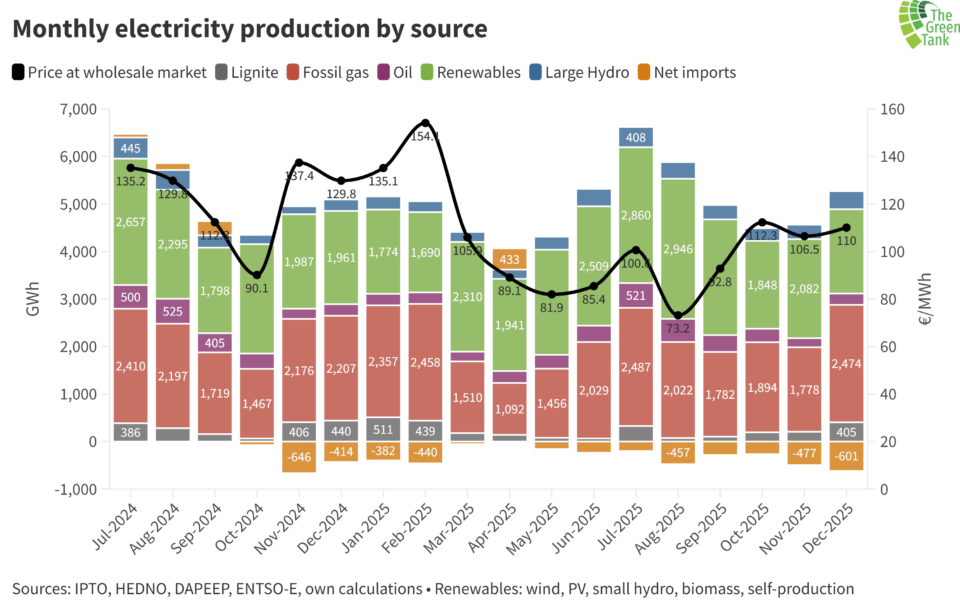
This slowdown is partly driven by a dramatic rise in energy waste. Green energy curtailments—electricity rejected by the grid due to oversupply—more than doubled to 1,867 GWh (or 6.6% of total RES production.) Thus, the increase in wasted green energy (968 GWh) essentially cancelled out the total increase in RES production (1,001 GWh) for the entire year.
The RES sector also saw a significant internal divergence: while photovoltaic production soared by 1,879 GWh to 4,409 GWh, wind generation fell by 895 GWh to 10,065 GWh.
Despite the influx of renewables and a doubling of hours with negative or near-zero prices (483 hours in 2025 vs 186 hours in 2024), Greek wholesale electricity prices remained stubbornly high. According to the Green Tank “high dependence on expensive fossil gas and the partial utilization of cheap RES” makes Greece the 8th most expensive market among 25 non-island EU countries.
Overall, clean energy sources (wind, solar, hydroelectric, biomass, self-production) produced 29,768 GWh, only marginally outpacing fossil fuels (natural gas, lignite, oil) at 29,719 GWh.
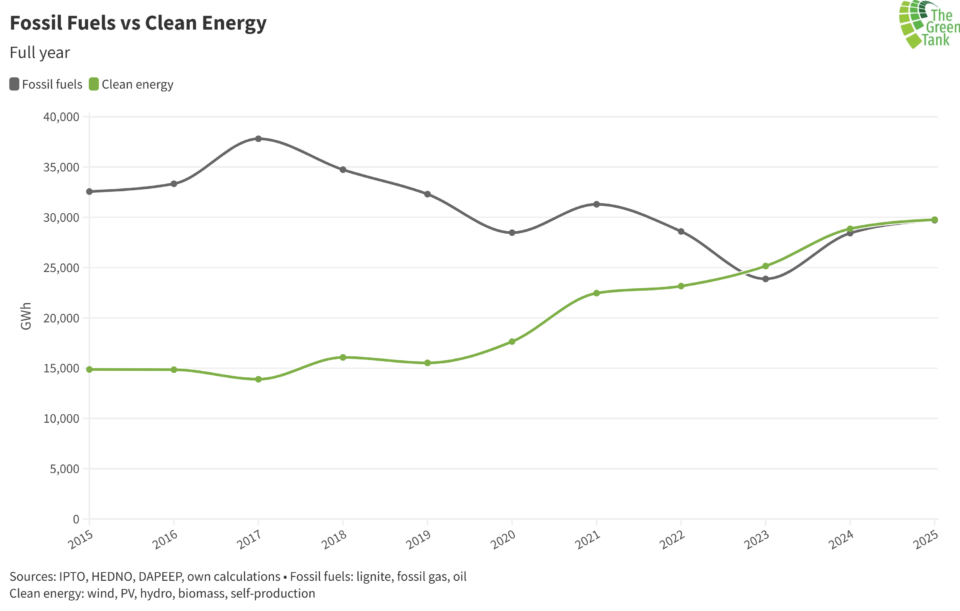
Because gas production grew twice as fast as renewables, the overall share of fossil fuels in the production mix actually increased from 48.8% in 2024 to 49.9% in 2025, while RES increased by only 0.5% from 49.5% in 2024 to 50% in 2025.