
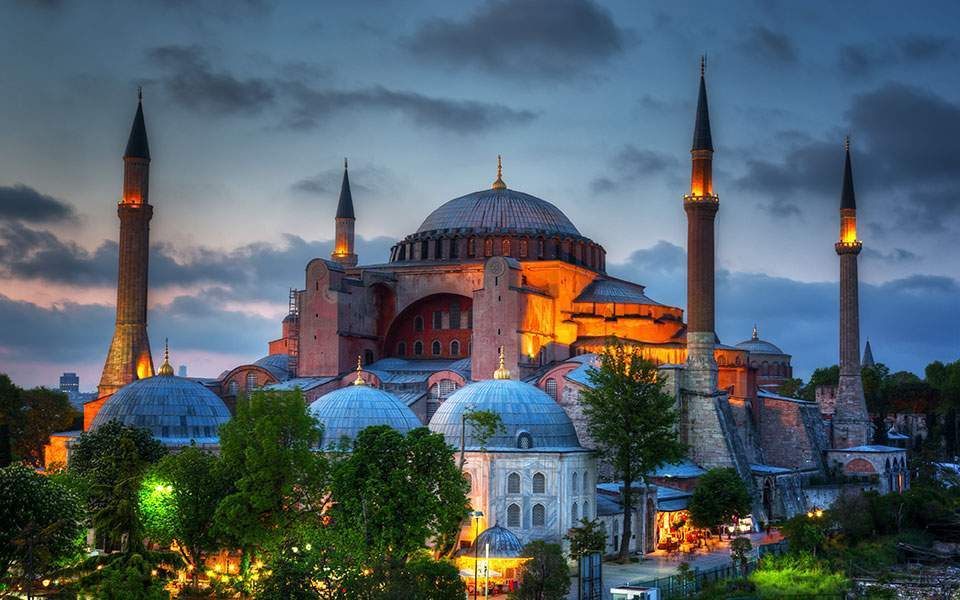
A Greek seismic expert has expressed concern regarding the structural integrity of Hagia Sophia following a 6.2-magnitude earthquake that recently struck Istanbul. Dr. Efthymios Lekkas, Professor of Dynamic, Tectonic, Applied Geology, and Natural Disaster Management and president of Greece’s Earthquake Planning and Protection Organization, warned that a stronger tremor could cause serious damage to the 1,500-year-old Byzantine era structure.
Appearing on Greek public television, Lekkas explained that while the recent quake did not severely impact the structure, a larger event, possibly reaching 7.0 on the Richter scale, could have catastrophic consequences for Hagia Sophia. He noted that the monument has already sustained significant wear over the centuries, worsened by environmental factors and recent changes to its interior environment following its reconversion into a mosque.
“The shell of this historic monument is 1,500 years old and its structural elements have deteriorated. There are external factors, mainly weather conditions, because [Hagia Sophia] is not built of marble like the Parthenon, but of construction materials,” Lekkas stated, adding that “we also have internal wear from the disintegration of materials and changes to the internal microclimate due to millions of visitors and worshippers.”
Turkish authorities have already launched an extensive restoration project. The work focuses on reinforcing the central and secondary domes using lighter and more resilient materials, replacing lead coverings, and upgrading the steel framework.
Ahmet Gulec, a member of the scientific board that supervises the restoration, explained the challenges of the restoration process to Hürriyet Daily News. “The underside of the dome is covered in mosaics, making structural intervention from below nearly impossible,” said Güleç. “To address this, the restoration will focus on the exterior, starting with the removal of the lead cover and cement-based materials that have caused damage over time.”