

The Hellenic Statistical Authority (ELSTAT) has announced the strength Greek Merchant Fleet for October 2025 showing a small but steady increase in the number of Greek-registered vessels flying the Greek flag. This analysis does not include the myriad of Greek-owned vessels registered abroad, mostly to flags of convenience.
According to ELSTAT’s provisional data, the Greek fleet of vessels with a capacity of 100 GT and over increased by 0.6% compared to October 2024, reaching 1,846 vessels. An increase of 0.4% had been recorded during the corresponding period, last year.
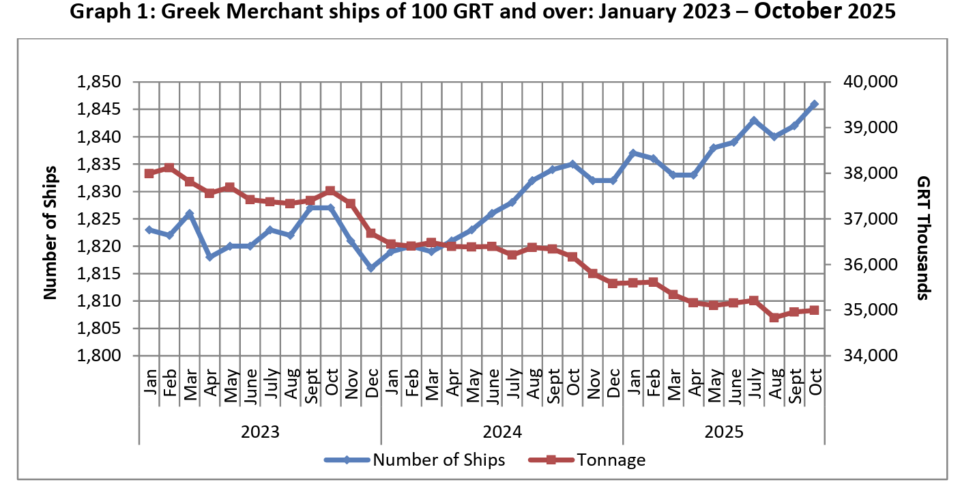
Image Credit: ELSTAT
Despite the continued increase of the Greek merchant fleet, its total capacity has decreased by 3.2%, continuing the downward trend of previous years. The fleet’s capacity now stands at 34.99 million GT, compared to 36.16 million GT in October 2024 and 37.61 million GT in 2023.
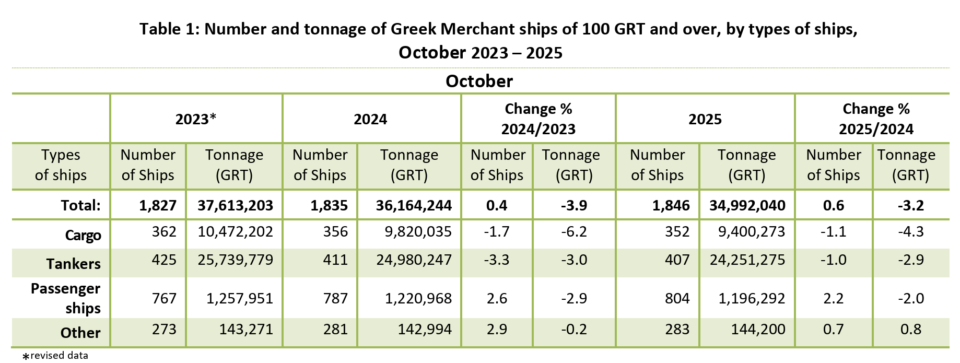
Image Credit: ELSTAT
Passenger ships are seeing their numbers rise on an annual basis thanks to blossoming tourism. Of the 1,846 total vessels in the Greek merchant fleet, 804 are passenger ships (a 2.2% increase), while the number of cargo ships (now 352 vessels) and tankers (now 407 vessels) decreased by 1.1% and 1.0% respectively compared to 2024.
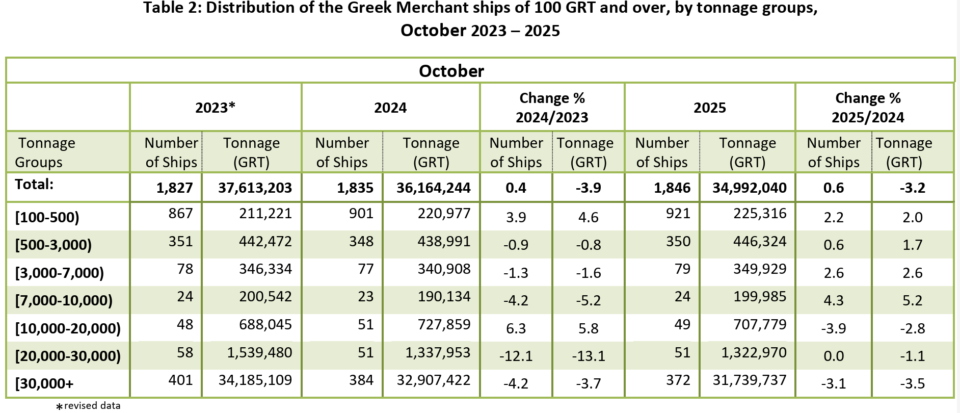
Image Credit: ELSTAT
The distribution of ships by gross tonnage highlights a continued preference for smaller categories, especially up to 500 GT which includes superyachts and small commercial ships. These increased by 2.2% compared to 2024. In contrast, the number of ships over 10,000 GT flying the Greek flag continues its mostly downward trend.
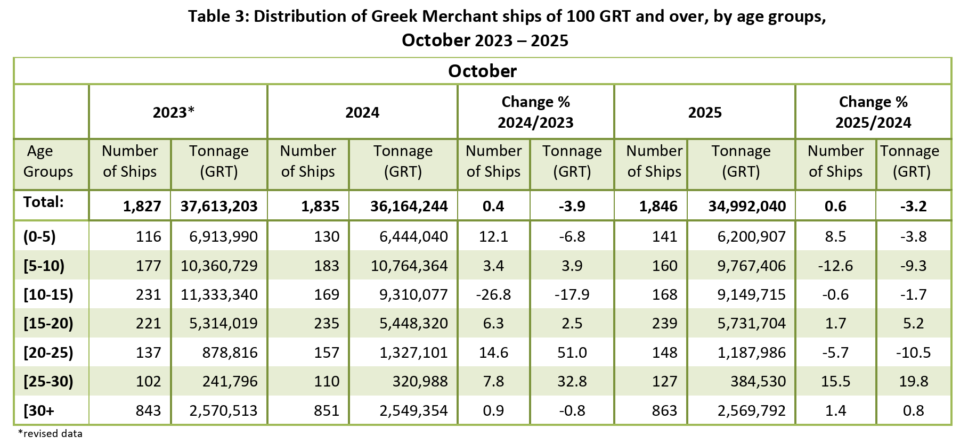
Image Credit: ELSTAT
The ELSTAT analysis also highlights key shifts in fleet age, with the newest vessels (0–5 years old) increasing by 8.5%, while another notable increase of 15.5% was recorded for vessels aged 25–30 years.
This pattern highlights dual characteristics within the Greek fleet. On one hand, it’s modernizing with smaller, newer vessels for the local market, many of which are also just under the important regulatory threshold of 500GT.
On the other hand, an increase in the number of older ships reflects market uncertainty for larger vessels like tankers and cargo ships. Here, Greek shipowners are adopting a ‘wait-and-see’ attitude regarding future technologies and compliance regulations mandatory for these ships.
Their solution is to hold-on to their current assets for as long as possible, or take advantage of the high international demand for second-hand ships, as demand of high-tech newbuildings is outstripping supply.
Read the ELSTAT report here.