
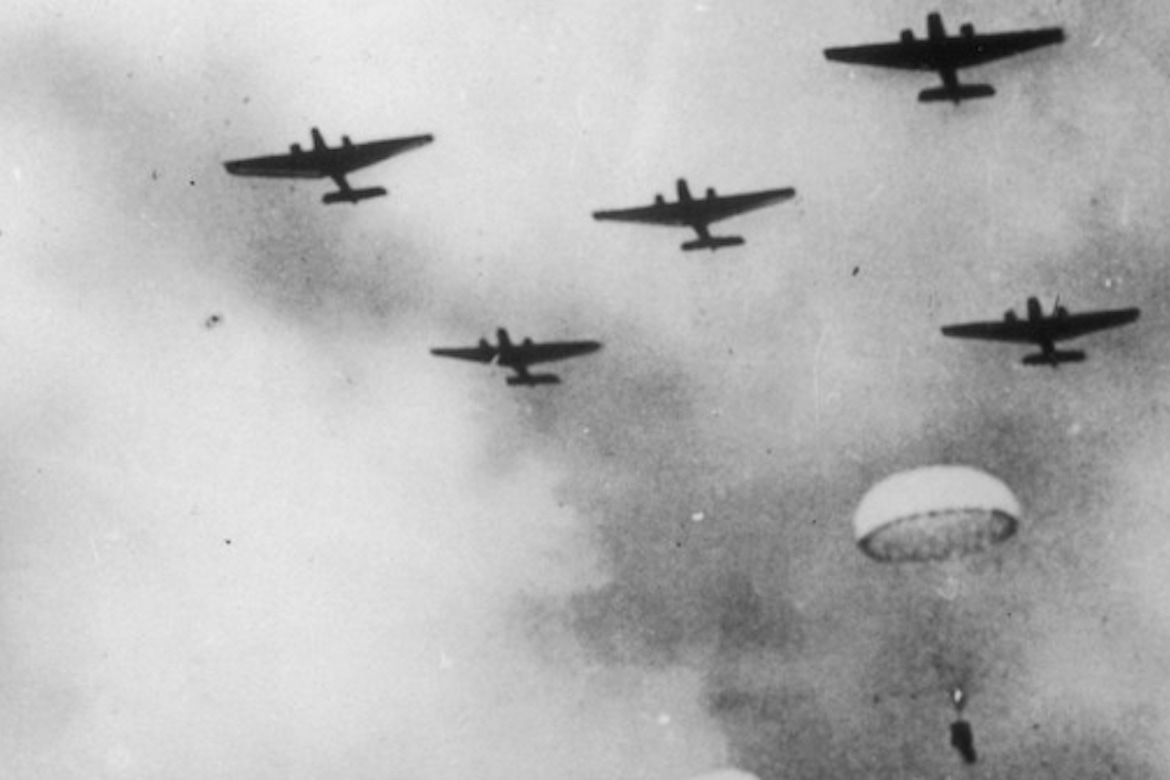
On May 20, 1941 the islanders of Crete were awakened by the sound of airplanes — hundreds of them — and “umbrella men” falling from the sky in what was an unprecedented airborne attack on an island.
That day marked the start of the epic Battle of Crete, when the Nazis launched Operation Mercury and history would be changed forever.
Big words? No. Not at all.
Unfortunately, you won’t read about this in most American history books. Victors write history and although Greece was on the side of the victors, the country was too destitute and poor, not to mention in the throws of a civil war immediately after WWII — too preoccupied to bother herself with taking her part in the history writing.
So the Brits, Americans and others wrote the history of the war and we learn about Dunkirk, the Battle of the Bulge and the Battle of Britain… but rarely about Crete.
But the truth is, Crete changed the course of the war and all of world history in so many ways. It was an unprecedented battle on so many fronts, three of which should have brought much more attention to this epic battle.
(1) It was the first battle where German paratroops (Fallschirmjäger) were used on a massive scale, but also the first mainly airborne invasion in military history. Because of the heavy casualties suffered by the paratroopers — 6,000 dead or missing in action — Adolf Hitler forbade further large-scale airborne operations.
Hitler was using Crete as a testing ground for his elite paratroopers. It was a dry run for an airborne invasion of the British Isles, which never materialized since Crete ended up so tragic for him. One has to wonder what the outcome of the war would have been had the Cretans surrendered from day one (like so many other European countries did) and if Hitler would have invaded Britain.
(2) Crete was the first place the invading German troops encountered mass resistance from a civilian population, including the kidnapping of a German general. Two thousand civilians died at the execution wall in the first month of occupation alone and brutal reprisals followed for the next three years of occupation.
The massive and unprecedented resistance — not seen by the French, the Poles or any European people before Crete — led Hitler to send an angry cable to Kurt Student, his general on the island.
“FRANCE FELL IN EIGHT DAYS. WHY IS CRETE STILL FREE?”
(3) Even though Crete eventually fell and the Germans occupied the island, the Cretans never stopped fighting. Hitler was forced to focus on the tiny island and send valuable troops and reinforcements. The unwanted attention to Crete caused him to delay his planned Spring invasion of Russia and instead divert attention to hotbeds of resistance like Crete.
The end result? A delayed invasion of Russia and a catastrophic end in the ice and snow of the Russian winter — something Hitler hadn’t planned.
Hitler won the battle, but with great losses that were noted in German archives and by German commanders in various biographies and testimonies. Hitler lost more men in the Battle of Crete than in any previous battle in the war up to that time.
Hitler’s Chief of Staff, Field Marshal Wilhelm Keitel admitted during the Nuremberg Trials, “…the unbelievably strong resistance of the Greeks delayed by two or more vital months the German attack against Russia; if we did not have this long delay, the outcome of the war would have been different in the Eastern Front and the war in general. And others would be sitting here today.”