
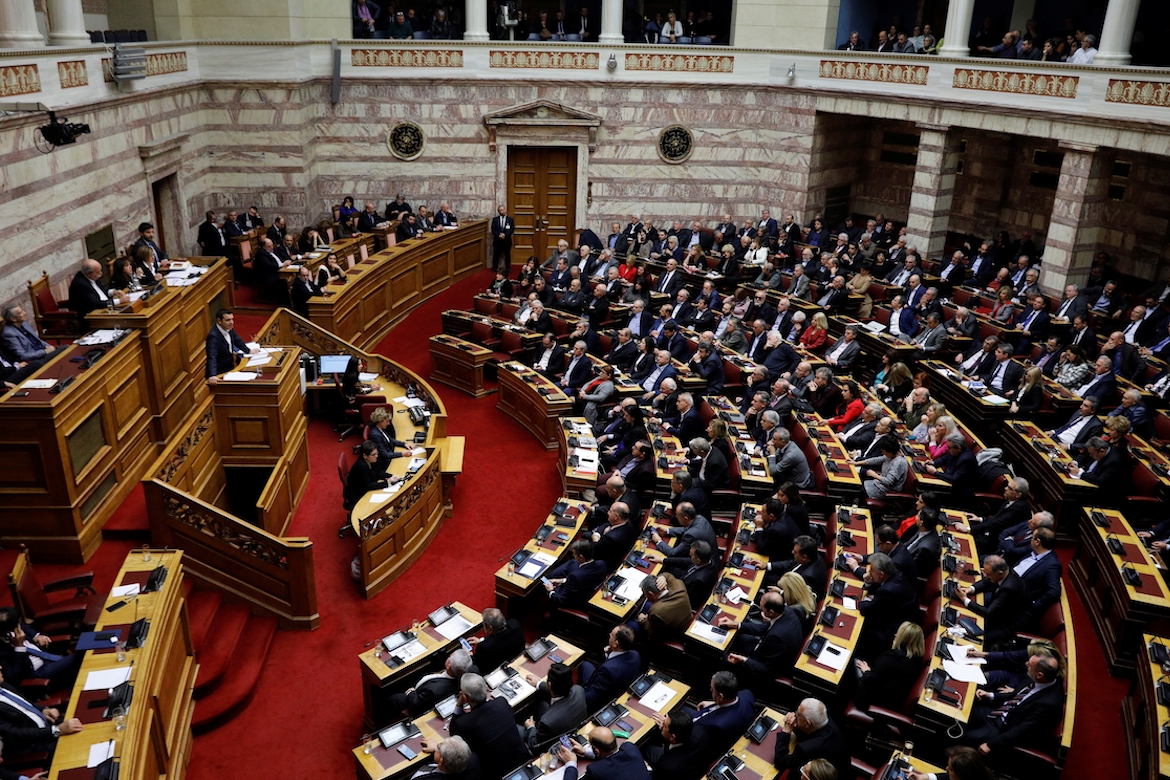
An analysis of the make up of the Hellenic Parliament reveals a significant crisis of representation following Greece’s parliamentary elections that took place in June 2023.
The study, conducted by Jenny Mavropoulou, a PhD candidate from the Department of Political Science and History at Panteion University, was presented at an event co-organised by the Friedrich Ebert Stiftung and the Institute for Social Democracy (InSocial).
According to the analysis, young people, women, and the working class are largely absent from the current Hellenic Parliament.
The typical Greek MP is characterized as a male, aged 60 or older, possessing high academic qualifications (university or postgraduate education), originating from the upper social strata, and holding previous experience in local government. An overwhelming majority of MPs, 98.2%, possess a higher academic education level.
255 MPs, or 87% of the Hellenic Parliament, belong to Greece’s upper social class. The lower social strata are severely underrepresented, with only 18 Greek MPs (6.1%) identified as being part of the working class, and 20 MPs (6.9%) originating from the lower class. Lawyers are the most prevalent group in the Hellenic Parliament, accounting for 66 MPs overall.
The study also points out an absence of young voices in the Hellenic Parliament. There are no elected MPs under 30 years of age, while the next youngest age group (30–39 years old) is represented by only 25 out of a total of 300 Greek parliamentarians.
Gender representation in the Hellenic Parliament also falls short, as only 69 women (23%) were elected in the June 2023 elections. This total is in direct contrast to Greek electoral law, which mandates a minimum of 40% women on ballots.
Left-leaning parties achieve a greater gender balance, up to 50% for Course of Freedom, starkly contrasting with New Democracy, whose MPs include only 30 women (19.3%).
Manina Kakepaki, a researcher at Greece’s National Centre for Social Research, noted that the current makeup of the Hellenic Parliament is also the result of institutional exclusions.
“Greece has the highest minimum age limit for eligibility to stand for election in Europe—25 years, along with Italy. In most countries, citizens can run for office starting at 18. This in itself restricts political renewal,” she stated.