
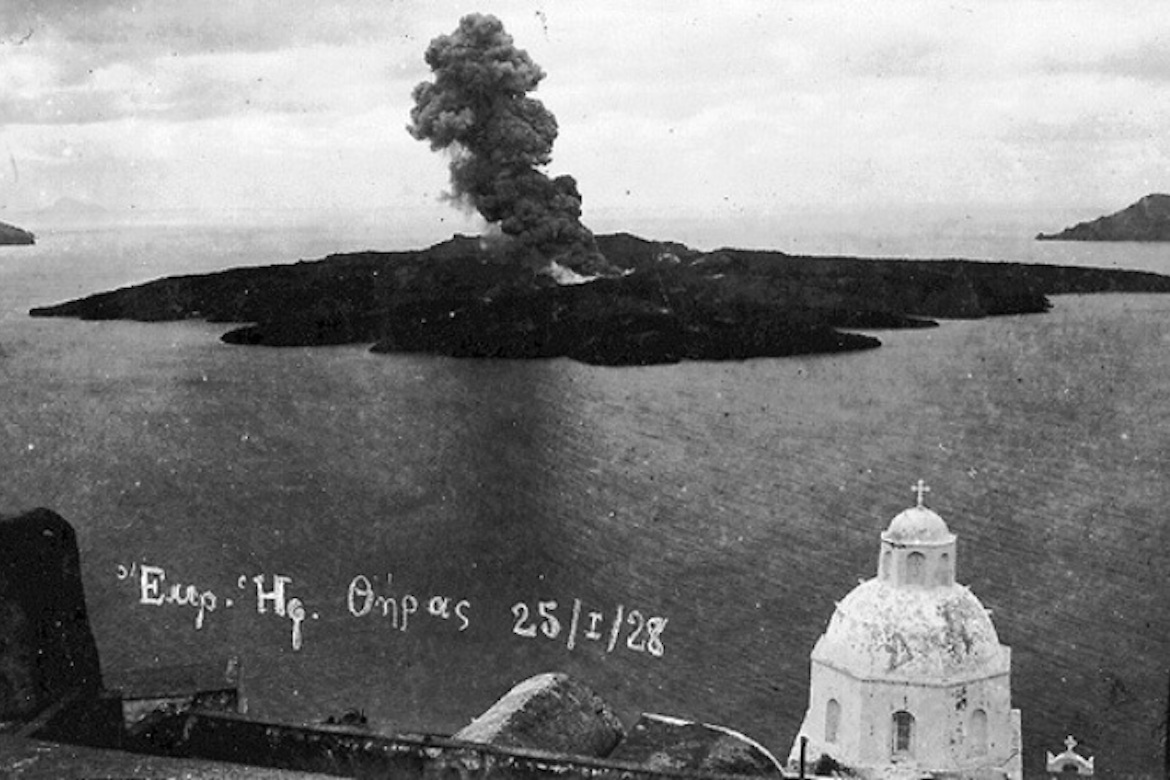
The restless volcano of Santorini—believed to be the original cause of the downfall of the Minoan civilization in Crete more than 3,000 years ago—erupted numerous times in the 20th century, beginning in 1925 and continuing for almost four years.
Explosions sent ash two miles into the air and terrified locals, whose homes were perched high up on the cliffs of the caldera, or rim of what was left after the last big eruption.
The photo above was taken on January 25, 1928.
Today the volcano serves as the backdrop to tens of thousands of tourists, wedding photos and selfies on the popular Greek island. People flock to the tiny volcanic island in Santorini’s harbor to dip into the hot springs and walk the smoldering hills.
However, the region remains geologically restless. In early 2025, a “volcano-tectonic crisis” triggered a state of emergency on the island, and a significant tourism decline.
Greek scientists confirmed this swarm of over 12,800 earthquakes was fueled by a massive underground magma intrusion moving near the submarine Kolumbo volcano. Fortunately, the magma arrested below the seafloor without erupting, and seismic tranquility has since returned to Santorini.