
Levels of plastic and microplastic contaminants are soaring in the Greek seas, leading to a 15-year record of plastic pollution.
Data released by the Archipelagos Institute of Marine Protection and reported by newspaper Ta Nea also warns this surge in plastic pollution is set to peak in the coming days as rainfall washes away inland trash towards the sea.
The findings of the Archipelagos Institute are alarming—in every new sample of seawater taken, the quantity of plastic fibers and fragments often approaches, or even surpasses, that of the number of planktonic organisms in the water. To illustrate this scale, Archipelagos notes that for every cubic meter of seawater containing up to 100,000 planktonic organisms, more than 100,000 pieces of microplastics were detected.
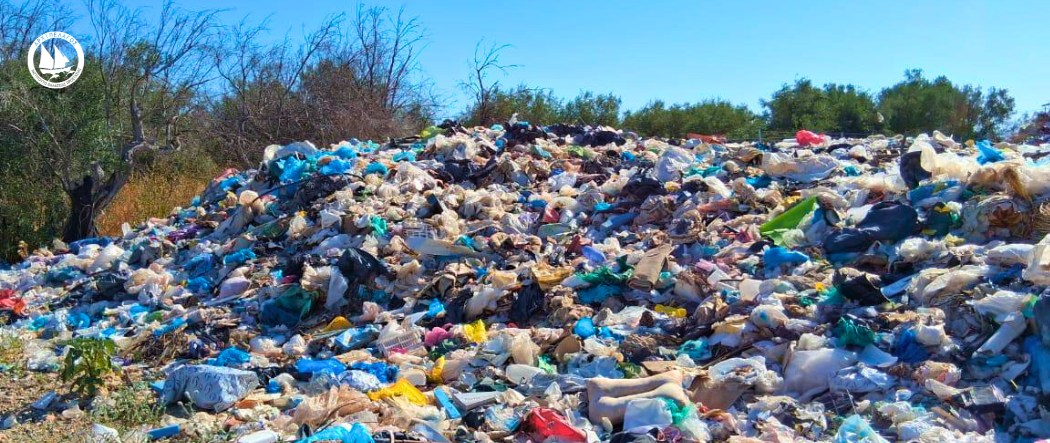
Archipelagos Institute director Thodoris Tsimpidis described the pollution levels in the Argolic Gulf as “hell” to the newspaper Ta Nea. A lawsuit, filed by Tsimpidis himself, speaks of the “unthinkable and organized environmental crime,” the result of systematic dumping of waste into the Tanos riverbed. Tsimpidis also argues that local authorities are turning a blind eye to the thousands of tons of waste dumped along the riverbed, just a mile from the sea.
Archipelagos Institute confirms that the case of the Tanos is unfortunately not an isolated incident. Microplastic concentration is particularly high in 167 beaches from Alexandroupolis, to Crete and from the most popular island to the most uninhabited rocky islets. In remote Gavdos, concentrations of microplastics were found to be as high as in the Central Aegean, while the figures in Keros compare directly with those of Attica. Some plastic samples have been confirmed to contain the biocide PCP, a human carcinogen that makes its way it the human bloodstream.
Archipelagos is critical of the fact that, in a world constantly feeding the sea with garbage, “legislation on waste management and restriction of plastic remains in the sphere of communication, not action.”
In the Nea article, hydrobiologist and Research Director Anastasia Miliou also noted that high concentrations of plastic fibers have been found in marine animals, including dolphins and turtles. Analysis of 350 fish samples from the Northeastern Aegean found that 100% of the fish contained microplastics, averaging 4.68 fibers ingested per fish.
Tsimpidis laments the long-term catastrophe, stating, “We will have garbage in the seas for 30 generations”.