
Greek Prime Minister Kyriakos Mitsotakis is facing swift and furious backlash from Pontian diaspora organizations after remarks he made in Ankara this week, standing alongside Turkish President Recep Tayyip Erdoğan.
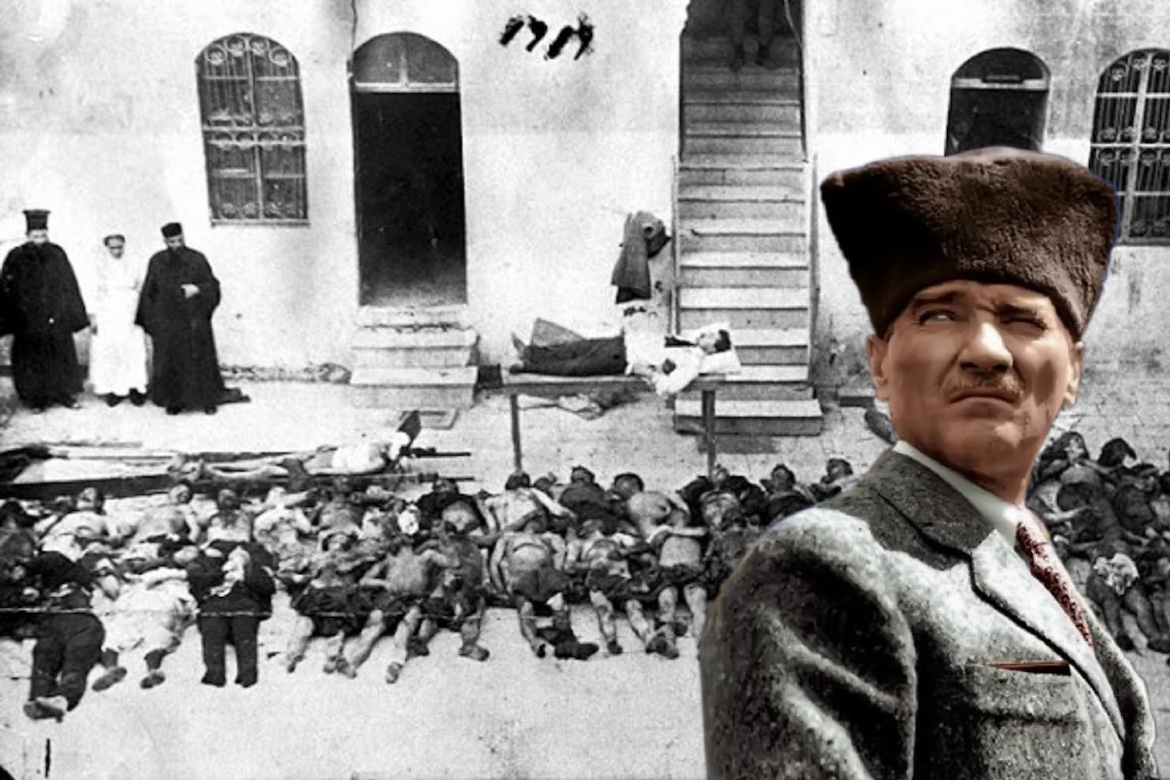
During meetings with his Turkish counterpart, Mitsotakis said Greece and Turkey “must uphold the legacy of Eleftherios Venizelos and Kemal Ataturk,” framing the reference as a nod to the 1930s-era reconciliation associated with the two leaders.
For many descendants of the Greeks of Pontos, Asia Minor, and Thrace—whose communities were destroyed in the years surrounding the end of the Ottoman Empire and the founding of the Turkish Republic—invoking Ataturk as a “legacy” to be safeguarded is not a symbolic olive branch. It’s a moral rupture.
On February 12, the Pan-Pontian Federation USA-Canada issued a public statement addressed directly to the Prime Minister, calling the remarks “profound pain and moral indignation,” and drawing a blunt comparison: no democratic state, they argue, would speak of protecting the “legacy” of Hitler in the name of diplomacy.
Below is the federation’s statement in full.
Statement by Pan-Pontian Federation USA-Canada (February 12th, 2026)
Prime Minister Mitsotakis,
In light of your recent meeting and public statements following discussions with Turkish leadership, we feel compelled to address an issue of profound historical and moral importance. As descendants of the victims of the Greek Genocide, references to protecting the “legacy” of Mustafa Kemal provoke profound pain and moral indignation.
Let us remind you, between 1914 and 1923, more than one million Greeks of Asia Minor, Pontos and Thrace were exterminated, deported or forced into exile. Ancient communities that had endured for millennia were destroyed. Villages were erased, churches desecrated and an entire civilization uprooted from its ancestral homeland. For us, this is not distant history. It is inherited trauma, preserved in testimony, memorials, and the collective conscience of Hellenism.
No democratic state would ever suggest safeguarding the “legacy” of Adolf Hitler in the name of diplomacy. No responsible leader would invoke the legacy of Nazism while disregarding the memory of its victims. Modern state-building, reform or geopolitical necessity should never erase or morally neutralize crimes against humanity. Likewise, for the Greeks of Pontos, Asia Minor and Thrace, the founding period of the Turkish Republic is inseparable from the systematic destruction of our people.
For years, Pontian organizations across the world have consistently and respectfully called for the Greek Genocide to be included as a matter of historical truth and moral responsibility within the framework of Greece’s diplomatic engagements. Rather than building on momentum toward recognition by the international community, we are faced with positions and actions that could hinder that process. Where we expect institutional consistency and a clear national position, we are confronted with silence or ambiguity.
The impact of this regression extends beyond symbolism to affect real human lives. The recent rejection of asylum for Yannis-Vasilis Yaylali, an activist of Pontic Greek descent who has publicly advocated for recognition of the Greek Genocide, has deeply troubled our community and raised serious concerns.
Recognition of the Genocide is not a bargaining tool, nor is it an obstacle to diplomacy. It is a fundamental act of respect toward historical truth and toward the memory of the victims. The marginalization or dilution of this issue does not strengthen Greece’s position, it undermines its moral authority.
We stand for peaceful coexistence and regional stability. We support dialogue based on mutual respect. But reconciliation cannot be built upon historical silence or selective memory. It requires truth, recognition, and moral clarity.
The memory of over one million innocent victims is sacred, inviolable and non-negotiable. Their suffering cannot be minimized, silenced or sacrificed for political or diplomatic convenience.
Greece, the cradle of democracy and the eternal guardian of honor, courage, and justice, holds a sacred duty to uphold historical truth. To remember, to speak and to demand justice is not hostility, it is the measure of our dignity, the conscience of our nation and the LEGACY we pass to future generations. It is a vow to the over one million innocent souls who were destroyed, a solemn pledge to preserve their memory and an unshakable affirmation of the humanity that defines us as a nation.
Also in Australia: A Parallel Outcry
The Federation of Pontian Associations of Australia has also issued an open letter to Mitsotakis, raising the same core concern over the use of the word “legacy,” while also highlighting the case of Pontian Greek activist Giannis Vasilis Yaylalí and his legal situation. You can read their full statement here.