
The Consulate General of Greece in Boston and College Year in Athens co-hosted a celebratory lecture featuring a prominent historian to commemorate the bicentennial of the 1821 Greek Revolution.
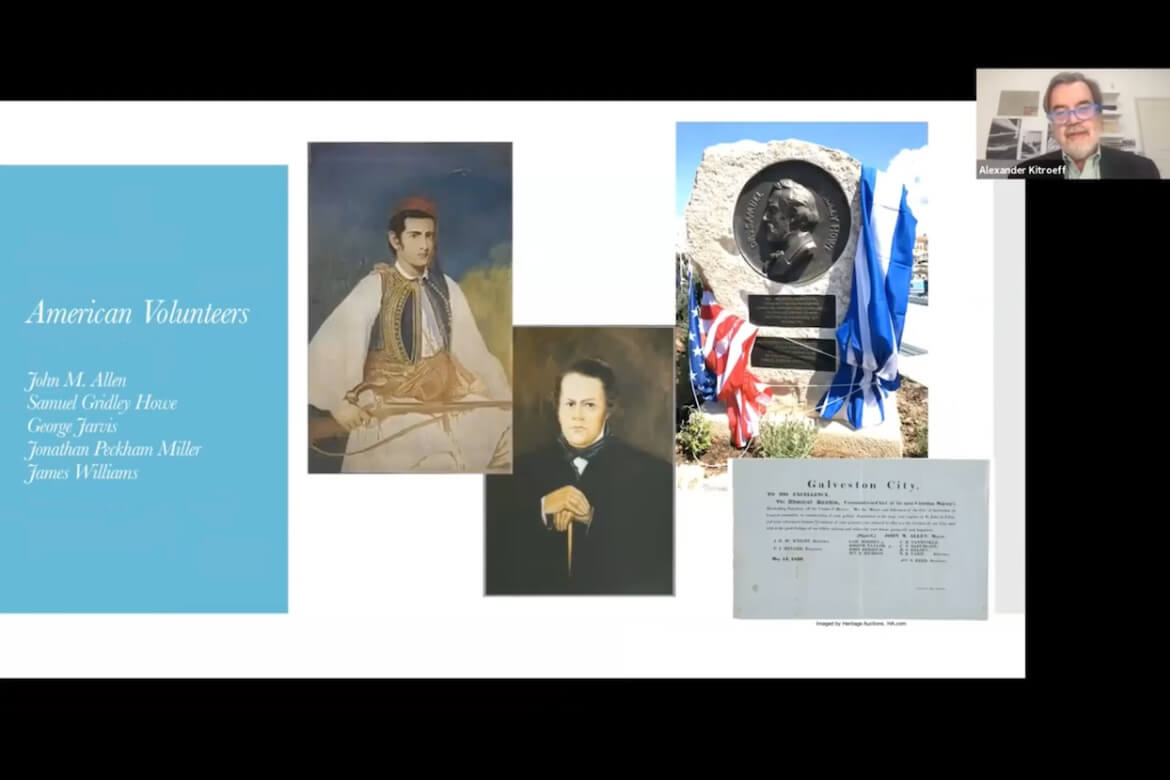
On March 17, Dr. Alexander Kitroeff, professor of history at Haverford College and a member of CYA’s Academic Advisory Roundtable, discussed the American philhellenic movement during the Greek Revolution.
Kitroeff presented a broader picture of American philhellenism and explored the reasons for its depth and breadth during the 1820s.
The wave of philhellenism that swept through the United States with the outbreak of the Greek War of Independence in 1821 included the establishment of “Greek committees” in Boston, New York and Philadelphia.
The surge of American support for the Greek cause also prompted American volunteers to travel to Greece to directly involve themselves in the conflict. Among those volunteers was Bostonian Samuel Gridley Howe.
Americans’ growing fascination with classical Greece facilitated this emergence of philhellenism which could be seen through the popularity of Greek Revival architecture and an interest in Greece itself.
The first visits to Greece by Edward Everett from Massachusetts and Nicholas Biddle from Pennsylvania also increased everyday Americans’ interest in the Greek struggle for freedom.
Greek Ambassador to the United States Alexandra Papadopoulou offered remarks and wrapped up the event which was presented under the auspices of the Embassy of Greece in Washington D.C.
Video: Lecture by Historian Alexander Kitroeff