
There are moments when identity stops being theoretical and becomes physical. Moments when belonging isn’t debated, explained, or defended—it’s lived.
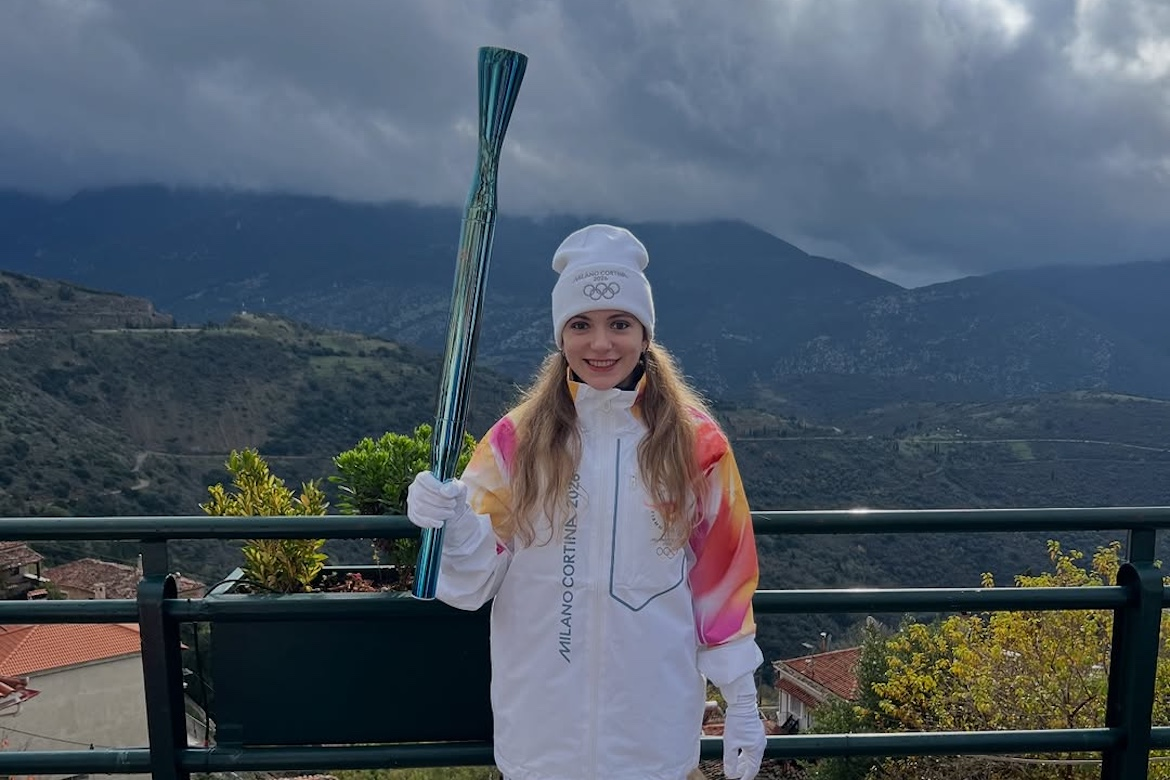
For Dimitra Korri, that moment came not on a podium, but on a mountain road in Arachova, as she carried the Olympic torch past the shadow of her father’s village, Distomo.
A Greek American. A daughter of the diaspora. Running with Greece’s flame in her hands.
The Olympic torch is designed to move forward, but it has a way of pulling memory along with it. It doesn’t just pass through towns—it passes through histories. Through names whispered at family tables abroad. Through villages left behind but never forgotten. Through identities shaped both by distance and devotion.
Dimitra’s story is not unusual in the Greek world, but it is rarely acknowledged properly. Raised in the diaspora, she competed for Greece at the highest levels—becoming a seven-time national champion in figure skating and a Balkan Games medalist—while also forging a creative life as a filmmaker, author, and singer-songwriter. Like so many Greek Americans, she learned early how to carry two places at once.
What makes this moment extraordinary is not only the honor of being selected by the Hellenic Olympic Committee as a torch bearer for the 2026 Winter Olympics. It’s where the flame was carried. Near Distomo—a place whose name carries immense historical weight. A village that represents endurance, memory, and the cost of history. To run there, as a Distomitissa, is not symbolic by accident.
The diaspora is often framed as something adjacent to Greece—close, but not quite inside the circle. Proud, but peripheral. Useful for nostalgia, tourism, and remittances, but rarely centered in national narratives of excellence and representation. Moments like this quietly dismantle that idea.
Greece did not ask Dimitra to watch. Greece asked her to run.
This is what a living relationship with the diaspora looks like—not performative, not sentimental, not transactional. It is trust. It is recognition. It is the understanding that Greek identity is not diminished by distance, but tested by it—and often strengthened.
As Dimitra ran alongside women athletes from snowboarding, boxing, and ski mountaineering, the image was unmistakably modern. Greek. Female. Global. Rooted. Forward-looking. No explanations required.
There is a tendency to treat the diaspora as something that must “return” to Greece in order to belong. But Dimitra didn’t return to Greece that day—she continued it. The torch didn’t reunite two halves of an identity. It revealed that they were never separate to begin with.
Between two homelands, there was no contradiction. Only motion. Only fire. Only Greece, running forward.