
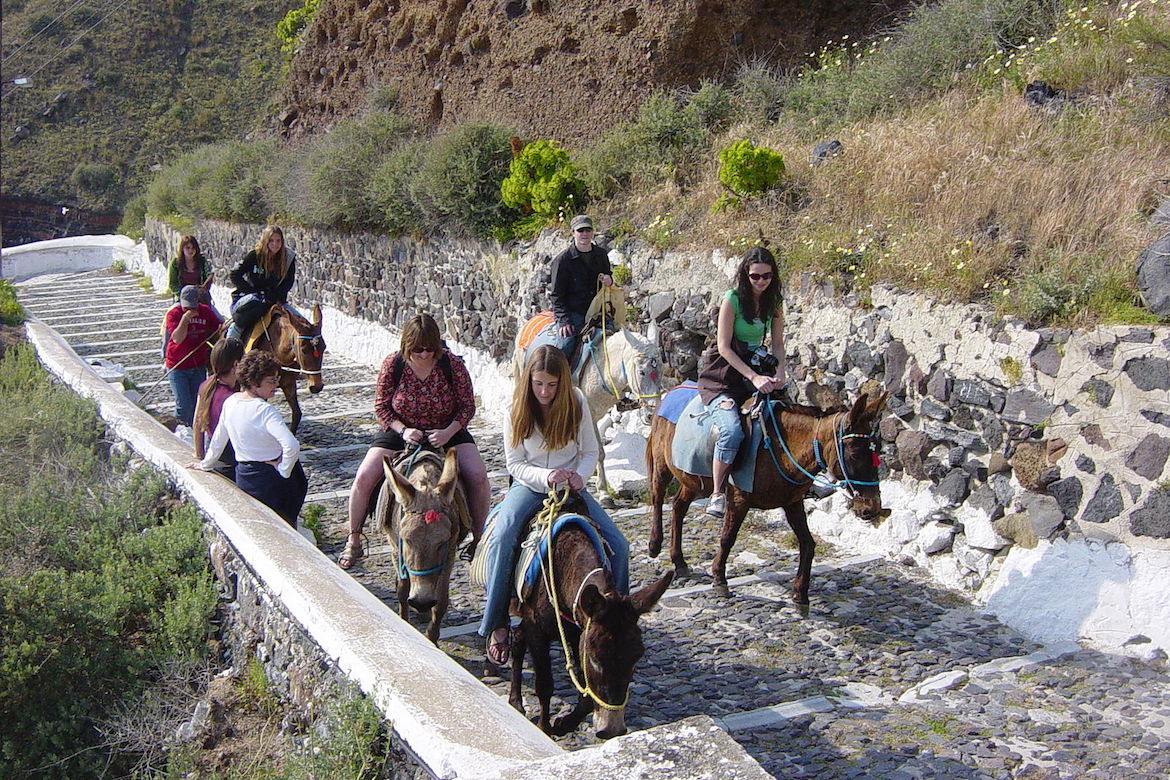
Officials on Santorini are urging visitors to avoid taking donkey taxis to climb up the island’s 600-steps on its iconic cliffside.
Their request forms part of a broader campaign called “In Their Hooves,” which is being led by animal rights activists in collaboration with the Greek government and the cruising industry.
The campaign aims to raise awareness among tourists about the stress placed on animals that carry heavy human cargo on a daily basis under Santorini’s scorching sun.
The Donkey Sanctuary, an international animal welfare charity, announced the campaign in March in response to the Santorini donkeys’ alarmingly high rates of spinal injuries, saddle sores and exhaustion.
Barbara Massa, The Donkey Sanctuary’s regional director for Europe, said in a statement that the organization has seen “great progress” through its partnership with Santorini’s government.
“They have helped us to deliver training to local enforcement bodies as well as supporting a revision of the existing Code of Practice for working equines in Santorini, which is subject to new animal welfare legislation currently being discussed by the Greek government.”
The plight of the island’s approximately 4,000 equines often makes sensational headlines during peak summer season, when as many as 17,000 tourists descend upon the tiny island every day.
As of August 2018, more than 108,000 people signed an online petition encouraging travelers not to take part in “mindless and unnecessary animal torture.”
Images of overweight tourists riding the animals have also prompted backlash on social media.
The outcry prompted the Greek government to draft legislation making it illegal to burden animals with “any load exceeding 100kg (15st), or one-fifth of [their] body weight.”
Officials did not explicitly label the measure an “overweight tourist ban,” but it has been widely considered as such.
For decades, tourists on Santorini have opted to take donkeys as their means of transport from the island’s port to its capital town, Fira.
A drastic increase in tourism prompted Greek officials in 1982 to inaugurate a five-cabin cable car that shuttles approximately 1,200 passengers per hour.
But this has not eliminated the donkey riding tradition, which still remains widely popular among the island’s visitors.

Animal welfare activists have condemned the tradition, arguing that visitors must make more informed decisions.
The Donkey Sanctuary created a short animated video (see below) urging tourists to pause and think before they choose to ride a donkey.
But the issue spans beyond tourists’ decisions. Santorini’s rising international popularity rises has skyrocketed its number of its annual visitors to an estimated 2 million.
Such high numbers have given way to a form of “over-tourism,” dramatically stressing not only the island’s animals but its entire infrastructure.
As part of efforts to help ensure Santorini’s sustainability, cruise companies have agreed to limit the number of passengers disembarking on the island. According to Santorini mayor Nikos Zorzos, the measure limits the number of daily visitors to 8,000 — still a considerable figure relative to the tiny island.
“Over-tourism is a problem,” Zorzos told The Guardian. “We’re trying to find solutions to runaway development. We’ve taken concrete steps to improve the welfare of donkeys and now with this campaign and the reduction in cruise passengers I am beginning to feel optimistic.”
The Donkey Sanctuary — “In Their Hooves”