

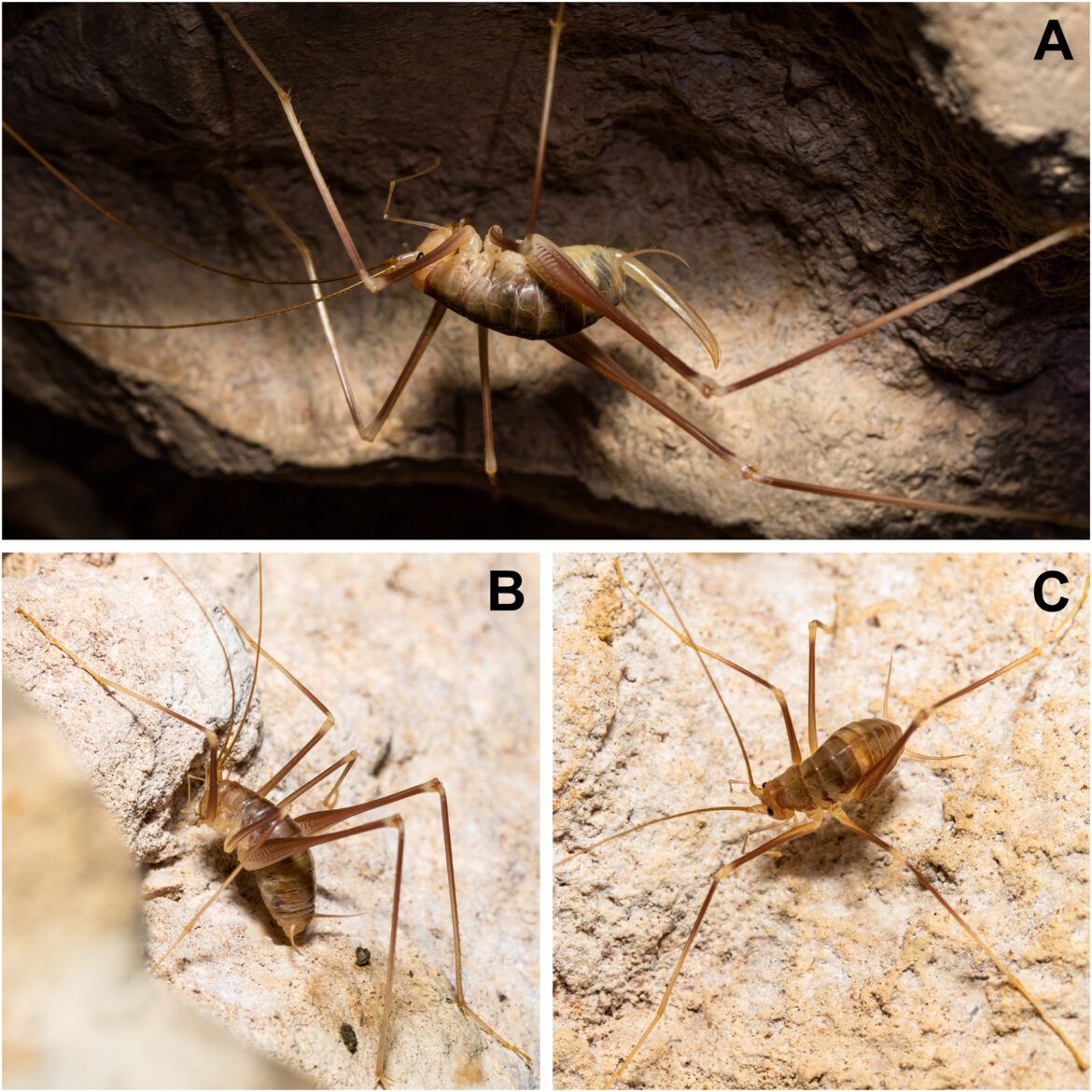
Greek researchers have identified a previously unknown species of cave cricket thriving in the dark confines of an artificial military tunnel, on the remote Greek island of Kastellorizo.
The newly described species, Dolichopoda balrogi, was officially detailed in the Journal of Orthoptera Research in May 2026. Their discovery unfolded across two independent expeditions in late 2025.
Lead researcher Konstantinos Kalaentzis first encountered the insects on October 17, 2025. A subsequent survey, conducted on November 15 and 16, revealed a highly localized population of exactly 37 individuals: 7 adult males, 10 adult females, and 20 juveniles.
The location of the find is highly unusual. Because Kastellorizo lacks accessible natural caves, the crickets were found residing exclusively within a 25-meter-deep man-made tunnel situated on the slopes of Mount Vigla.
Adult specimens were collected by hand from the tunnel’s vertical surfaces, preserved in 97% ethanol, and stored at -18°C for later by the Korinthian Museum of Natural History, in Greece and the Museum of Zoology of the University ‘La Sapienza’ of Rome (MZUR), in Italy.
Dolichopoda balrogi is a brownish-colored cricket that entirely lacks wings. Because these insects spend their entire lives in pitch-black underground environments, they do not fly. Instead, they rely on unique, tiny spikes on their long, arching legs. These specialized leg spikes give the insect amazing grip, so it can easily hang upside down or crawl across slippery, damp rock walls without falling.
The cricket’s scientific name is a direct homage to the Balrog, the ancient demonic fire-spirits from J.R.R. Tolkien’s The Lord of the Rings which fled into the subterranean depths of the Misty Mountains.
Because the entire known population of the Balrog cricket is restricted to this single man-made tunnel, the researchers warn the species is extremely vulnerable to habitat disturbance.
“A more detailed and specialised survey of the island’s caves should be conducted to determine whether additional populations of the species exist on the island,” they write in their research paper. “Furthermore, it would be valuable to consider possible management strategies to ensure the conservation of the population.”