
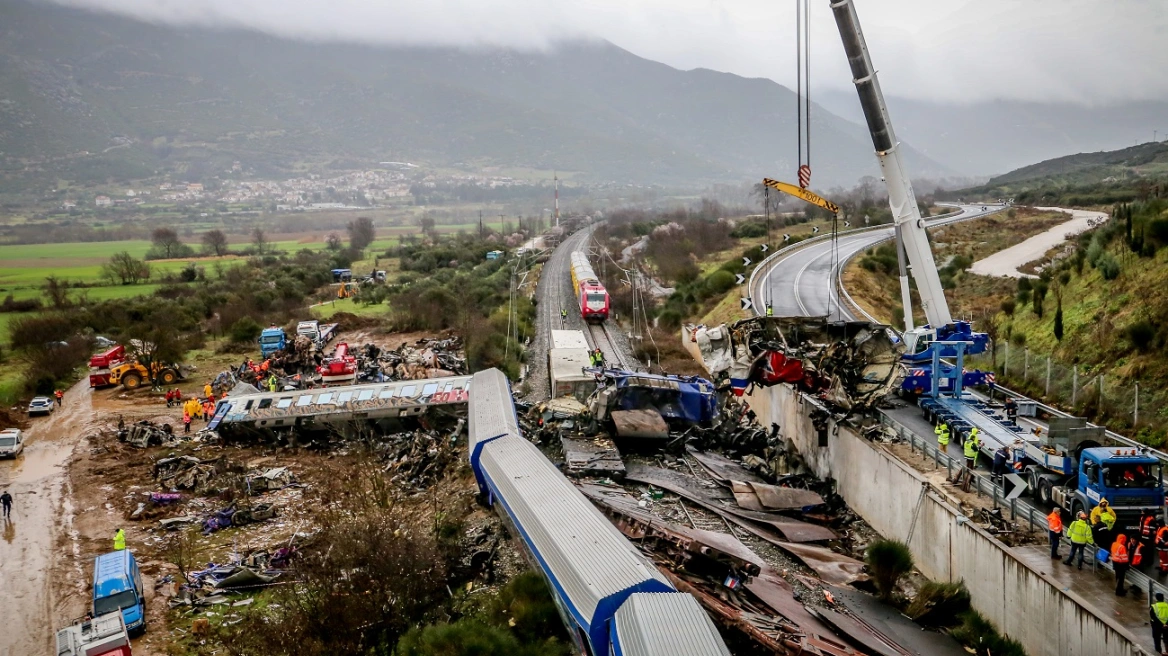
On the night of February 28, 2023, Greece experienced the worst train disaster in its history. Just after 11:20 p.m., a passenger train (Intercity 62) traveling north from Athens to Thessaloniki was inadvertently routed by the stationmaster onto the same track as a southbound freight train. The two trains collided head-on at full speed near Tempi, in the Larissa region.¹ The catastrophic crash caused not only a derailment but also an explosive fireball that engulfed the front carriages of the passenger train, where temperatures reached an estimated 1,200–1,500°C.²
Most of the approximately 350 passengers on the train were university students,³ many of whom suddenly found themselves trying to escape the wreckage amid scorching fires and thick smoke. Many passengers didn’t make it. The death toll from the Tempi tragedy today stands at 57, with more than 100 injured. Many victims have only been identified through remnants of their DNA.
Although Greek Prime Minister Kyriakos Mitsotakis has acknowledged systemic failings and emphasized that the primary responsibility for the Tempi tragedy was “human error that collided with longstanding pathologies of public administration,” he has also condemned what he calls its “political weaponization.”⁴
Yet the Tempi tragedy has revealed how decades of underinvestment, cronyism, and lax enforcement of safety standards can converge to produce catastrophic outcomes—and the Greek public has taken notice.
In a televised interview days after the crash, retired Larissa stationmaster Giannis Kollatos described the 59-year-old stationmaster on duty that night as lacking sufficient experience. He contended that this newly appointed stationmaster had completed only a brief training period—reportedly seven months of theoretical and two months of practical instruction—before being assigned to one of the busiest stations in Greece.⁵
Kollatos further alleged that the appointment was secured through political influence, stating that the stationmaster had “no practical expertise” and was sent to Larissa merely to secure a higher-paying role before retirement.⁵
He also recalled how, in 2000, a modern tele-control system was installed at Larissa station but remained unused until 2007, when he was tasked with training other stationmasters to operate it. Once activated, this system allowed staff to monitor and manage train movements remotely, providing a level of safety that, according to Kollatos, would have made the Tempi tragedy “impossible.”⁵
However, Kollatos stated that in 2012 the system fell into disuse due to cost-cutting measures and the dismissal of essential personnel—steps he believes were taken to reduce expenses and pave the way for the railway’s eventual privatization. As a result, the tele-control system and its associated safeguards were abandoned long before the Tempi tragedy.⁵
Now, almost two years after the Tempi tragedy, and following the release of the Hellenic Air and Rail Safety Investigation Authority (HARSIA) report, Kostas Kapetanidis, head of HARSIA’s investigative unit presented evidence of malpractice that underscores serious systemic failings and reinforces the urgent need for comprehensive reforms across the Greek railway sector, putting the Mitsotakis government in a difficult position.
In the HARSIA press conference, Kapetanidis noted factors such as the stationmaster’s heavy communication workload—about 90 brief exchanges in 60 minutes—and an earlier operational error that caused him “emotional distress.” According to Kapetanidis, this distress significantly contributed to the accident, as the stationmaster remained fixated on his previous mistake and the obligation to report it.⁶ ⁷
Kapetanidis also addressed another major issue: the fireball that engulfed parts of the passenger train following the initial crash. He stated that simulations conducted for the HARSIA report suggest the fire’s intensity cannot be fully explained by “the officially declared freight load or just the locomotive’s fuel,” pointing instead to “the possible presence of an unknown type of combustible material.”⁶ ⁷ Furthermore, he noted that inspection of the accident scene was not carried out systematically enough to determine the exact nature of these unknown substances.⁶ ⁷
This last finding also supports an investigative report by veteran police reporter Vasilis Lambropoulos, who wrote that local fire service and police officers testified to being astonished when heavy machinery arrived to fill in part of the wreckage just days after the accident. Other officers testified about meetings with unnamed political figures who ordered them to have the area cleaned up by the end of the weekend—before forensic investigators could conduct a thorough on-site examination. The official who allegedly gave the order was Christos Triantopoulos, a deputy minister to the Prime Minister tasked with coordinating the operation, though Triantopoulos denies issuing instructions to bulldoze the site.⁸
According to a statement from the Larissa Prosecutor’s Office, local judicial authorities did not order the early removal or covering of soil and debris either. Officials have since filed charges for “breach of duty” against those involved, and the case has been attached to the main investigation.⁹
Further controversy arose when another aspect of the Tempi tragedy surfaced: 11 minutes of missing audio recordings between the stationmaster and the passenger train driver, Yorgos Koutsoumbas, just before the accident. According to the driver’s family, these recordings allegedly disappeared from official logs, obscuring critical evidence about whether the driver noticed the wrong track assignment or tried to alert the stationmaster.⁸ An independent audio expert hired by one victim’s family sought access to the raw recordings but was barred by court order—citing procedural reasons, though families see it as stonewalling.⁸
While government officials strongly deny hiding anything about the Tempi tragedy and accuse opposition parties of exploiting it for political gain, opposition forces charge the Greek government with nepotism and covering up fuel smuggling and adulteration—a multimillion-dollar business in Greece.
As a result, tens of thousands of Greeks, as well as various political parties and civic organizations, have spent the past two years demanding accountability, arguing that the accident epitomizes what is wrong with a political system that attempts to hide the truth and shift blame downwards. For them, it was not simply an “accident at Tempi,” but rather a “Crime at Tempi.”
The Greek government’s position is not strengthened by recent opinion polls showing that 66% of Greeks are dissatisfied with its handling of the Tempi tragedy,¹⁰ even though Minister of Justice Giorgos Floridis points out that 40 individuals have already been charged and denies any cover-up attempt.¹¹
Meanwhile Greece’s Minister of Infrastructure and Transportation, Christos Staikouras, acknowledged during a parliamentary session that the country’s railway network still operates without a fully functional tele-control system. Staikouras attributed certain setbacks to damage caused by severe weather events but offered no firm date as to when automated safety measures would be fully implemented nationwide.¹²
Public anger over the Tempi tragedy has hardly subsided. In fact, it has grown more intense as demands for accountability remain unmet in the eyes of many Greeks. Today, on February 28—the anniversary of the crash—large demonstrations are planned across the country. Many businesses, both large and small, will close in solidarity, even if only for a few hours.
This collective act of protest expresses not just outrage over the loss of innocent lives, but a broader indictment of systemic negligence and deep-rooted dysfunction that persist in modern Greece.
Whether these mass mobilizations will ultimately reshape the nation’s political landscape remains uncertain. Yet Greece’s longstanding tradition of democratic ideals and active civic engagement, from the student movements of the 1970s to the powerful protests of the past decades, has repeatedly played a defining role in forging the country’s modern identity.
Today is the second anniversary of the Tempi tragedy. It’s also the day when public pressure on the Greek government for transparency and reform reaches a critical point. History has shown us that, when this happens, meaningful change in the Greek political system is inevitable.
Cover Photo Credit: Proto Thema
Sources:
1. Proto Thema – Σύγκρουση τρένων στη Λάρισα: Το μοιραίο λάθος του σταθμάρχη Λάρισας που έφερε την τραγωδία – Συνελήφθη μετά την κατάθεση
2. Lifo – Σύγκρουση τρένων στα Τέμπη: «Αναπτύχθηκαν θερμοκρασίες έως 1.500 βαθμούς, έλιωσαν τα σίδερα»
3. Naftemporiki – Τέμπη: Το χρονικό μίας τραγωδίας, η ανατομία ενός εγκλήματος
4. Lifo – Μητσοτάκης: «Στα Τέμπη συγκρούστηκαν ανθρώπινα λάθη με χρόνιες παθογένειες»
5. AlfaVita – «Ποιος είναι υπεύθυνος που έγινε αυτός Σταθμάρχης; Πολιτικό μέσο; Πολιτικό μέσο! Να τα πούμε με το όνομά τους»
6. Naftemporiki – Πόρισμα ΕΟΔΑΣΑΑΜ για Τέμπη: Πιθανή παρουσία αγνώστου καυσίμου – Χάθηκαν κρίσιμα στοιχεία
7. Κathimerini – Τέμπη: Καταπέλτης το πόρισμα του ΕΟΔΑΣΑΑΜ – «Εγιναν όλα λάθος, καταστράφηκαν τα στοιχεία σε τρεις μέρες»
8. To Vima – Tempi train crash, pervasive cover-up charges rock government, political system two years after disaster
10. To Vima – Δημοσκόπηση Pulse – Τέμπη: Οι 2/3 αμφισβητούν τους χειρισμούς – Διψήφια η διαφορά ΝΔ – ΠαΣοΚ
11. Proto Thema – Φλωρίδης για Τέμπη: Ποια συγκάλυψη όταν ήδη έχεις 40 κατηγορούμενους;
12. DocumentoNews – Σταϊκούρας στη Βουλή: Δύο χρόνια μετά τα Τέμπη δεν υπάρχει τηλεδιοίκηση – Πετά το μπαλάκι σε Χρυσοχοΐδη και Χατζηδάκη για το λαθρεμπόριο