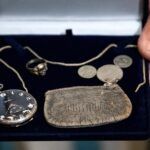

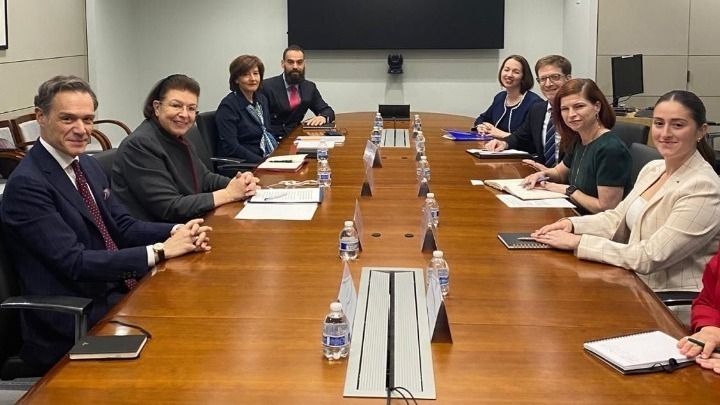
The U.S. has returned 26 artifacts to Greece during a handover ceremony that took place at the Greek Embassy in Washington. Homeland Security Investigations (HSI), U.S. Customs and Border Protection (CBP), the FBI and State Department coordinated the recovery, while Greek Culture Minister Lina Mendoni accepted the artifacts on behalf of Greece. The recovered antiquities include a marble torso of Asclepius and 25 coins from the Ancient Greek, Roman, and Byzantine periods.
The statue of Asclepius dates to the 1st or 2nd century C.E., standing 40 inches tall and weighing 500 pounds, and was seized after a HSI and CBP investigation showed that the claims made in the accompanied paperwork were fraudulent.
HSI Memphis seized a silver didrachma of Rhodes, minted in 304 B.C.E., which depicts the sun god Helios in the front and the Rose of Rhodes on the reverse. Authorities confiscated the coin because the importer or shipper failed to provide evidence that it was exported from Greece prior to the imposition of U.S. import restrictions.
A gold coin from the city of Lampsacus, once strategically situated near the Dardanelles in northwestern Turkey, and dating from 370 B.C.E., was also looted and sold to a middle-man. Depicting Hercules on the front and the winged Pegasus on the reverse, the coin was subsequently acquired by the head of a criminal organization and exported out of Greece into Germany. Failing to sell at an auction there, the coin found its way to an auction house in Philadelphia.
Another artifact, a 4th-century B.C.E. bronze Macedonian coin, depicts Persephone on the front and Hydra on the reverse. This coin was also looted and smuggled out of Greece by the same criminal organization. It was sold at auction in 2009, put up for sale again in 2017, and found its way to the same Philadelphia auction house.
“ICE HSI takes great pride in leveraging our investigative expertise and customs authority, along with our partners, that led to the repatriation of these 26 invaluable antiquities illicitly plundered from their homeland back to the people of Greece,” said ICE Deputy Director Charles Wall. “These treasured artifacts were a valued part of life in the ancient world. I am especially grateful to the investigative and prosecutorial team responsible for recovering and returning these priceless treasures.”
Since 2007, HSI has repatriated more than 200 objects of cultural heritage to Greece, many of which were seized under the bilateral cultural property agreement between the United States and Greece implemented in 2011. The agreement restricts the import of illicit Greek archaeological and ethnological material into the U.S., protecting items from the Upper Paleolithic period through the 15th century C.E..
During the handover ceremony, Mendoni stated that “I feel great joy to be among allies, companions, and devoted friends of Greek culture who decisively contribute to my country’s struggle against antiquities trafficking, which constitutes a crime against humanity and its cultural heritage. This represents a substantial vindication of the efforts of the Ministry of Culture of the Hellenic Republic in combating crimes related to the illegal trafficking of cultural goods. Today, thanks to the Memorandum of Understanding between Greece and the United States, we are receiving significant antiquities that are being repatriated, as this institutional framework is an effective tool in our bilateral cooperation. The contribution of the American authorities has been decisive. Through the implementation of the memorandum, it became possible to identify, seize, and return the antiquities to their country of origin. Greece remains firmly committed, through continuous research, consistency, and method, to the protection and repatriation of its cultural assets, making use of every available means. We place particular importance on our international collaborations, especially with the United States, which is a vast art market. We are working together to renew and further strengthen the memorandum so that our cooperation continues and expands. We return to our homeland carrying a heavy load – a load not measured by scales, but by memory and history. Greece will continue to work with faith, dedication, methodical planning, and responsibility as the guardian of its cultural heritage, which concerns not only Greeks but all of humanity.”
An additional 12 ancient Greek objects, voluntarily returned by private individuals were also repatriated. The items included clay figurines, vessels from the archaic and classical periods, as well as stone fragments.