


Greece lags behind its European counterparts in adopting work from home (WFH), according to the latest Global Survey of Working Arrangements (G-SWA), conducted between November 2024 and February 2025.
The survey, compiled by researchers from King’s College London, Stanford University, Princeton University, ITAM, and the ifo Institute, covered 40 countries and more than 16,000 full-time college graduate workers.
According to the survey, Greek employees reported an average of 0.6 WFH days per week—well below the global average of 2024/2025 of 1.27 days, and well behind the global WFH frontrunner, Canada whose employees clock an average of 1.9 days at home.
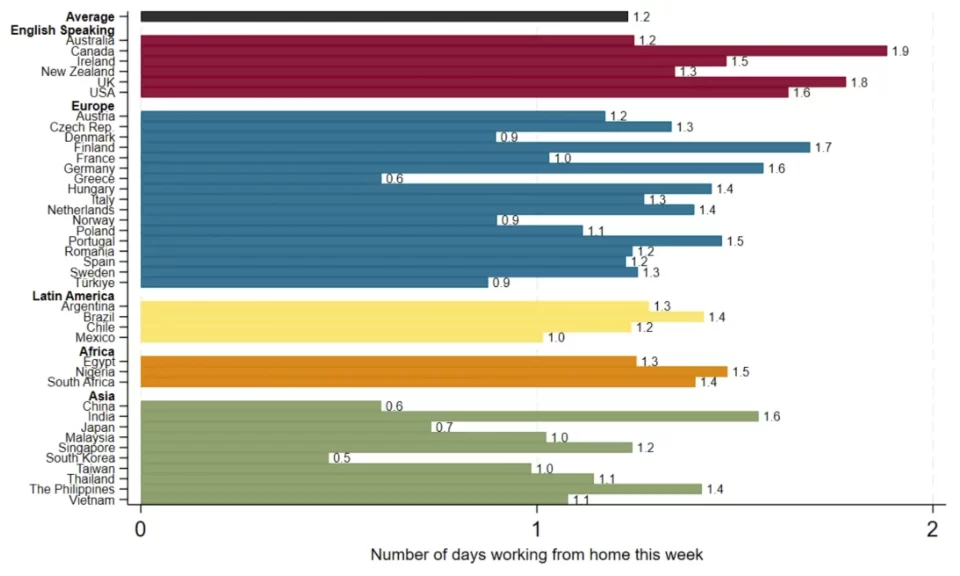
WFH days per week / Photo Credit: Stanford University
It’s the English speaking countries that have embraced more flexible arrangements, with an average of 1.5 to 2 WFH days a week, while Europe trails slightly behind with 1 to 1 to 1.5 WFH days a week.
Employees in Latin American and African countries average around 1 WFH day a week. Asian countries have the lowest WFH days at 0.5 to 1 day per week.
Additional findings from the survey also indicate that WFH levels have stabilized since 2023.
Hybrid working arrangements are more prevalent among working parents, while employees without children tend to prefer either full WFH or fully onsite work.
WFH rates are also similar between men and women worldwide, while the strongest desire to WHF is expressed by women with children.