
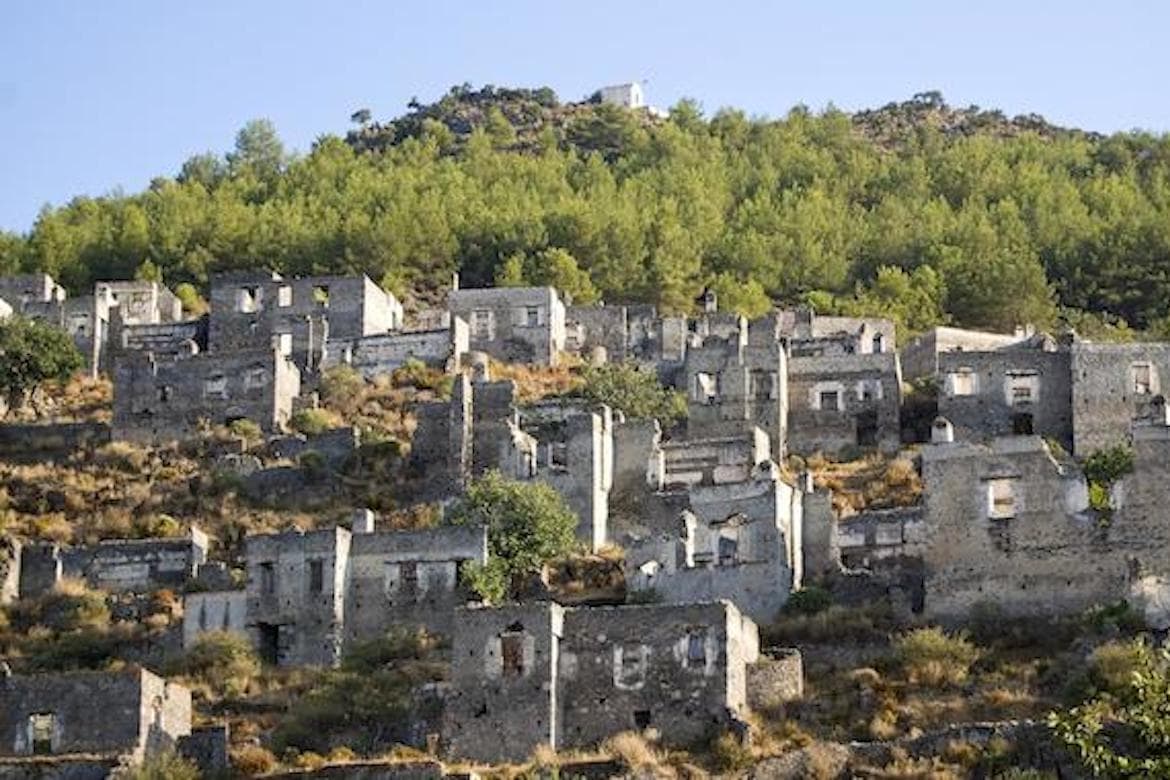
One of the world’s spookiest “ghost towns”— abandoned almost a century ago by thousands of fleeing Greek residents, is on the auction block for development and transformation into a tourist site by the Turkish government. The town of Kayaköy, known in Greek as Levissi was a thriving town of about 10,000 people— with a half dozen Greek Orthodox churches, more than 500 homes and a majority Greek population up to the early 1920s.
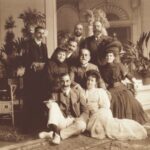
The Muslims, who lived on the surrounding valley floor of the Kaya (“Rock”) Valley, tended to be farmers, while the Christians, who inhabited the hillside, were mostly artisans; the two communities were closely linked by trade and helped each other in times of need. Christian and Muslim women exchanged food and sweets at weddings and religious festivities; Muslim musicians played at Orthodox festivities and took part in wrestling matches during Easter celebrations; children played together in the lanes; and men of both religions congregated at local cafés, fingering their worry beads, smoking water pipes and playing backgammon.
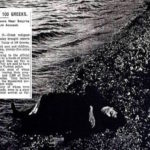
Today, the site is an eerily compelling and moving reminder of the sad aftermath of the First World War and subsequent Greco-Turkish War, which resulted in the massacres of tens of thousands of Greek Christians who had lived in what is now modern Turkey for centuries. Like millions of others, the Greeks of Kayakoy were part of the population exchange of 1923 and were forced to relocate to mainland Greece.
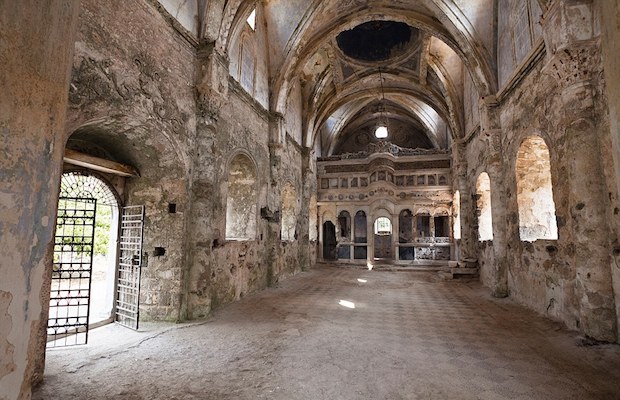
Meanwhile, the Muslim farmers exiled from Greece at the same time found the land in Kayakoy inhospitable and soon left for other areas of Turkey, leaving the hillside village abandoned for a second time. In 1957, a 7.1 magnitude earthquake delivered Kayakoy its final coup de grâce, destroying most of the town’s buildings. Homes and businesses around the valley floor were later restored or rebuilt, but the hillside homes and buildings have been left untouched.
The hillside of Kayakoy remains deserted, never having recovered – either culturally or economically – from the mass exodus in 1923. The homes, schools, shops, cafés, chapels and churches have been left to crumble, unprotected from looters or the elements. The Turkish Ministry of Culture rescued the hillside from mass development by granting it museum status a few years ago.
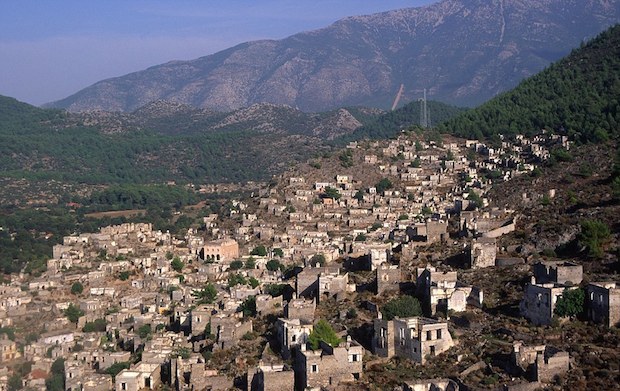
The Turkish Culture Ministry has announced that it will partially open the archaeological site to investors and the restoration project will include a hotel and tourist facilities that will encompass one-third of the village. Part of the agreement is that the company that wins the contract— a 49-year lease of the space, will also have to spend millions restoring parts of the village and make it tourist-friendly.
But the plan has been met with concerns that any development work will mean the town, a valuable part of the country’s cultural and historic heritage, will lose its authenticity.
Louis de Bernieres, the British novelist most famous for his novel, Captain Corelli’s Mandolin, has voiced cautious reservations about the Turkish government’s plans. His second novel, Birds Without Wings, took inspiration from the village (Eskibahçe, the fictional setting for the novel, was based on Kayaköy). He said the development “could either be a wonderful rebirth, or a terrible act of vandalism, depending on how sensitively it is done.
“The town cannot take motor traffic, as the streets are too narrow, and putting in infrastructure might cause damage,” he added. “The restorations should be as authentic as possible, so that the former way of life is evident.”
Locals and ex-pats have started a Facebook group called Save Kayaköy, and a petition calling for the 500 ruined houses, five churches and 14 small chapels to be preserved as a historical monument.
“We do not think that any restoration can be undertaken without causing major damage to the site,” the petition states.
Turkey’s Ministry of Culture and Tourism said it hopes to rent out some of the village in order to bring its historical and cultural fabric “back to life.” A spokesman said that it would not be building any new hotels in the region but that “Kayaköy’s buildings and houses will be restored to their original appearance and design.”
“The ministry is not pursuing mass tourism policies but is rather focusing on restoring and renovating the culturally significant site to its original state and attracting tourists in line with this vision,” the spokesman added.