
Christopher Nolan filmed his epic across several countries. But audiences know where Odysseus belongs—and it is Greece they will come looking for.
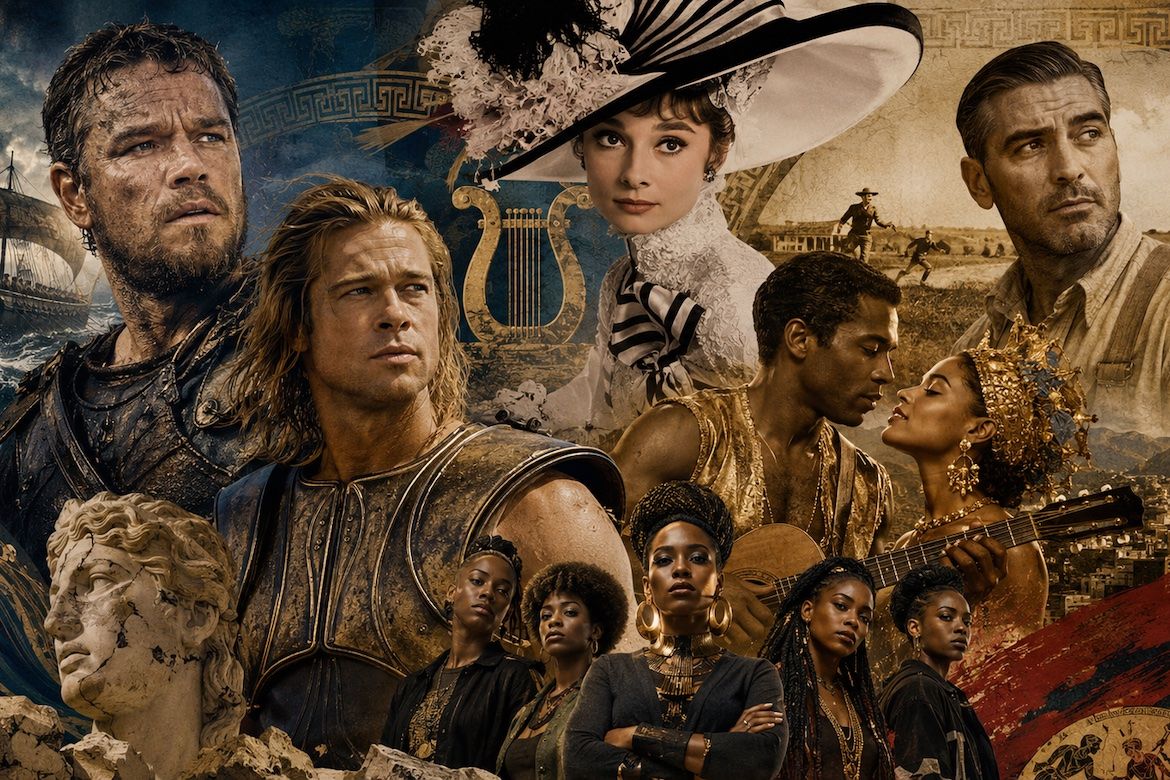
Christopher Nolan has accomplished something extraordinary. He has taken one of the oldest works of Western literature and transformed it into one of the biggest cinematic events of the year.
The Odyssey opened with $264.1 million in worldwide ticket sales, including $124.5 million in the United States and Canada and another $139.6 million overseas. Its debut surpassed that of Nolan’s Oppenheimer, confirming that a Greek story nearly 3,000 years old can still command the attention of a global mass audience.
For Greece, the significance of that achievement extends far beyond box-office bragging rights.
Millions of people have now watched Odysseus battle his way across hostile seas, confront monsters and gods and struggle to return to his wife, his son and his island home. They have watched a Greek story unfold on the largest screens in the world, carried by some of Hollywood’s most recognizable actors and promoted through a massive international campaign.
And many of those viewers will now want to experience a piece of that story for themselves.
Nolan did not film every scene in Greece. He did not need to.
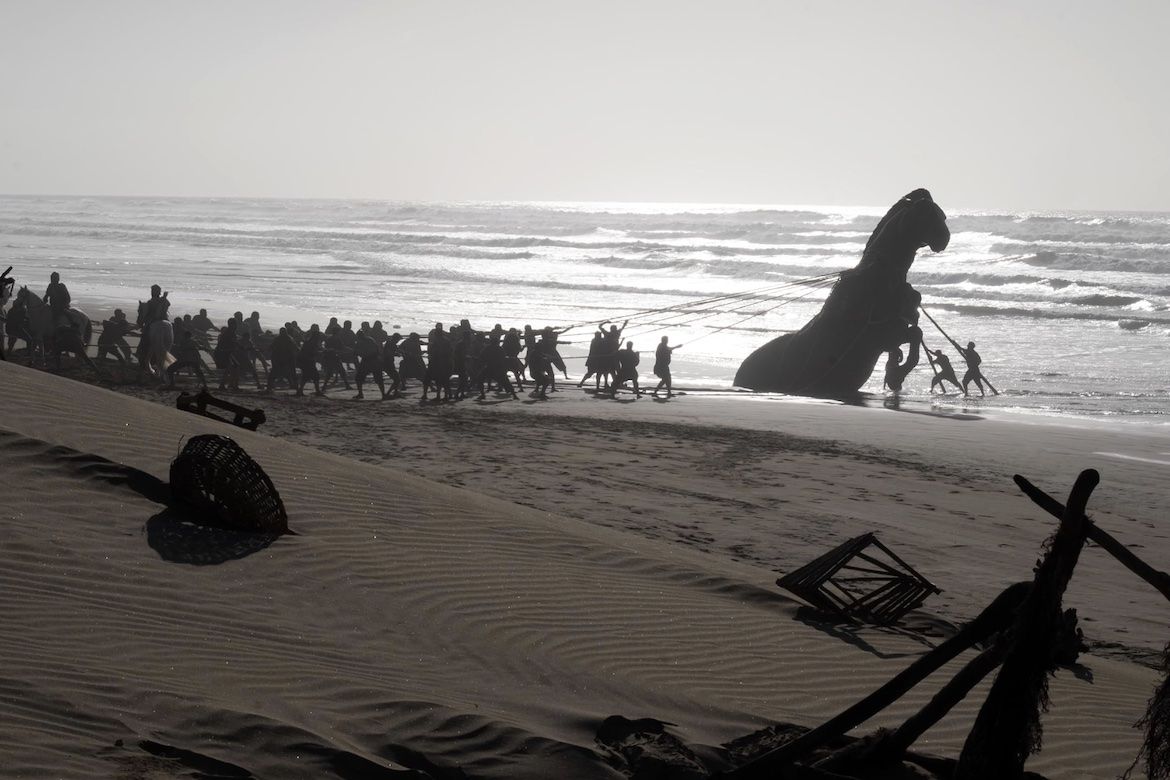
The movie was filmed over 91 days in multiple countries, using locations in Greece, Italy, Morocco, Iceland and Scotland, along with substantial studio production in Los Angeles, to construct its sprawling mythological world. Sicily stood in for parts of Ithaca. Morocco became Troy. Icelandic and Scottish landscapes represented other stages of Odysseus’ journey.
But cinema is not an atlas. It does not sell geography with cartographic precision. It sells emotion, atmosphere and longing.
Most viewers will never study the production notes to determine which island stood in for Ithaca or whether a particular coastline was Greek, Italian, Moroccan or Scottish. They watched a story born in Greece, populated by Greek heroes, Greek gods and Greek ideas.
When they begin imagining their own journey into the world of Odysseus, it is Greece they will search for.
The Greek portion of Nolan’s production included some of the Peloponnese’s most spectacular landscapes: Nestor’s Cave, Voidokilia Beach, Almyrolaka Beach, Methoni Castle and Acrocorinth.
The Hellenic Film Commission worked with Universal Pictures and Nolan’s production company during preparations, while the Greek Ministry of Culture issued filming permits with preservation conditions intended to protect the archaeological and natural sites.
Those locations will undoubtedly attract visitors searching for scenes they recognize from the film. Yet the potential “Odyssey effect” is much larger than a tour of camera positions.
The film has reopened the entire map of Homeric Greece.
Ithaca was not used to portray Odysseus’ home in the movie, but that will hardly prevent travelers from going there. The island remains inseparable from Odysseus, Penelope and the idea of the long-awaited homecoming.
Messenia offers not only Nolan’s scenery but also the Palace of Nestor and the landscape through which Telemachus traveled in search of news of his father. Corfu is traditionally associated with Scheria, where the shipwrecked Odysseus encounters Nausicaa and the Phaeacians. Kefalonia, the Ionian Islands and the wider Peloponnese offer their own archaeological sites, caves, harbors and traditions connected to Homer’s world.
These places can become part of journeys that are not merely about identifying where a scene was filmed, but about entering the cultural and physical world that produced the story.
The international tourism industry has not waited for the box-office dust to settle
Tour operators are already attempting to cash in, packaging journeys through destinations associated with Homer, Odysseus and Nolan’s production. Some emphasize places seen on screen. Others are constructing broader routes around mythology, archaeology and the imagined path of Odysseus. New itineraries are already being promoted for upcoming travel seasons.
More revealing, however, is the speed with which travel publications around the world have begun turning the film into an invitation to visit Greece.
In India, Condé Nast Traveller published “7 Unique Ways to Explore Greece in Odysseus’ Footsteps”, directing readers toward philosophy walks through Messenian olive groves, historical tours of Ithaca, Homer-inspired sailing voyages, traditional weaving experiences and places associated with Penelope, Telemachus and Odysseus.
The story is significant not simply because of the experiences it recommends, but because of where it appeared. From thousands of miles away, readers in one of the world’s largest and fastest-growing travel markets are being encouraged to view Nolan’s film as the beginning of their own Greek journey.
In Britain, The Independent predicted that Messenia would become a holiday hotspot, describing the region’s beaches, towns and archaeological sites as an overlooked corner of Greece about to receive worldwide attention.
British magazine Country Life has offered readers a guide to following in the footsteps of Odysseus and Nolan, turning the production’s locations into the framework for a modern journey through Greece and the wider Mediterranean.
In Spain, Condé Nast Traveler explored the landscapes used to recreate ancient Greece, while an earlier feature placed the Peloponnese among Europe’s destinations to watch in 2026, in part because of the attention expected from Nolan’s film.
In the Middle East, Dubai-based Gulf News mapped the international locations that brought the film to life, giving particular attention to Voidokilia Beach, Nestor’s Cave and the Greek landscapes connected to the Cyclops sequence.
American publications have responded in much the same way.
Vogue described the movie’s filming locations as an “epic travel guide”, presenting Acrocorinth, Voidokilia Beach, Methoni Castle and Nestor’s Cave as destinations travelers can experience for themselves.
The American edition of Condé Nast Traveler mapped the real-world locations behind Nolan’s epic, while Forbes published a guide to turning the Greek filming locations into an actual journey.
Global travel authorities have joined the movement. Lonely Planet published a guide to six of the movie’s filming destinations, and Time Out offered practical advice for visiting locations connected to the production.
Taken individually, these may appear to be ordinary travel stories attached to a major movie release. Taken together, they reveal something much larger.
From New Delhi and Dubai to London, Madrid and New York, travel editors are teaching their readers how to convert the experience of watching The Odyssey into an actual journey.
And in almost every version of that journey, Greece remains the emotional destination.
This is more than “set-jetting,” the now-familiar phenomenon of travelers visiting places they have encountered in movies and television series. The Odyssey creates an opportunity for Greece to unite cinema tourism with archaeology, mythology, sailing, literature, gastronomy and cultural travel.
It could also help widen the country’s tourism map.
For decades, much of international Greek tourism has been concentrated around a predictable circuit of Athens, Mykonos and Santorini. Odysseus offers a different map—one that leads travelers into the Peloponnese, across the Ionian Islands and toward smaller ports, castles, archaeological sites, walking trails, caves and landscapes still closely connected to local life.
Greece has seen the power of cinema tourism before.
When Mamma Mia! reached theaters in 2008, its fictional island of Kalokairi became real in the imaginations of viewers around the world.
Much of the movie’s outdoor filming took place on Skopelos, with additional scenes filmed on Skiathos and along the Pelion coast. Skiathos became an important gateway for travelers arriving in the Sporades, while Skopelos emerged as the heart of the cinematic pilgrimage.
Visitors came searching for the beaches, pine-covered coastlines and tiny Agios Ioannis chapel they had seen on screen. Couples wanted to marry on the island, renew their vows, hold champagne receptions and recreate their own versions of the film’s sun-drenched Greek-island fantasy.
The effect was so immediate that it became known internationally as the “Mamma Mia effect.” In December 2008, The Guardian reported on the wave of film-inspired visitors and wedding requests reaching Skopelos.
The influence did not disappear after one season. Nearly two decades later, the movie remains embedded in the international identities of Skopelos and the Sporades. Tours continue to visit filming locations, couples still arrive with Mamma Mia!-inspired wedding dreams, and images from the movie remain among the region’s most recognizable tourism assets.
The essential lesson is that travelers were not particularly concerned with what was real and what had been constructed for the screen.
Mamma Mia’s Kalokairi did not exist.
The fantasy did.
And Greece was where people went to find it.
The Odyssey has the potential to produce that effect on a much larger scale.
Mamma Mia! sold the fantasy of falling in love on a Greek island. Nolan’s film sells something broader and more elemental: adventure, endurance, identity, loyalty and the human desire to find one’s way home.
That last idea has always had a special meaning in Greek culture. Homer called it nostos—the homeward journey. It survives in the modern word “nostalgia” and in the emotional pull that continues to bring Greeks back to their villages, islands and ancestral homes across generations.
Now, through Nolan’s film, that idea has been placed before a worldwide audience.
There will, of course, be serious questions about how Greece receives the attention that is coming.
The Guardian has already documented concerns in Messenia, where protected environments, water scarcity and accelerating tourism development are placing pressure on the landscapes surrounding Voidokilia Bay and the Gialova lagoon.
Local residents quoted in the report expressed support for tourism but warned that the region must be protected from development that overwhelms its natural resources, local communities and identity.
Those warnings are legitimate and deserve a serious conversation of their own. An opportunity of this scale must be managed intelligently, with respect for communities, archaeological sites and fragile natural environments.
But the opportunity itself should not be obscured.
At a time when countries spend vast sums attempting to manufacture recognizable tourism identities, Greece has been handed something almost impossible to create: one of humanity’s foundational stories, retold by one of the world’s most influential filmmakers and embraced by audiences across continents.
Christopher Nolan may have needed several countries to construct his cinematic world.
Homer needed only one place for Odysseus to call home.
And when the world goes searching for that home, it will come to Greece.