
From Chania to Elounda, international hotel brands, ambitious residential communities and a new generation of service companies are transforming the island’s most accessible coastline.
For decades, Crete’s northern coast has been the island’s principal gateway to the outside world—a long ribbon of cities, seaside villages, beaches and resort communities stretching from Chania in the west to Agios Nikolaos and Elounda in the east.
Unlike the French Riviera or Spain’s Costa del Sol, these destinations have traditionally developed independently, each with its own character, identity and tourism market.
That separation is beginning to blur.
A wave of luxury hotel openings, residential communities, branded residences and major transportation investments is gradually creating something larger: an increasingly connected northern coastal corridor attracting visitors, investors, second-home owners, foreign residents and members of the Greek diaspora seeking a more permanent connection to the island.
It may be premature to declare the arrival of a fully formed “Cretan Riviera.” The island’s roads, water systems, housing supply and other public infrastructure have not always kept pace with the speed of tourism development.
But the direction is unmistakable.
International hospitality groups are establishing some of their most prestigious brands on Crete. Developers are building homes designed not only for summer holidays, but also for longer stays, remote work and year-round living. Around them, a growing network of companies is helping foreign residents and diaspora Greeks navigate everything from property purchases and construction to relocation and home management.
Global Hotel Brands Move Into Western Crete
One of the clearest signs of Crete’s changing profile is the arrival of major international hotel brands in the Chania region.
The JW Marriott Crete Resort & Spa opened near Marathi on the Akrotiri Peninsula, marking the first JW Marriott property on the island.
Spread across approximately 100 coastal acres, the resort includes 160 rooms, suites and villas, many with private pools, along with restaurants, wellness facilities and landscaped spaces designed around the surrounding Cretan environment.
The importance of such a development extends beyond the addition of new hotel rooms. Marriott brings an enormous international reservation network, a global loyalty program and access to travelers who may not previously have considered western Crete as a luxury destination in its own right.
Hilton is also establishing a presence in the Chania area through the Hilton Chania Old Town Resort & Spa, a waterfront property situated between Nea Chora and the historic center of Chania.
The resort includes 85 rooms and suites, along with restaurants, wellness facilities, pools and conference spaces. It has been positioned as a year-round urban resort rather than a conventional seasonal beach property—an important distinction for a destination attempting to expand its economy beyond the summer months.
These properties join an already sophisticated hospitality market around Chania that includes Domes Zeen Chania, part of Marriott’s Luxury Collection, as well as a growing number of independently operated boutique hotels within restored buildings in Chania’s Old Town.
Together, they reflect a broader shift in western Crete. Chania is no longer being marketed only as a picturesque historic city or a gateway to famous beaches. It is increasingly being presented as an international luxury destination with the ability to attract higher-spending travelers throughout more of the year.
Elounda Begins Its Next Chapter
At the eastern end of Crete’s northern coast, Elounda is undergoing a different kind of transformation.
The region has long occupied the upper reaches of Greek luxury tourism, with some of the country’s best-known resorts clustered around Mirabello Bay. Its newest projects, however, are expanding the concept of Elounda beyond a collection of exclusive hotels and toward a broader residential and resort destination.
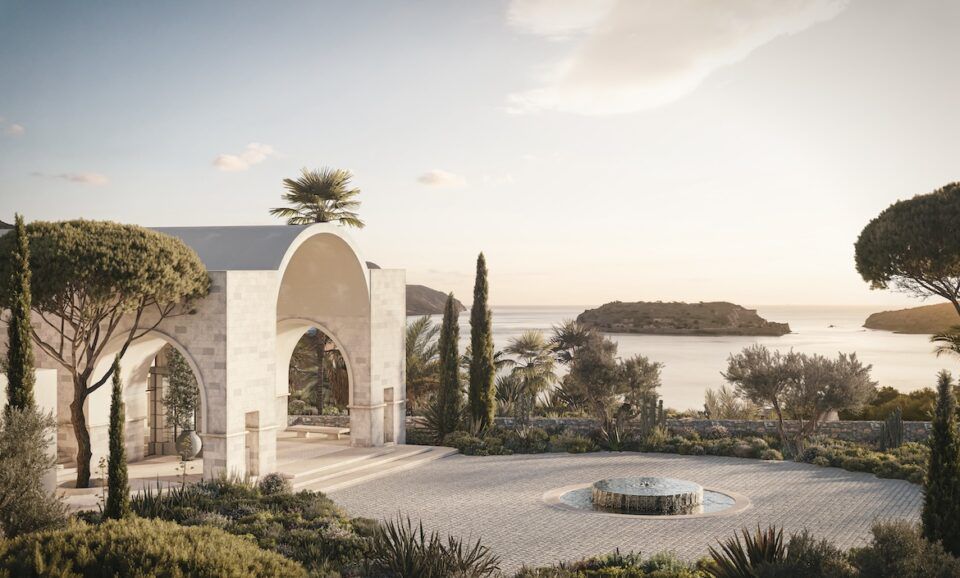
The historic Blue Palace, located between Elounda and the fishing village of Plaka, is being comprehensively redesigned before reopening as Rosewood Blue Palace.
The project will mark the entry of Rosewood Hotels & Resorts into Greece. The reimagined property is expected to include 154 rooms and suites, many with private pools, together with restaurants, a beach club, gardens and Rosewood’s Asaya wellness concept.
The hotel remains owned by the Cretan hospitality company Phāea, led by sisters Agapi and Costantza Sbokou, whose family has played a significant role in the development of Crete’s tourism industry.
Nearby, Elounda Hills is taking shape on an entirely different scale.
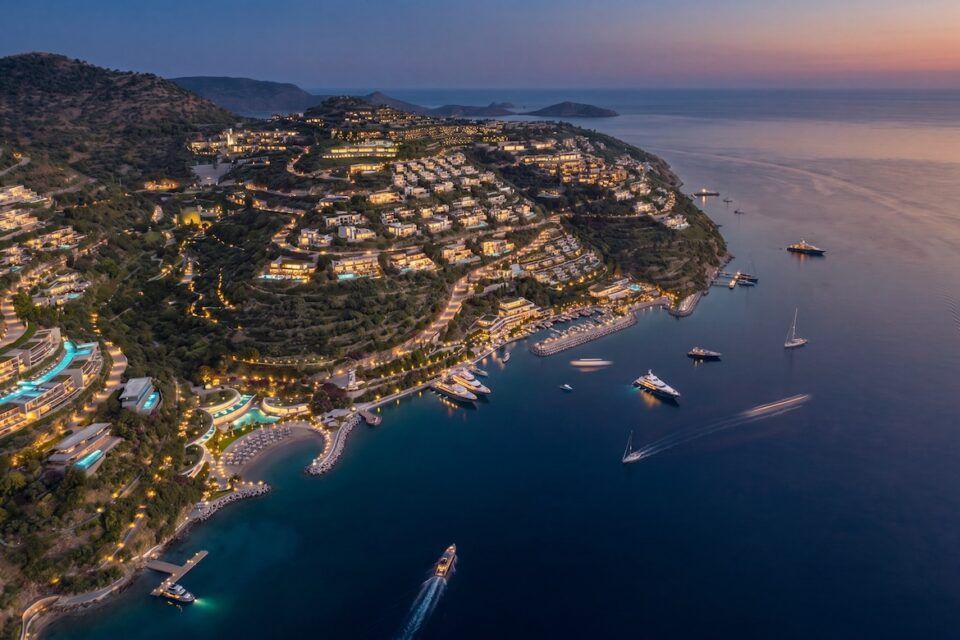
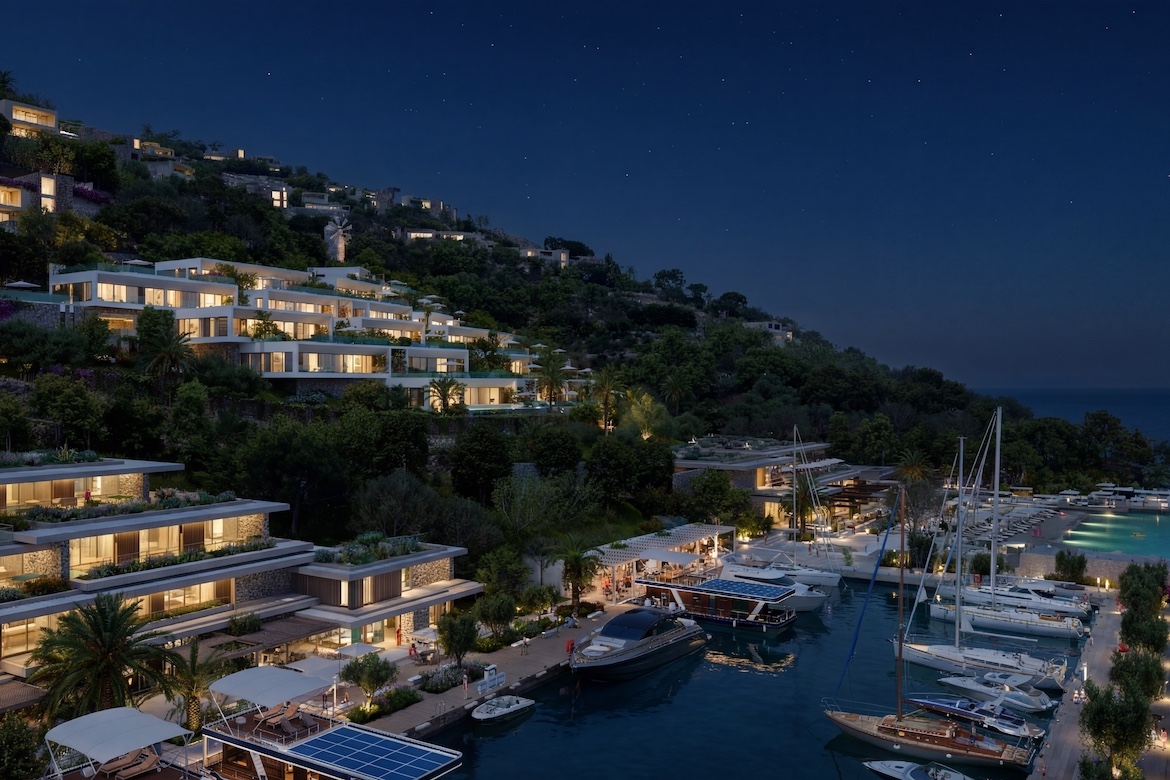
Spread across approximately 90 hectares overlooking Mirabello Bay, the development is planned as an integrated coastal community combining luxury hotels, branded residences, a marina, restaurants, retail, wellness facilities, beach clubs and public gathering spaces.
Plans include a property operated by 1 Hotels & Homes, hundreds of apartments and villas, a 64-berth marina and a two-kilometer waterfront promenade.
The development has received Strategic Investment status from the Greek government and is being developed by Mirum Group. It is scheduled to open in phases.
Elounda Hills represents one of the most significant examples of the growing branded-residence market in Greece. Rather than buying an independent villa and arranging maintenance, security and rental management separately, owners purchase homes within a professionally managed resort environment offering hotel services and shared amenities.
The model is already well established in destinations such as Dubai, Florida, the Caribbean, Spain and Portugal. Its arrival in Crete suggests that developers increasingly view the island as a serious competitor within the international luxury second-home market, rather than simply a seasonal villa destination.
Residential Development Moves Beyond the Resort Gates
The transformation of northern Crete is not limited to major hotel and resort developments.
Smaller residential projects are increasingly being designed for international buyers seeking a modern home close to the sea without necessarily purchasing inside a large hotel complex.
Near Chania, Cretan Wave Residences is a development of contemporary villas in Daratsos, close to the beaches west of the city.
The residences are being marketed directly to international buyers seeking a second home, investment property or base for longer stays on Crete. The project emphasizes access to Chania, the airport, nearby beaches and local services, together with private pools and modern construction.
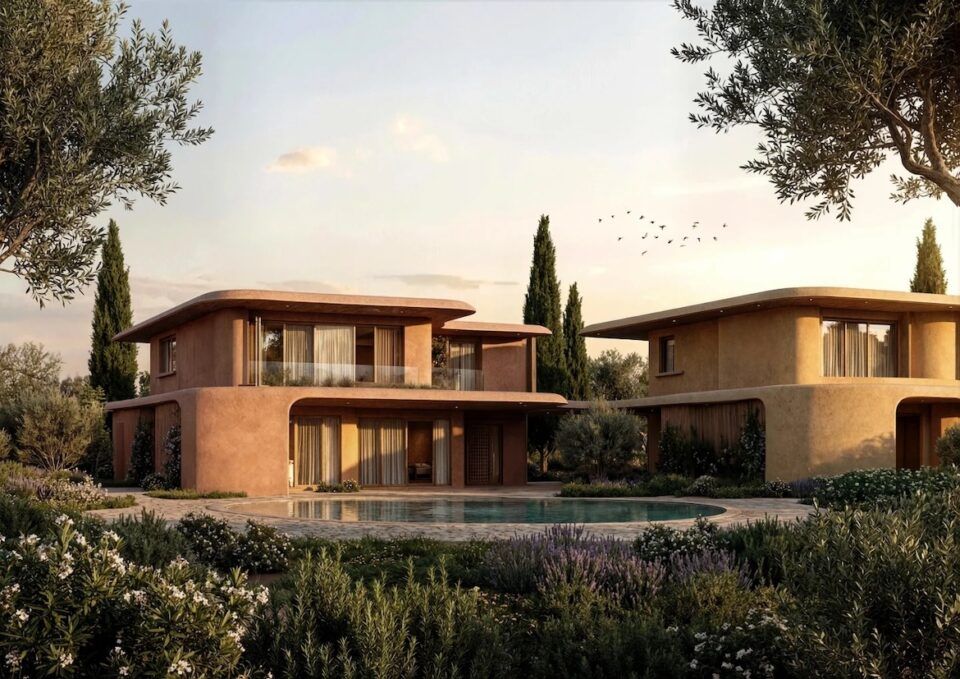
The development illustrates the way the foreign-property market on Crete is changing.
The traditional image of an international buyer purchasing an old stone house in a mountain village is being supplemented by demand for turnkey residences with energy-efficient construction, pools, landscaping, smart-home systems and professional property management.
For members of the Greek diaspora, these homes offer a new way of maintaining a connection to the island. A residence in Crete no longer has to be an inherited family home that sits closed for much of the year. It can be a professionally maintained base used for several months at a time, for remote work, retirement or extended family stays.
Similar residential communities are appearing around Rethymno, Heraklion, Hersonissos, Agios Nikolaos and other parts of the northern coast, reflecting growing demand from Europeans, North Americans and diaspora Greeks seeking a combination of lifestyle, accessibility and investment potential.
A New Industry Built Around Living in Crete
The increase in international property ownership is creating demand for businesses that barely existed in their current form a generation ago.
Foreign homeowners and returning diaspora Greeks often require bilingual legal and accounting assistance, architectural services, construction oversight, property maintenance, insurance, utility management and help navigating Greece’s bureaucracy.
Those planning to live on Crete for longer periods may also need assistance with residency procedures, health care, schools, vehicle registration, banking and the day-to-day management of a home while they are outside Greece.
Companies such as Elysian Living are positioning themselves within this expanding market. The Crete-based company offers the design and construction of contemporary villas while presenting its services as part of a broader transition toward living and investing on the island.
Real estate companies such as Elxis have also built business models around connecting international buyers with property in Greece. With a presence in both Crete and northern Europe, the company markets Greek homes directly to buyers in countries including the Netherlands, Belgium and Germany.
This developing service economy may ultimately prove as economically significant as the headline hotel projects.
Hotels create substantial employment, but permanent and semi-permanent residents spend money throughout the year. They hire builders, architects, gardeners, cleaners, accountants, lawyers and tradespeople. They use local shops, restaurants, health services and professional offices beyond the traditional tourism season.
That year-round spending is particularly important for an island whose economy remains heavily dependent on an increasingly intense summer season.
The Airport That Could Reshape the Island
No single project is likely to influence the future of Crete more profoundly than the new international airport under construction at Kastelli, southeast of Heraklion.
The airport will replace the heavily congested Nikos Kazantzakis International Airport and is being designed as one of Greece’s largest aviation gateways.
According to Heraklion International Airport Crete, the project includes a terminal of approximately 93,000 square meters and a runway capable of accommodating larger aircraft and increased international traffic.
The new airport is being developed to handle as many as 15 million passengers annually.
Its opening will not simply add capacity. It will alter Crete’s transportation geography.
Kastelli will provide improved access to central and eastern Crete, strengthening the connection between Heraklion, Hersonissos, Malia, Agios Nikolaos and Elounda. It will also support the large-scale developments now underway at the eastern end of the island.
Together with improvements planned for the Northern Road Axis of Crete, known as VOAK, the airport could make travel between the island’s major cities and resort areas faster and more predictable.
That increased accessibility is one of the principal forces helping to create a more unified northern coastal corridor.
But it will also bring considerably more visitors to an island already confronting traffic congestion, seasonal overcrowding and pressure on local infrastructure.
Opportunity—and Responsibility
The image of a new Mediterranean Riviera is undeniably attractive.
Luxury hotels, contemporary residences, marinas, restaurants and internationally connected coastal communities promise jobs, investment and new opportunities for Crete.
But the word “riviera” can also conceal the consequences of uncontrolled development.
Crete’s water resources are limited. Housing costs are rising in many of the island’s most desirable communities. Short-term rentals have reduced the supply of homes available to local residents, while roads and public services are placed under enormous strain during the summer.
The challenge is no longer whether development will happen. It is already happening.
The more important question is what kind of coastline will emerge from it.
A successful Cretan Riviera cannot consist only of gated resorts, expensive villas and seasonal restaurants. It must remain a functioning place for the people who live there, with affordable housing, reliable infrastructure, protected landscapes, accessible beaches and towns that remain vibrant after the summer season ends.
Crete possesses advantages that few Mediterranean destinations can replicate.
It has major cities, universities, hospitals, archaeological sites, productive farmland, mountain communities, historic villages, year-round ferry connections and one of the strongest cultural identities in Europe.
Those qualities—not luxury alone—are what make the island attractive.
From Chania and Marathi to Rethymno, Heraklion, Agios Nikolaos and Elounda, the pieces of a new northern coastal corridor are rapidly falling into place.
Whether it becomes one of the Mediterranean’s great year-round destinations—or another coastline overwhelmed by its own success—will depend on the decisions being made today.