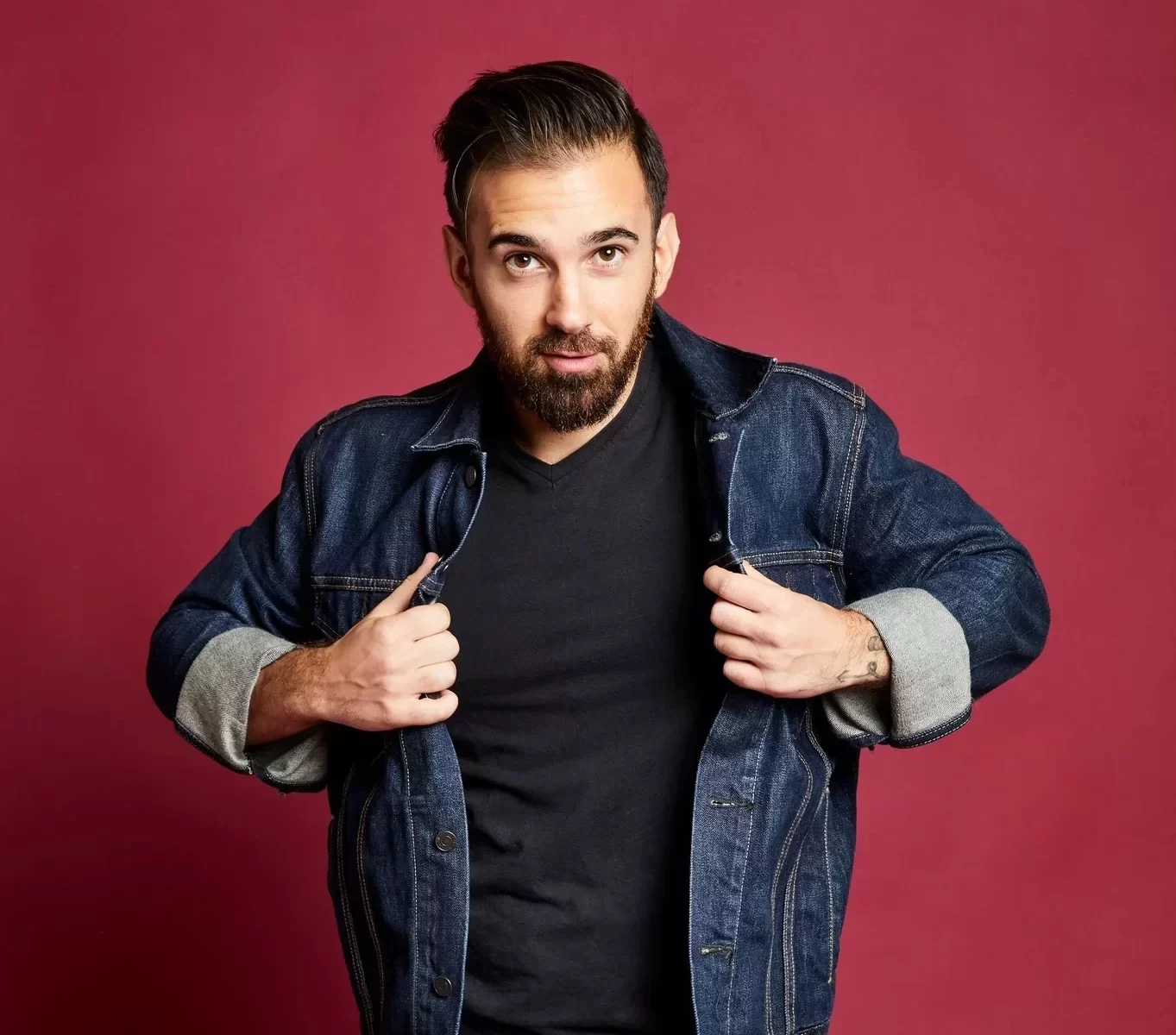

Anthony Locascio is an Australian standup comic of Greek and Italian descent that blends incisive joke writing with reflections on heritage, identity, and the world at large. After breaking out as a two-time NSW Raw Comedy State Finalist, Anthony has toured nationally and internationally with shows including Don’t Call Me A Wog! (2022), Heart of Darkness (2023), and PAPPOU (2024), performed across Australia, London, New York, Canada, and New Zealand.
In January 2025, he filmed PAPPOU at Sydney’s iconic Enmore Theatre. Anthony’s first special, Confirmation, is available on Amazon Prime and Apple TV. He is currently touring a “Best Of” show ahead of a U.S. tour, and is developing his next original set which will premier in 2026.
Outside of stand-up, Anthony also works across podcasting, writing, and content creation, and is passionate about building cross-cultural storytelling that resonates in Australia and beyond.
Anthony, congratulations on filming PAPPOU at the Enmore Theatre. What does this mean to you personally? What’s it like having a platform to talk about your cultural heritage?
Thank you! It’s a huge milestone for me — Enmore is the quintessential theatre for all Sydney based performers, it’s been a lifelong dream, and it has deep cultural ties to Greeks in Sydney specifically.
The platform is wonderful — I am deeply grateful for the support of my ethnic communities in allowing me to ply my craft for so many years, and this feels like a real apex of that, in that I am telling a story that resonates extra with them.
You are of Italian and Greek descent—two strong and some might say overbearing cultural backgrounds. How have they shaped your life choices and your decision to pursue comedy?
They have somewhat I suppose; my ethnic backgrounds do form a strong part of my identity, and as any kind of artist, I need to mine all aspects of my life to truly do my best work. Having said that, there are only a few of us doing comedy in Australia of these cultural extractions, and I think that’s down to the fact that it’s not easy to turn around to immigrant parents and convince them going into the arts is a viable life choice.
What about Greece? Have you had the chance to perform there yet?
Sadly no, but not for lack of trying! The comedy scene in Greece, at least on the stand-up side, is fairly undeveloped. As such there isn’t really much scope for a comic of my level to come and sell tickets. It’s really only big names who can tour right now, or people working in Europe. Or at least that’s what promotors have told me. Nevertheless, as I do speak Greek very well, it’s always going to be a bucket list item to not only tour Greece, but do a show in Greek.
Your stories about family and culture strike a chord with many in the diaspora. But how do you decide what’s too sacred or too personal to turn into comedy?
I don’t — and it’s upset a few family members in the past. Comedy is an ‘ask for forgiveness rather than permission’ kind of artform. I write what’s true to me and what’s important and try to say it all in a well-intentioned manner. In most cases it’s not what you talk about but how you talk about it.
How do you draw the line between laughing at, and confronting/subverting ethnic Greek and Italian stereotypes in your set?
I actually don’t see a line at all. In fact, stereotype humour is something I find old hat. I try and modernise my commentary on ethnic issues as much as I can, and add nuance and personal touch.
I should also note that despite my new show being broadly about the life of my grandfather, who is inescapably a Greek immigrant, the show also tackles more pervasive topics such as homophobia, addiction and the nature of modern masculinity, just to name a few.
My shows are never exclusive, I abhor the idea that anyone would come to a show and feel left out because they don’t belong to a certain subset of people. If the jokes are about Greeks, but are funny to all, it humanises Greeks to everyone. That’s my ultimate goal.
In PAPPOU, you adopted your grandfather’s catch phrase “den masao” (“doesn’t faze me”) as a Greek teaching of resilience that’s been handed down to you. What inherited attitudes or customs from Greek heritage do you think shouldn’t be handed down through the generations?
I think the resilience and work ethic, and obvious family values, are essential. Thereafter, I don’t think we should mire ourselves in strict adherence to inherited customs — that can contribute to diasporas being a little fossilised in immigrant communities.
We should retain a love and respect for the cultures of our forebears while infusing enough layers of modernity. Our immigrant ancestors did not leave their lives behind in the search of a new, better life, just for us to act like villagers, for lack of a milder term.
Do you believe humour can be a source of change within the diaspora?
It can and should be, and not just for diasporas but for everyone. Humour disarms sensitive issues, and allows us to reflect on them with clarity. The flip side to that is, not everyone has a good sense of humour, and that can lead to difficulties. Ultimately, if people like stand-up, and have open hearts, change can be affected quite easily.
But not huge change. I would like to redefine what my ethnic communities perceive comedy to be. For too long in Australia, Greeks (and Italians) have really only had a few sources of comedy and the style barely varies. I represent modern, real stand-up first and foremost, and my ethnicity second. I don’t only talk about Greek and Italian issues. Hopefully I can broaden perspectives, even in small ways.
As people become more multicultural, do you feel ethnic identities (and thus ethnic humor) retain their relevance over time?
It honestly depends on how you define ‘ethnic humour’. I personally would like to see the term die. I am not an ethnic comedian — I am a comedian who happens to represent certain ethnicities and talks about them often, but always to raise a wider point.
I’m actually not a fan of traditional identity politics and the divisiveness that goes with it. I will never not be Greek and Italian. By being funny to all and representing these cultures, I’d hope that I endear our cultures more to others.
In years gone by, strict ‘ethnic comedy’ was a building block to lending a voice to under-represented subcultures. But that time is gone.
See Anthony Locascio’s stand-up comedy special Pappou on YouTube: