
One of the world’s foremost Orthodox Christian theologians has published a provocative commentary that has already sparked debate in Orthodox Christian circles throughout the world.
In The Wheel Magazine, which calls itself a “journal of Orthodox Christian thought and culture” that seeks to share stories and commentaries “intelligently and constructively for the 21st Century—a pluralistic era which presents Christianity with new and unique challenges, demanding a creative re-imagination of its social identity and role in public discourse.”
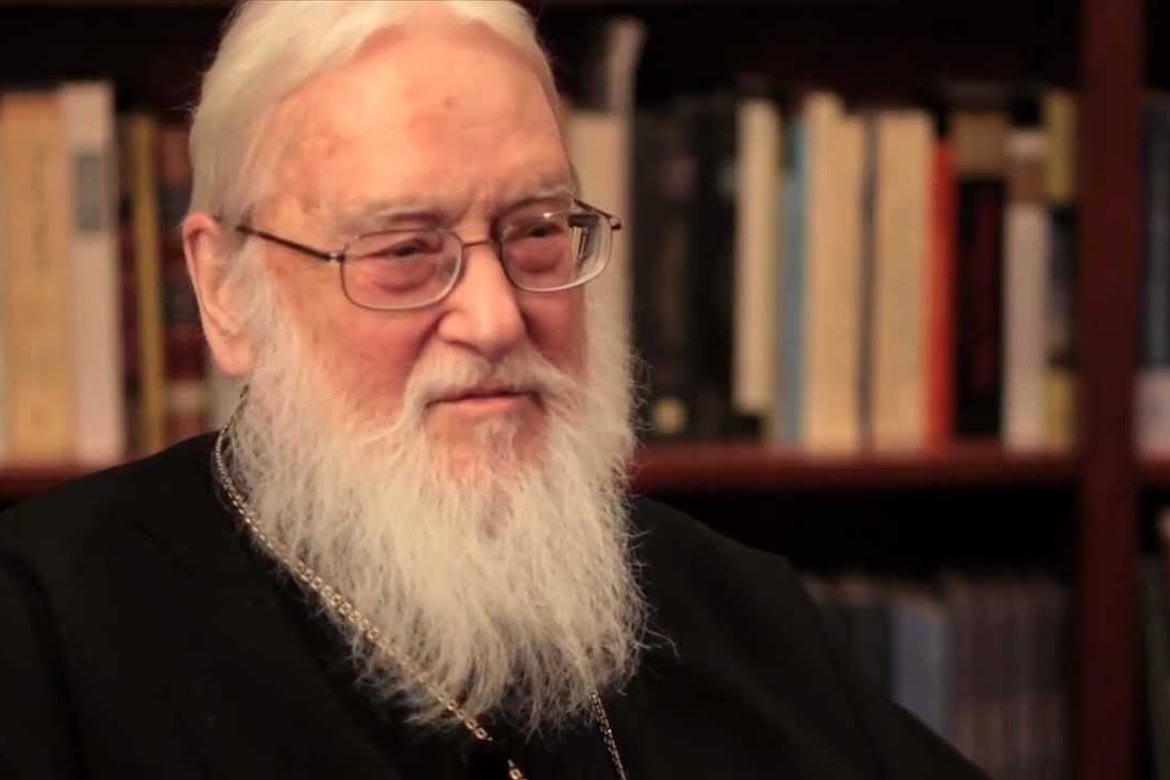
Metropolitan Kallistos Ware of Diokleia penned a multi-page foreword for Spring/Summer 2018 edition of the magazine in which he outlines and analyzes the Church’s approach towards homosexuals in the context of the Orthodox Church’s rules and how they are treated.
Ware, who is a celebrated scholar, theologian and author and former lecturer of Orthodox Christian studies at Oxford University in the United Kingdom, opens a public dialogue on the matter– one that has often been ignored or kept behind closed doors amongst prominent Orthodox Christian leaders.
Ware writes, “In the past, Orthodox have usually been reluctant to discuss such matters; but the questions cannot now be avoided. Silence is not an answer.”
Ware asks the rhetorical question– and proceeds to answer in his own perspective, “What, then, has the liturgical rite to tell us about the meaning of marriage and sexuality?”
Portions of Ware’s commentary are below:
“With regard to homosexuality, the Orthodox Church today has undoubtedly to confront a series of difficult issues. Without accepting everything that is said by the three authors of the text “Jesus Christ and Same-Sex Marriage,” I fully recognise that they are dealing with genuine problems. I can see at least three anomalies in our current treatment of
homosexuals. First, until recent times, Orthodox thinkers did not make use of the concept of sexual orientation, as this is understood in contemporary psychology. More precisely, they assumed that there is only one orientation, and that is heterosexual. They considered that persons of homosexual inclination were such because of personal choice and were therefore willfully wicked. Nowadays Orthodox writers would normally prefer to make a distinction between orientation and action. Homosexual orientation, we would say, is indeed contrary to God’s plan for humankind, being one of the consequences of the fall.
“But homosexual men and women are not personally guilty of their orientation, because this is not something they have chosen; they only become guilty if by deliberate choice they decide to live out this orientation in their actions. They can choose to be celibate. This argument, however, places us in difficulty. Persons of heterosexual orientation have the option of getting married, and so in a positive way they can fulfill their erotic desire with the Church’s blessing through the God-given sacrament of holy matrimony.
“But homosexuals have no such option. In the words of Vasileios Thermos, “A homosexual subject is called to lead a celibate life without feeling a vocation for it.” Are we right to impose this heavy burden on the homosexual?
“A second anomaly is to be found in the way homosexuals are commonly treated in the sacrament of confession. All of us recognize that there is an important distinction to be made between those homosexuals who engage in casual encounters, seeking out in some “gay” bar a partner for a single night; and on the other hand, those homosexuals who are committed to a permanent relationship, faithful and monogamous, in which deep love is involved. Surely no Christian is in favour of sexual promiscuity. Yet what frequently happens in confession?
“Let us suppose that the one who is promiscuous comes to feel a sincere revulsion for his way of life, and with genuine penitence resolves to pursue a life of purity in the future. In that case, he will probably be given absolution by the priest and will be permitted, perhaps with certain restrictions, to receive holy communion. For a time, he refrains from sexual activity, but then from frustration and loneliness he relapses into another casual encounter. After that he repents, and is absolved, and is once more blessed to receive communion. Then after a time he again lapses. So the cycle continues.
“What happens, by contrast, to the faithful and monogamous homosexual? Perhaps the priest says in confession, “Are you willing to give up your homosexual relationship?” The penitent may answer, “I cannot do that.” The priest may rejoin, “You can continue to share a common life, marked by mutual affection; but will you abstain from further sexual activity?”
“The other may well reply, “I am not yet ready to undertake that.” (Yet I have known homosexuals who have indeed transformed their relationship in this way.) The priest, faced with this refusal, may well feel that he cannot bless the penitent to receive the sacrament.
“Now here certainly is a paradox. The homosexual committed to a stable and loving relationship is treated more harshly than the homosexual who is casual and promiscuous, and who is seeking not true love but passing pleasure. Something has gone wrong here.
***
“Why do we put so great an emphasis upon genital sex? Why do we seek to enquire what adult persons of the same sex are doing in the privacy of their bedrooms? Trying to gaze through the keyhole is never a dignified posture. What harm are they doing to others? (“Ah!” it will be said, “they are doing harm to themselves.”) I am not suggesting here that we should bluntly set aside the traditional Orthodox teaching, but we do need to enquire more rigorously into the reasons that lie behind it.”
The full commentary appears in the current edition of The Wheel, here.
See a PDF of Ware’s full commentary here.
*****
Since you’re here… I have a small favor to ask.
More and more people than ever before are reading The Pappas Post and despite increasing costs to maintain the site and provide you with the quality content that you deserve, I will never “force” you to pay for our website or add a paywall. I believe in the democracy of the internet and want to keep this site and its enriching content free for everyone. But at the same time I’m asking those who frequent the site to chip in and help keep it both high quality— and free. We’ve implemented a “free-will” annual subscription for those who want to support our efforts. I guess it’s fair to call it a philotimo subscription… because you don’t have to do it but it’s really the right thing to do if you love the site and the content we publish. So if you like The Pappas Post and want to help, please consider becoming a “philotimo subscriber”. Click here to subscribe. If you’d rather make a one time donation, we will gladly accept any amount, with appreciation. Click here to donate any amount.